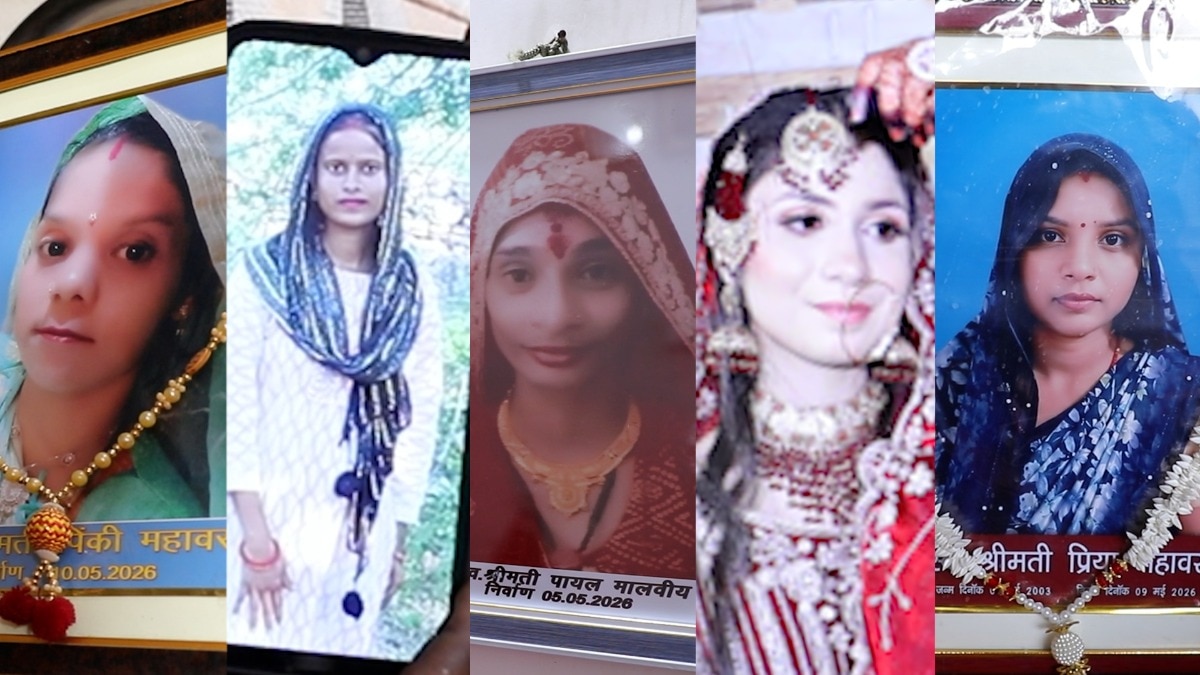
Five women who walked into government hospitals expecting to return home with their babies instead became the faces of one of Rajasthan's worst maternity tragedies. At the centre of the investigation is oxytocin, a drug relied upon across the world to prevent fatal bleeding after childbirth, which, it was found, reached Kota hospitals without the very ingredient that makes it work.On most days, children from the neighbourhood drifted in and out of Pinky Mahawar's modest home in Kota. Some arrived because their parents were away at work. Others came simply because Pinky never turned anyone away.At 30, she was the kind of woman families leaned on in moments of need. Her three-year-old son followed her everywhere, while her 13-year-old intellectually disabled nephew depended on her care.In a locality where most households survived on daily wages, her home had quietly become a place of routine, comfort and reassurance, not just for her own family but for many others around her.Twenty-year-old Jyoti Verma was looking towards a different future. After persuading her family to accept her decision to marry outside her caste, she was preparing to continue her education and build a life on her own terms. Twenty-six-year-old Payal Malaviya, who had never been to school herself, often spoke of ensuring that the child she was carrying would receive the education she never had.Shirin, only 20, had not yet completed a year of marriage, while 22-year-old Priya Mahawar was preparing to begin work as a private teacher to supplement her family's income. The women came from different neighbourhoods and villages across Kota and nearby districts, belonged to different communities, lived different lives and nurtured different ambitions.Between 4 and 8 May, however, those lives became bound together by a tragedy that has shaken Rajasthan and exposed uncomfortable questions about the quality of medicines supplied to India's public hospitals and the oversight meant to safeguard them.All five entered government hospitals expecting to return home with their babies but none of them did. Investigators would later place at the centre of the tragedy a medicine that has long been regarded as indispensable in maternity care.Oxytocin, a synthetic version of a hormone naturally produced by the body, is routinely administered after Caesarean sections and induced labour to help the uterus contract and prevent postpartum haemorrhage (PPH), one of the leading causes of maternal mortality worldwide.For decades, it has been counted among the simplest and most effective interventions available to obstetricians. According to investigators, however, the batch of oxytocin supplied to Government Medical College and JK Lone Hospital under the brand name Tocin contained no active pharmaceutical ingredient at all, only sterile water.For women who develop severe postpartum bleeding, doctors say the absence of timely oxytocin can allow blood loss to spiral rapidly, depriving vital organs of oxygen and dramatically worsening the chances of survival.The allegation has since triggered a nationwide recall of products manufactured by Jackson Laboratories, action by state and central drug regulators, and an investigation that has drawn the attention of the World Health Organization (WHO).Yet for the families who lost daughters, wives and mothers within hours – or days – of childbirth, the story begins much earlier, inside labour rooms where routine deliveries gave way to inexplicable medical emergencies in quick succession.SHATTERED FAMILIESTwenty-six-year-old Pawan Malaviya earns between Rs 7,000 and Rs 8,000 a month as a daily-wage labourer. Nearly Rs 5,000 goes towards the rent for the family's two-room house in Kota's Anandpura locality, where he lived with his mother, younger brother and wife, Payal.Money was scarce, but when Payal became pregnant, the family allowed itself to think beyond survival. “She used to say that our child would study well and have a good future,” Pawan recalled. According to the family, Payal's pregnancy had been uneventful. She was admitted to Government Medical College on 3 May for a Caesarean delivery, which initially appeared successful.Relatives say she even spent a few moments with her newborn son before her condition deteriorated.“The bleeding would not stop. Her blood pressure dropped sharply and she kept saying she felt extremely hot and restless,” they recalled. “Soon after, she lost consciousness.”Payal was shifted to the intensive care unit. Her sister-in-law, Teena, remembers seeing a nurse administer an injection through Payal's intravenous line before she was wheeled away.“Several units of blood were arranged for her, but she never recovered,” she said. “A few hours later, we were told she had died.”Only hours earlier, the family had named the baby Nitwik, a name Payal had chosen herself.“Everything changed in a matter of hours,” Pawan said. “Today my son does not even have his mother's milk.”Teena has since moved from Jhalawar to care for the infant, though only temporarily. “The baby cries through the night,” she said. “Formula milk does not suit him.”Like many others, the family initially accepted the death as an unforeseeable complication of childbirth. That changed when they learnt that several women admitted around the same time had developed strikingly similar symptoms.“We later discovered that the medicine given to these women was allegedly fake,” Pawan said. “We protested and demanded answers, but we are still waiting.”About 35 kilometres away in Suvansa village of Bundi district, Rohit Mahawar had chosen Kota Government Medical College because it was, in his words, “the biggest and most trustworthy hospital in the region”.His wife Priya, too, underwent a C-section and appeared stable for several hours before her condition worsened suddenly. She was shifted to the ICU, and later that night the family was handed her body amid a heavy police presence.By then, two other women had also died, while several more developed severe complications requiring intensive care in quick succession – an unusual cluster even for one of Rajasthan's busiest maternity centres.Among them was Shirin, a 20-year-old who had not yet celebrated her first wedding anniversary. Five months into her pregnancy, she had visited JK Lone Hospital for a routine ultrasound when, according to her family, doctors advised a minor procedure to treat an incompetent cervix, a condition in which the cervix opens too early during pregnancy.The procedure was brief. The bleeding that followed, they say, never stopped.As her blood pressure collapsed and her kidneys began to fail, Shirin was placed on a ventilator and shifted first to Government Medical College and then to two private hospitals as her family searched desperately for treatment.She died on 17 May after nearly two weeks in hospital. By then, the family had spent around Rs 3.5 lakh, mortgaging the few assets they own but still could not save her and lost the unborn child as well.Ravi Naik, whose wife Jyoti Verma was among those who died, now calls a village in Jhalawar every day just to see his newborn son over video. A relative who recently gave birth herself agreed to breastfeed the child.“It was painful to send him away,” Naik said. “But I thought it was the best chance for him.”Pinky Mahawar's newborn daughter and three-year-old son, Lakshit, are now being raised by relatives. “I cannot go out to work any more because someone has to stay with the baby,” her sister-in-law said. “What hurts the most is knowing Pinky died because of someone’s negligence and greed.”Inside the hospitals, the deaths – and the protests that followed from grieving families and opposition leaders – forced authorities to order an inquiry. Drugs administered to the women were seized for testing. One of the two govt hospitals in Kota where the pregnant women had gone for the procedure What investigators would uncover in the weeks that followed would transform what first appeared to be a series of tragic medical complications into a case with implications far beyond Kota.THE QUESTIONS THAT REMAINPPH is typically defined as blood loss exceeding 500 mL after a vaginal delivery or 1,000 mL after a C-section. Left unchecked, the rapid loss of blood can deprive vital organs, including the brain, kidneys and liver, of oxygen, triggering irreversible damage within a matter of hours.India has, over the past decade, made significant gains in reducing maternal mortality, with the Maternal Mortality Ratio (MMR) declining from 130 deaths per 100,000 live births in 2014-16 to 88 in 2020-22.Those gains have largely been driven by better institutional deliveries, improved emergency obstetric care and wider access to lifesaving interventions such as oxytocin.It is this context that has made the Kota episode particularly alarming.Investigators eventually traced a possible common link: a batch of oxytocin marketed under the brand name Tocin, supplied by Punjab-based Jackson Laboratories.Laboratory analysis, according to investigators, found that the injections did not contain the active pharmaceutical ingredient they were meant to deliver, but only sterile water.For women who developed severe PPH, doctors say the absence of effective oxytocin could have deprived them of one of the most critical interventions available to control life-threatening bleeding.The findings triggered a nationwide recall of products manufactured by Jackson Laboratories and widened into an investigation into drug quality and procurement practices.Punjab's Food and Drug Administration revoked the licence of the company's manufacturing facility in Amritsar, citing gross irregularities and violations of Good Manufacturing Practices.Soon afterwards, the Union Health Ministry and the Central Drugs Standard Control Organisation (CDSCO) cancelled manufacturing licences for two of the company's units, including one in Himachal Pradesh and the WHO, too, sought a report from the Indian government, giving the episode an international dimension.Yet, even as regulatory action gathered pace, the precise cause of each death remained under scrutiny. Hospital authorities have stopped short of attributing every fatality solely to the allegedly defective injections."The deaths and ongoing hospitalisation of some women are multifactorial and probably not due to fake oxytocin alone," Dr Nilesh Jain, Dean and Principal of Kota Government Medical College, told India Today."I am not a gynaecologist," he added, "but scientifically, the absence of oxytocin alone after a Caesarean section may not necessarily lead to death. The complete inquiry report has already been submitted to the government."Meanwhile, concerns over the quality of medicines supplied to Rajasthan's public hospitals have spread beyond Kota.In Bikaner, six women reportedly developed acute kidney complications following Caesarean deliveries, prompting another investigation into medicines administered during treatment.Similar cases have since been reported from Jodhpur, Banswara and Bhilwara, raising fresh questions about oversight across the state's pharmaceutical supply chain. Taken together, reports from these districts indicate that at least 18 women have died following Caesarean sections under circumstances that investigators are examining for possible links.For the families left behind, however, the debate is no longer confined to scientific causation or regulatory procedure.They know investigations may eventually determine that multiple factors contributed to the deaths.What they struggle to accept is that women who entered public hospitals for routine childbirth, many of whom appeared stable after delivery, never returned home, and weeks later, they are still waiting for a clear account of what went wrong, who will be held responsible, and whether the system that failed them has changed enough to ensure it does not happen again.- EndsPublished On: Jul 20, 2026 11:32 IST
Five mothers, one missing medicine: Inside the Kota maternity tragedy
Full Article
Original Source
Read the full article at Indiatoday →KhanList aggregates and links to publicly available news content. We do not host full articles from third-party sources. Always verify important information with original sources.