
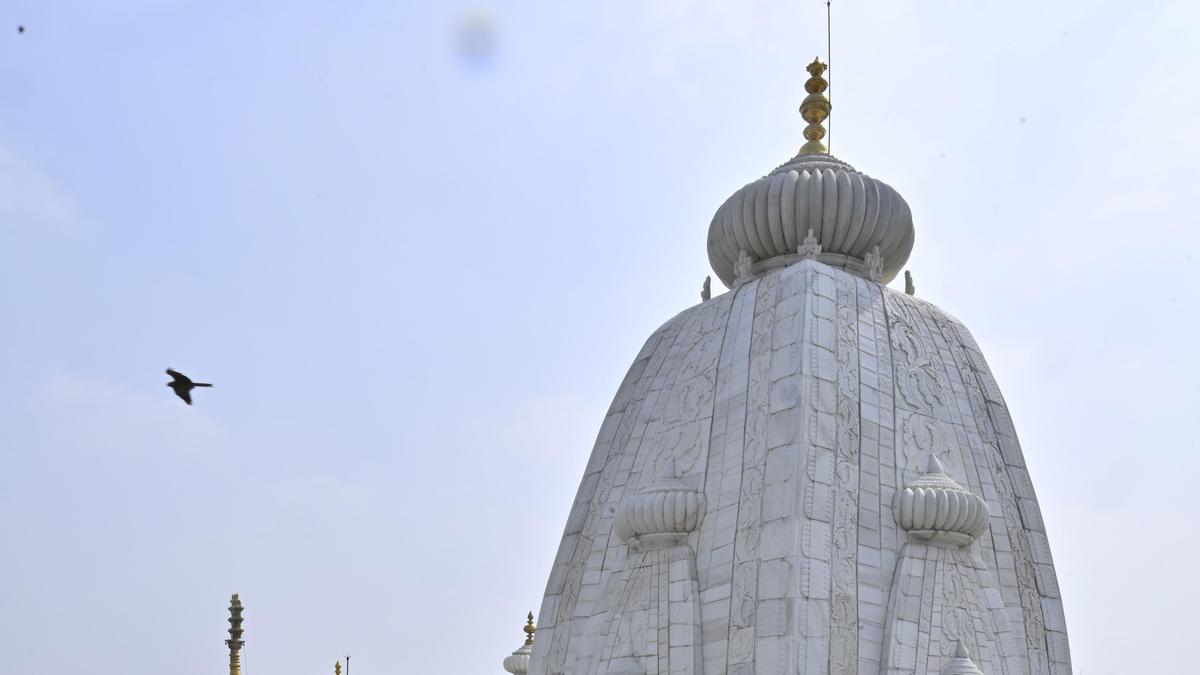
For nearly five decades, two familiar sights have stood witness to Hyderabad’s changing skyline: a white-marble temple on a hill and a newspaper that has reported on the city, its people and its politics.On Kala Pahad, also known as Neeladri, the Sri Venkateshwara Temple, popularly known as Birla Mandir, has looked over Hyderabad since it opened to devotees in February 1976. Six months later, in September, The Hindu established its full-fledged presence in Hyderabad and the erstwhile Andhra Pradesh. Fifty years later, both remain closely associated with the city, though in very different ways.Also Read: The Hyderabad that was, and the city it is nowThe story of Birla Mandir goes back to the early 1960s. Late Ganga Prasad Birla, an industrialist and member of the Birla family, would look towards Kala Pahad and Naubat Pahad from his room at the Hill Fort Palace, also known as the Ritz Hotel, in Adarshnagar, then an upscale part of the city. According to accounts of the temple’s origins, it was from there that he developed the idea of building a temple on the hill. Construction began in 1966. Nearly a decade later, the temple, built in white marble, stood above Hussainsagar.It did not take long for Birla Mandir to become one of Hyderabad’s best-known landmarks. For devotees, it was a temple. For visitors to the city, it became another stop on the tourist circuit, along with Hussainsagar, the Charminar, Golconda Fort and the Salar Jung Museum.Also Read: Hyderabad on new growth orbitThe Hyderabad temple is also different from most of the Birla Mandirs across the country. Its presiding deity is Lord Venkateshwara. The recently established Birla temple in Ayodhya, dedicated to Lord Rama and Goddess Sita, is another exception. In most of the other Birla temples, Lakshmi Narayan is the principal deity.From its hilltop, Birla Mandir has seen a city change dramatically. Hyderabad went through the end of the Emergency, political changes and social upheavals, the growth of the technology sector and the long movement that eventually resulted in the creation of Telangana.Much of that change was recorded in the pages of The Hindu. Governments changed, elections were fought, movements took shape, old neighbourhoods changed and new parts of the city came up. The newspaper reported on these changes as they happened.There is another story behind the temple, one that Jayendra Ramesan, 63, remembers from his father. Mr. Ramesan, who now lives in the United States, is the son of former IAS officer N. Ramesan, who played an important role in the temple’s construction. He said the project involved his father, late Ganga Prasad Birla and then Andhra Pradesh Chief Minister Kasu Brahmananda Reddy. “Together, they brought Lord Venkateswara to Hyderabad for those who could not go to Tirumala,” he said.His father was a devotee of Lord Venkateshwara and later served as chairman of the Tirumala Tirupati Devasthanams (TTD). Mr. Ramesan said his father was closely involved in the decision to bring the Balaji temple to Hyderabad. He still remembers one visit to the temple as a teenager. “Once, in 1978 or 1979, when he took me to the temple, I was probably 17. I remember being taken to Birla Mandir by my father,” he said. “We quietly went in, took darshan and were walking on the top when he asked me if I knew who the architect of the temple was. When I said I did not know, he told me, ‘Yours truly.’ It was a goosebumps movement for me.”Unlike many temples where devotees make a wish or take a vow and return to fulfil it, Birla Mandir has relatively few such repeat visitors. A large share of its visitors are tourists.The temple was built using 2,000 tonnes of Makrana marble and combines Dravidian, Utkala, Rajasthani and Gujarati architectural styles.It receives around 5,000 to 6,000 devotees a day on weekdays. The number crosses 10,000 on weekends and can reach nearly one lakh on occasions such as Vaikuntha Ekadashi, New Year’s Day and Ugadi.For many visitors, though, the attraction is also the atmosphere inside. People from other faiths are welcome. There are no special seva arrangements or separate queues of the kind seen at many other temples.Shyam Kothari, executive officer of the temple, also supported Mr. Ramesan’s account of how Lord Venkateshwara came to Hyderabad. He described Birla Mandir as a “modern wonder” and a place of worship open to everyone. “We have panels depicting Buddhism, Judaism, Sikhism and other faiths inside the temple. It is a place beyond class, caste, creed or religion. Nobody is deprived of darshan once they enter the main gate,” he said.While the city changed, Birla Mandir has largely stayed where it was, looking down on all of it.(deshpande.abhinay@thehindu.co.in)
Five decades, two landmarks, one evolving city
Full Article
Original Source
Read the full article at Thehindu →KhanList aggregates and links to publicly available news content. We do not host full articles from third-party sources. Always verify important information with original sources.