
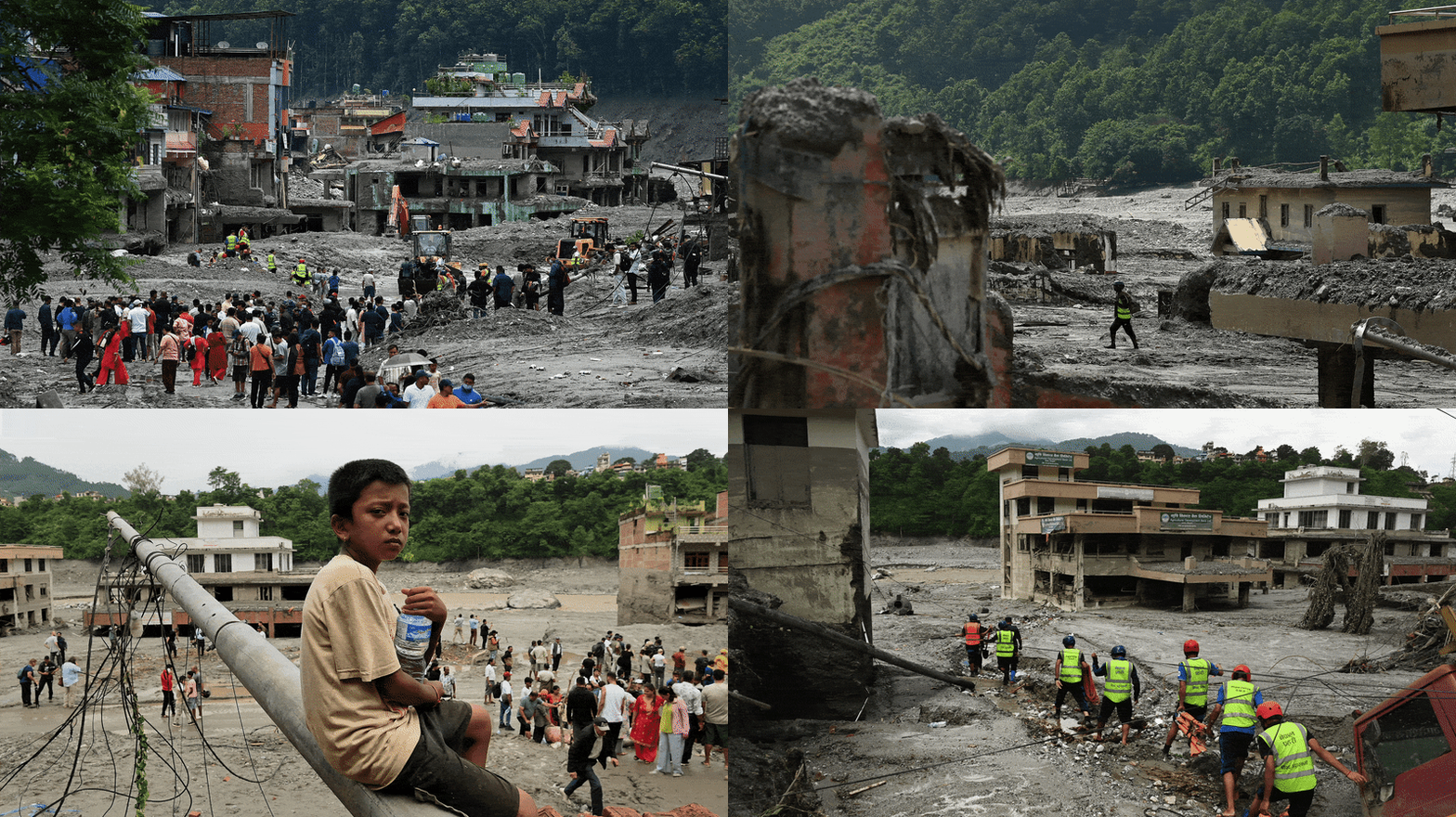
Dhading/Sydney: Five missing Australians were eating breakfast in a six-storey Nepalese hotel when it was hit by catastrophic flooding last week, according to the founder and chief executive of the company running their tour, while another 10 were on their way to the Tibetan border.Sagar Pandey, whose US-based Himalayan Glacier tourism operator was leading 15 Australians through the region when disaster struck, said the missing travellers were starting their day at the Kailash Hotel, downriver from the Gyirong Port crossing on the Nepal-China border, when flash flooding smashed the hotel and its surrounds on Wednesday.This photo released by Xinhua News Agency shows a mudslide-hit area near Gyirong Port in south-western China’s Tibetan Autonomous Region.Xinhua via AP“Five were in that hotel, and 10 were on the road,” Pandey told this masthead.Footage of the township captured hours after the flooding shows brown sludge blanketing the riverbanks where several buildings once stood. Structures higher up the hill remained upright, having escaped the worst of the disaster, which has killed at least 900 people and left more than 4700 missing in Nepal and Tibet.This masthead is working to determine the identities of the five Australians inside the hotel at the time of the floods.Brothers Aarush, 11, and Ashwin Muralitharan, 14, were the youngest Australians to embark on the Himalayan Glacier tour, along with their parents, Chandrasekaran and Shylaja, who lived in Cherrybrook in Sydney’s north-west.Relatives said the Muralitharan family’s last known location was the Kailash Hotel and that their final communication with family was at 6.47am, when they mentioned they were going to have breakfast and then head to immigration.The family is among 43 Australians who remain missing, up from a previous estimate of 42.Queensland woman Renee Spry was returning from a pilgrimage to the Tibetan Mount Kailash when disaster struck, her family has said. Spry’s last known movement was through the Gyirong Port border crossing moments before the flood, according to her sister, Clair.Spry’s partner, Shaun, and their two daughters intend to travel to the region to try to find her. “We continue to pray for her, the Nepalese people and those also still to return to the safety of their homes and families,” Clair said.Ashwin and Aarush Muralitharan and their parents were travelling with Himalayan Glacier and are currently missing.InternetRenee Spry was on a pilgrimage when the flash flood swept the border post between Nepal and Tibet.InternetForeign Affairs and Trade Assistant Minister Matt Thistlethwaite confirmed the number of missing Australians as the federal government committed another $3 million to Nepal’s recovery effort.“We haven’t given up hope that we can rescue those Australians safe and well,” Thistlethwaite told ABC News Breakfast. “We’re doing everything we can, working around the clock to try to locate those missing Australians.”The Australian Defence Force is expected to transport the supplies to Nepal in the coming days.“It takes our contribution to over $8 million, but we stand ready to help the Nepalese government as they try to rescue as many people as possible,” Thistlethwaite said.The news came as authorities in Nepal warned of possible fresh flooding and urged residents in flood-affected districts to remain on high alert after water levels rose in the Bhote Koshi River.Flood warning notices were sent to people’s phones on Sunday as rescue crews worked to clear a major highway connecting Kathmandu to one of the worst-hit areas.The latest warnings came after Chinese authorities informed their Nepalese counterparts of increased water flow upstream, according to Dharam Raj Uprety, chief executive of Nepal’s National Disaster Risk Reduction and Management Authority.The Chinese state news agency Xinhua, citing the country’s water resources ministry, said a new lake that formed after Wednesday’s floods high in the mountains had largely drained. But Xinhua said the ministry had warned that a crater located 5.6 kilometres upstream, which held an estimated 1.4 million cubic metres of water, still posed some risk and required close monitoring.Nepal’s disaster agency said on Monday the death toll had climbed to 903 with 4247 missing, while Chinese authorities reported 16 deaths and 546 missing on the Tibetan side of the border.The missing include hundreds of people from over a dozen countries who were in the region to work, visit the mountains or make a pilgrimage to a sacred peak. On Sunday, Chinese state media said 261 foreigners were missing in Tibet, including over 100 Nepalese and others from around the world.However, there were pockets of good news, with five-year-old Manisha reunited with her parents after being pulled from the rubble on Friday.Rescue workers looking for survivors near Syabrubesi in Ruswa district had thought they could hear a cat stuck under the rubble. Instead, they found Manisha alive but barely responsive and were able to free her after a two-hour operation. She is now in a stable condition in hospital.In Nuwakot, the head teacher of a Nepalese school was able to evacuate about 900 students to safety just moments before the flood hit.“If we had made the decision 10 minutes later, all of us, including the students and me, would not be able to speak to you today,” Rajendra Dawadi, who leads the Tribhuvan Trishuli Secondary School, told the BBC.At another school, in Dhading, a group of schoolchildren survived when they left their classroom for lunch, while others escaped because teachers told them to quickly evacuate.“The teachers said, ‘there is a flood, and you should leave bags and tiffins’,” said Lakshmi Shrestha, the mother of a student attending the school. “That’s how they managed to survive.”Residents begin returning homeIn Dhading, one of the worst-hit regions in Nepal, some residents began returning to ruined homes to see what could be salvaged.They sat in homes with walls washed away by the floods, shovelling sludge-like mud and rubble off balconies or window frames. Others scanned the ground for items they could pick out of the mud and rinse off. One man had returned for his chickens, which he found alive. He tied them up and put them in the cabin of his truck.“Everything is finished. Nothing is left. Not even our home,” Sharmila Tamang, a Dhading resident who was trying to salvage items from her home, told The Associated Press.At a key power plant that was severely damaged by the floods, workers started inspecting the facilities to survey the destruction, even as rescuers worked to reach hundreds of people believed to be stuck inside blocked hydropower project tunnels across the region.Mohan Kumar Dangi, president of the Independent Power Producers Association of Nepal, or IPPAN, said the floods damaged at least 12 hydropower projects across Rasuwa and Nuwakot districts and about 900 people were missing from the project sites.Rescue efforts are focused on people trapped in the gigantic tunnels built for controlling the waterflow to produce hydropower.Along the river, homes, vehicles and farm tractors could be seen jutting from the thick gray-brown sediment that enveloped entire villages in some areas. Parts of rice terraces along the riverside had dropped into the river after landslides hit them.Residents are receiving constant flood warningsHomes and businesses left intact after the flooding were still without electricity on Sunday, as twisted power line poles and wires lay tangled in the mud.Residents of flood-hit villages said they were struggling to make sense of near-constant alarms they had received since the initial floods.“Sometimes they say a flood is coming, then we have to run again to higher ground, even at night. There is also rain,” said Govind Shreshta, a resident. “It’s really difficult for me. I have a 72-year-old father and 70-year-old mom. I must carry them and I am exhausted. It’s going on like this for those who are still alive.”Large concrete and smaller suspension bridges were destroyed, leaving communities on the other side of the river with less easy access.“Those who are there are now stuck there. Those who are here are stuck here. It’s going to be very difficult,” said Sattan Singh Tamang, 47, who was working near a bridge when Wednesday’s floods came.Minister says Nepalese have become victims of climate changeWednesday’s flash floods started after a glacial collapse high in the Himalayan region. Scientists who studied satellite images said bedrock underneath a glacier high in the Himalayan region had collapsed, taking part of the glacier with it. The rockfall was so extreme that it registered as a magnitude 5.2 earthquake.The rocks and melted water then swelled the rivers in the valleys below, causing a torrent of water that swept buildings, bridges and earth downstream in Tibet and Nepal.Nepal’s foreign minister called for a global response to climate change, saying Nepal was bearing a disproportionate share of its impact.From our partners
Five Australians were having breakfast at a Nepalese hotel. Then came a wall of water
Full Article
Original Source
Read the full article at Smh →KhanList aggregates and links to publicly available news content. We do not host full articles from third-party sources. Always verify important information with original sources.