
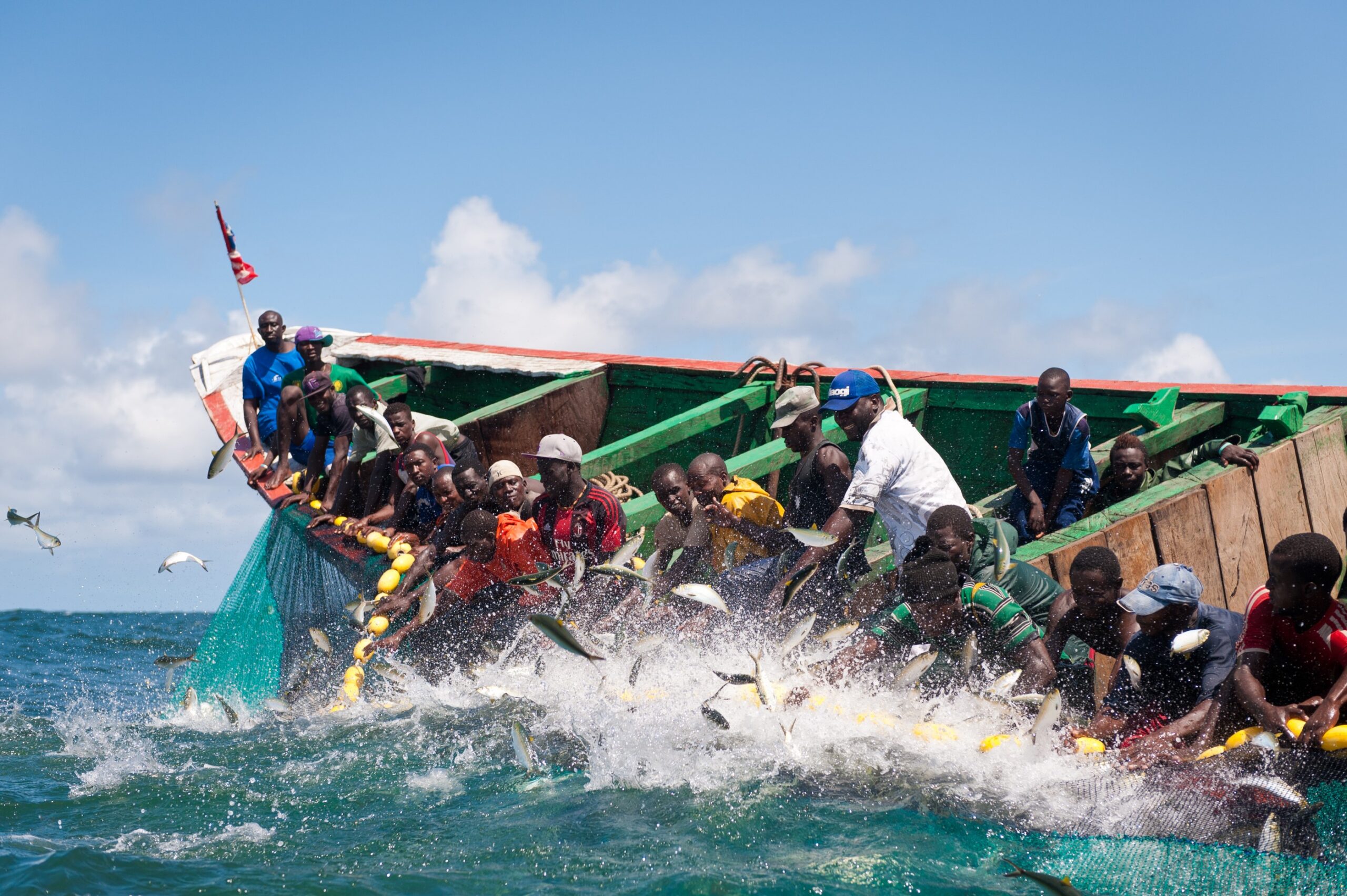
Senegal’s rapidly growing fishmeal industry is diverting fish from local markets into factories producing feed for farmed seafood and livestock, raising concerns about food security and fishing livelihoods.The country’s fishmeal plants have faced repeated accusations of pollution and harming health, with at least eight plants linked to environmental violations, unsustainable fishing practices, and civil unrest between 2018 and 2024.Local fish supplies are declining. Fish are increasingly diverted to make fishmeal for export. Coastal communities are struggling. Some fishers are attempting the dangerous sea journey to Europe in search of better prospects.The Outlaw Ocean Project investigated Senegal’s fishmeal industry, visiting three factories and speaking with residents, workers and managers about its environmental, economic and human costs. This article is from Food for Feed, a series investigating the global fishmeal industry. It is produced by the Outlaw Ocean Project, a news organization based in Washington, D.C., and excerpted by Mongabay. On Aug. 20, 2022, at least 50 protesters poured into the streets of Cayar, Senegal, demanding the closure of a nearby fishmeal factory, Touba Protéine Marine. Marching from the coastal town’s fishing wharf to the plant, they hoisted signs reading “Cayar is sick” and “Our water is contaminated.” In a video that spread widely on Facebook, demonstrators chanted, “Time to respect our Cayar.” Their grievances were many. Protesters said the Senegalese government had broken its pledge not to authorize any new fishmeal plants — factories that produce a lucrative dark-yellow powder by cooking and pulverizing fish. Touba Protéine Marine, they said, had been built less than a third of a mile from homes, triggering health problems and violating local zoning laws, according to government documents and satellite imagery. The stench, residents said, made daily life unbearable. “Harsh reality of the Global South,” wrote Serigne Mbaye, one of the demonstrators, in a Facebook post sharing the protest video. The plant, owned until 2022 by the Spanish company Barna, was said to process whole fish. Elsewhere in the world, fishmeal is typically produced from bycatch and undesired parts of fish. The use of whole fish is legal, according to Fatou Diouf, a director in Senegal’s Ministry of Fisheries, in a written response to questions. “There is no law prohibiting the production of fishmeal and fish oil from whole fish,” she wrote. “However, since [fishmeal] factories are limited in number, further control methods will be implemented to prevent them from processing whole fish.” Senegalese fish processor women hold a banner reading “Women United against Fishmeal” outside the Fisheries Minister building, after a meeting to present their demands to the authorities to stop fishmeal and fish oil production in West Africa. © Pape Diatta Sarr / Greenpeace. Much of the fish caught in Senegal’s waters is used by one of six operating fishmeal plants that dot the coast. These produce fishmeal used as feed for chickens, pigs, and especially farm-raised seafood. But as so much fish is turned into fishmeal, the shift is undermining local fishing and food security. Senegalese families who for generations depended on fishing are now selling or repurposing their boats to flee to Europe. With few prospects at home, many Africans attempt the sea journey of more than 1,500 kilometers (930 miles) from Senegal to Europe’s nearest touchpoint, Spain’s Canary Islands, a route that claimed more than 3,000 lives in 2025. “We’re fishermen, but there’s no fish left here, so we left,” Cheikhou Omar, a 21-year-old fisher, said in September 2024 as he sat on a beach in Senegal, rescued after the fishing boat he took trying to get to Spain capsized, killing 30. Cayar, Senegal. Simonetta Pugnaghi via Unsplash. Unsplash license. From July 2024 to March 2025, journalists from the Outlaw Ocean Project visited three fishmeal plants in Senegal — Omega Fishing, Touba Protéine Marine, and Saint Louis Sea Production — to interview nearby residents, plant managers, and workers. The interviews revealed a variety of concerns and accusations of wrongdoing tied to the factories. Omega Fishing, Touba Protéine Marine, and Saint Louis Sea Production did not respond to requests for comment. Between 2018 and 2024, at least eight fishmeal plants in Senegal were linked to environmental violations, unsustainable fishing practices, and repeated episodes of civil unrest, according to reporting by the Outlaw Ocean Project in Senegal. During that period, the plants were accused of polluting the environment on at least a dozen occasions, sometimes by dumping fish-processing waste onto nearby beaches, other times by releasing smoke that residents said caused respiratory problems. A 2022 study by the U.N.’s Food and Agriculture Organization found that five fishmeal plants then operating in Senegal were associated with rising respiratory illnesses, including rhinitis and chronic cough, particularly among children, the elderly, and people with preexisting medical conditions. In April 2018, a fishmeal factory run by Société des Produits Halieutiques opened in Abéné, an eight-hour drive south of Cayar (also spelled Kayar). Soon after the factory began operations, residents reported thick black smoke, a strong stench, and untreated wastewater flowing into rice fields and wells, according to Malagen, a Senegalese news outlet. Within weeks, Abéné’s beach was littered with dead fish. Investigators suspected the die-off was caused by pollution discharged from the plant. Residents mobilized. Youth groups and environmental activists organized protests. A community referendum overseen by the Ministry of Environment found that more than 90% of respondents opposed the factory. After six neighboring villages issued a joint memorandum rejecting what they called a “killer” and “toxic” industry, the government suspended the plant’s operations in July 2018. To be sure, the fishmeal industry has brought benefits to Senegal. It has generated millions of dollars in tax revenue and created hundreds of jobs, while helping grow more seafood to meet burgeoning world demand. But there are hidden costs, and questions about who bears the burden of the problems caused by the fishmeal industry. Fish that once sustained local communities are increasingly being diverted into fishmeal factories for export — not only in Senegal, but in the Gambia, in Mauritania, and across the world. The size of the industry is vast: Half of all seafood globally is farmed, and most of that is fed fishmeal and fish oil. Aquaculture, a $313 billion industry, is the fastest-growing segment of global food production. In Mauritania, the Nouadhibou fishmeal factory, processes fish landed at the port, especially sardinella, a sardine-like fish. Image by © FAO / Ibrahima Mbengue. The development of fishmeal and fish oil in West Africa started in the early 2010s, when foreign investment, largely from Chinese and European firms, poured into the region to build such factories geared toward export markets in Europe and Asia. The result was a gold rush for small pelagic or open-water fish. By 2019, roughly 50 fishmeal and fish oil plants were operating across Mauritania, Senegal, and the Gambia, according to Greenpeace, collectively consuming an estimated half a million metric tons of fish each year. Over the decade leading up to 2021, the industry expanded tenfold along the West African coast. Senegal alone counted at least six operating fishmeal plants in 2024, clustered along the coast near Saint-Louis, Cayar, Dakar, Joal, and Sandiara. Fishmeal factories in West Africa are jeoparizing the food security and livelihoods of millions of people. These factories use enormous amounts of fresh fish to feed aquaculture and livestock. Image by © Julien Flosse / Greenpeace. While the industry has grown, Senegal’s food insecurity will likely worsen. Between 2009 and 2018, the volume of small pelagic fish available in local markets fell by two-thirds, while per-capita consumption dropped by half. The FAO has warned that by the mid-to-late 2020s, Senegal could face an annual shortfall of roughly 150,000 metric tons of fish for human consumption. In Bargny, a coastal community about an hour’s drive south of Cayar, Fatou Samba, a 58-year-old fish processor, said the change could be measured in the number of meals eaten daily. “Today, having three daily meals has become a problem, which has never happened to us,” she said. “We don’t think about saving money. We think about our survival.” As fish disappear into production plants and food becomes harder to afford, more families are confronting the same choice Omar did in 2024: Stay and go hungry, or climb into a boat and head north. This story is excerpted and edited by Mongabay from Food for Feed, a global investigation into the fishmeal industry conducted by an international team of journalists at the Outlaw Ocean Project. Reporters examined more than 1,400 fishmeal factories across 64 countries — tracing supply chains from fishing vessels to processing plants, feed mills, fish farms, and seafood retailers. The reporting effort involved dozens of journalists visiting factories and farms and boarding fishmeal ships at sea. The project includes Bait to Plate, an online tool developed by the Outlaw Ocean Project that tracks the fishing and seafood industries. Banner image: Fishers at work in artisanal fishing pirogues with seine nets off the Senegalese coast, Kafountine, Casamance. Image © Clément Tardif for Greenpeace. Fished out at sea and smoked out on land, Senegal fishers take on a fishmeal factory Mauritania’s fishmeal fever ends as government tightens regulation Report links fishmeal production to decline in key species for Guinea-Bissau communities Credits Topics
Fishmeal factories take Senegal’s fish from the dinner table
Full Article
Original Source
Read the full article at News →KhanList aggregates and links to publicly available news content. We do not host full articles from third-party sources. Always verify important information with original sources.