
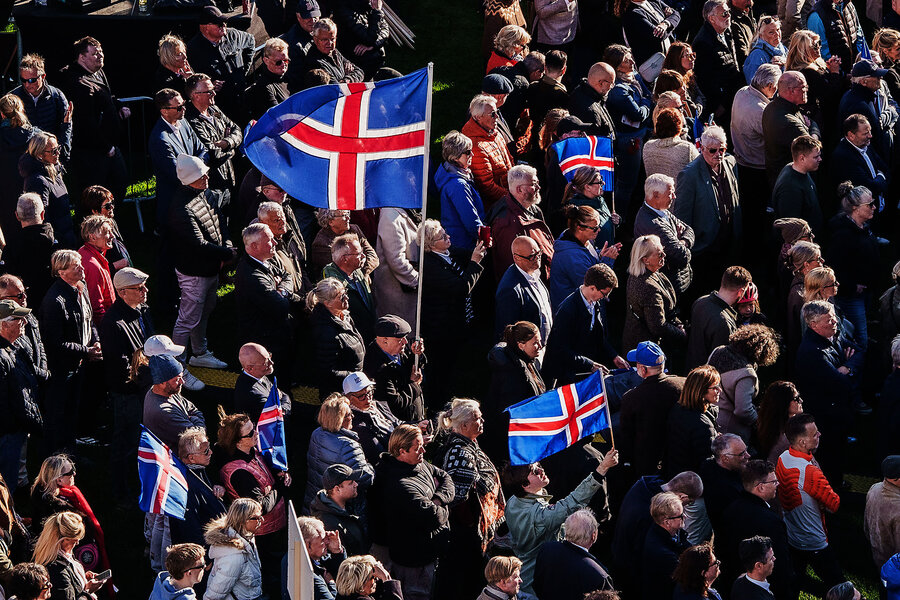
Guðmundur Johnsen does not want Iceland to join the European Union, and in true Icelandic fashion, he begins his argument with a near-thousand-year-old history lesson.Here in a quiet public garden overlooked by the tourist guides, his fingers reverently trace a volcanic stone from Þingvellir, the ancient cradle of Icelandic democracy. The inscription carries a story – and a warning. When the national assembly of chieftains that ruled medieval Iceland from Þingvellir gave their allegiance to the Danish crown in the late 1200s, Mr. Johnsen translates, “the power of parliament faded away.”“If we go into Europe,” he adds, “we will suffer the same fate. Iceland will be a shadow of itself.” Why We Wrote This As Iceland votes on whether to restart talks about joining the European Union, the debate is sparking larger questions for the nation. Is it willing to reconsider its fierce independence and should it look toward the United States or the EU for its future security? Icelanders go to the polls Saturday to decide whether they want to hold negotiations to join the European Union. It is a high-stakes vote for the EU, which wants to show the world it is dynamic and desirable. Here in Iceland, the debate circles around fishing rights and Brussels’ often exhausting regulations. But in truth, the vote is about something much deeper. It is about whether a remote island on the edge of the Arctic, still animated by the Viking spirit, is willing to dramatically reconsider its most cherished tenet – fierce independence – to adapt to a changing world. Mark Sappenfield/The Christian Science Monitor Guðmundur Johnsen explains the inscription on a stone in Republic Park in Reykjavík, Iceland, Aug. 27, 2026. He opposes efforts to join the European Union. Polls suggest a dead heat. In public debates, arguments for voting yes swirl around the potential stability of the euro and the chance to bring down inflation, now at more than 5%, and interest rates, which are at 8%. But often unspoken is perhaps the thorniest question of all: Can Iceland still trust the United States?Since 1951, Iceland’s vaunted sense of independence has essentially been underwritten by a defense pact with America. With no military, Iceland is wholly dependent on that promise. For at least some, Saturday’s referendum is about opening the door to a backup plan.“Our independence rests on the fact that the U.S. was a benevolent power that valued allies and wanted them to be independent and democratic, believed in multilateral, international institutions and dialogue,” says Kristinn Árni L. Hróbjartsson, co-founder and executive director of Varða, a security-focused think tank in Reykjavík, the capital. “This has fundamentally changed.”Saturday’s referendum is not a vote to join the EU. Iceland closed talks to do that in 2015. This weekend’s vote will determine whether to restart those talks. A second referendum would then be required to endorse any plan to officially become part of the bloc for the first time. Mark Sappenfield/The Christian Science Monitor A ship stands in dry dock in Reykjavík harbor, Aug. 27, 2026. Iceland’s fishing industry is among the strongest opponents of efforts to join the European Union. The fact that even this interim step is so contentious is a testament to how jealously Icelanders guard their independence. When Esja Alyssa Matich moved here from the U.S. in 2016, she remembers going to a comedy show called: “How to Become Icelandic in 60 Minutes.” The line that stuck with her? “Iceland is a small nation that thinks it is very big.” Now a translator of Icelandic poetry and prose, she says that spirit defines the country – “exploratory, brave, unbounded by borders.”“If you don’t take risks here, you don’t survive,” she says. “When you think you are bigger, then it allows you to take bigger swings.”In that way, the question at the core of the referendum is whether Icelanders think their wild, far-flung nation is still big enough to continue going it alone.The nation’s single greatest concern is what happens to its largest and most beloved industry, fishing, with many “no” voters worried that EU membership could mean handing over some control of its waters.But Iceland is changing. According to one analysis by an Icelandic economist, tech is expected to supplant fishing as Iceland’s largest generator of export revenue by 2030.Finnur Pind is in the business of taking some of Iceland’s biggest swings. Dressed in a red T-shirt with shoulder-length blond hair and just the right hint of a beard, Mr. Pind looks like the rock star he says he once wanted to become. Instead, he’s now a rock star of a different sort.As co-founder and chief executive of Treble Technologies, Dr. Pind is a leading entrepreneur in Iceland’s thriving tech sector, pioneering new ways to help AI improve sound recognition. Treble’s office in central Reykjavík could stand in as an Arctic replica of Silicon Valley, with complex mathematical equations penned on meeting-room windows and a weight room across the hall. Mark Sappenfield/The Christian Science Monitor Finnur Pind stands outside the office of his tech startup, Treble Technologies, in Reykjavík, Aug. 27, 2026. Iceland’s thriving tech industry sees both benefits and drawbacks to joining the European Union. Icelanders in the tech sector, according to polls, are among those most likely to vote yes on Saturday. The arguments are simple. They start with the fact that Iceland has only 395,000 people. Any company with ambition has to think bigger.“Scaling in Iceland is kind of impossible,” Dr. Pind says. “You have to become an international company.”Then there’s the fact that many potential investors aren’t quite sure what to make of a company from a mostly empty lump of volcanic rock in the middle of the North Atlantic. Or that tech companies in Iceland have to deal with the volatile local currency, the króna.“I was fundraising, and there was definitely some hesitancy around us not being part of some larger bloc,” Mr. Pind says. “It would preempt a lot of difficult questions if we were an EU country.”For Hjálmar Gíslason, who has founded five Icelandic startups, the world is just getting too big. “Where my thinking has changed is in the bigger picture. We are becoming very small in comparison to the forces changing history.”With the changes in geopolitics and the rise of AI, he says, “standing always outside this bloc is a fragile position to be in.”But most agree that Europe isn’t an easy fit for Iceland.“There is a culture problem,” says Mr. Gíslason, the founder and chief executive of GRID, a startup that builds spreadsheet technology. “In Europe, every investor would tell me why this wouldn’t work. On the American side, it was all about, ‘How can I be helpful?’ There is a can-do attitude” that fits with the Icelandic mentality.Many here say that, despite Iceland’s European roots, the country feels just as much kinship with the United States – if not more. At a rally for the “vote no” campaign on Thursday, Hjördis Vilhjálmsdóttir plainly stated that she would rather join the U.S. than the EU.With Iceland-themed glasses and a national flag tucked into her hair, there is no question of her allegiance. Speaking of her homeland, she says with patriotic flair, “Iceland is a paradise as it is. We have managed by ourselves without any help since 874.”Then she corrects herself. “We had the support of the United States of America” both in defending the island and in helping it from poverty to prosperity after World War II.Would the U.S. still come to Iceland’s aid today? Ms. Vilhjálmsdóttir says she is “100% sure.” Mark Sappenfield/The Christian Science Monitor Hjördis Vilhjálmsdóttir attends a rally against joining the European Union, Aug. 27, 2026. She says Iceland has been just fine on its own for more than a millennium. Others are not. At the “vote no” rally, Ágústa Finnlaugsdóttir says the time is not right to join the EU – yet. “But maybe in two or four years if there is war in Europe,” she says. “I think it is possible.”Why? “Because of the two guys,” she says before pausing to add, “in Russia and the United States.” Russian President Vladimir Putin and U.S. President Donald Trump, she clarifies.This is a new feeling in Iceland, and not everyone is sure what to make of it. Iceland has never been in a traditional war and has never been invaded.“We have a feeling of not being threatened, we never have,” says Hallgrímur Oddsson, founder and director of Evrópustraumar, an EU-Iceland relations think tank.But this year, when Mr. Trump was threatening the Danish territory of Greenland, “we saw why it matters that Denmark was in the EU,” he says.That is part of the government’s reason for wanting to restart conversations with the EU, says Mr. Hróbjartsson of the Varða think tank. “Starting a conversation now, we start negotiations from a position of strength. If we wait too long, and we’ve got our backs against the wall, we would not be.”
Fishing in a larger pond: Icelanders are divided on EU vote
Full Article
Original Source
Read the full article at Csmonitor →KhanList aggregates and links to publicly available news content. We do not host full articles from third-party sources. Always verify important information with original sources.