
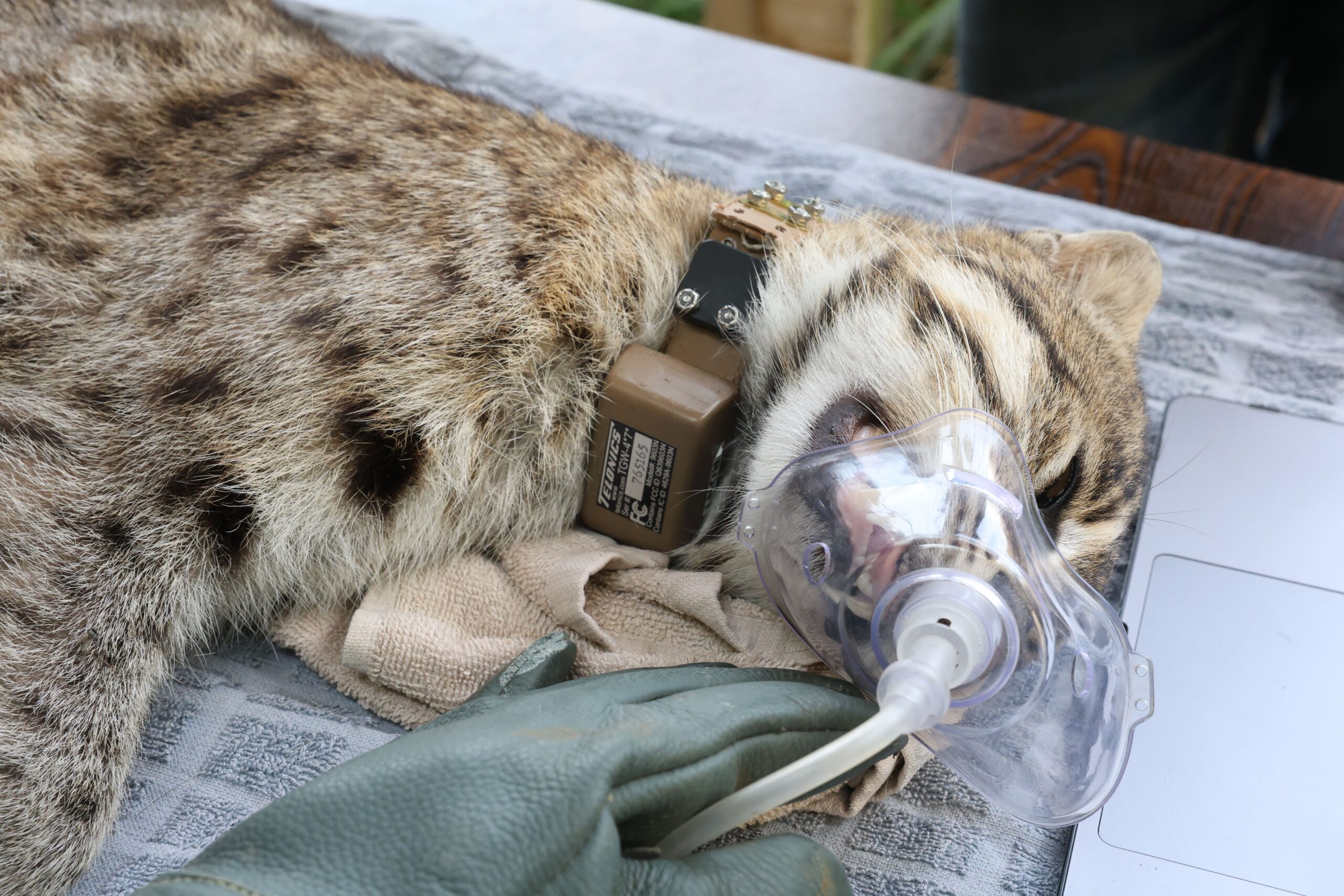
A fishing cat found badly injured and malnourished in northern Bangladesh has been returned to the wild following months of intensive rehabilitation. The feline was recently released into a tea estate bordering a large freshwater wetland, after being fitted with a satellite-tracking collar. Fishing cats (Prionailurus viverrinus), one of the larger species of small wildcats, may number as many as 7,500 in the wild, according to the IUCN, the global wildlife conservation authority. They’re found mostly in India, Sri Lanka, and Bangladesh, where roughly 95% of their range falls outside protected areas. They also occur in Cambodia, Myanmar, Nepal, Pakistan, and Thailand; and are thought locally extinct in Indonesia and Vietnam. The Bangladesh Forest Department rescued the male fishing cat in February 2026 and transferred it to the Jankichara Wildlife Rescue and Rehabilitation Centre in the country’s northeast. The odds that it would survive was low, according to the Creative Conservation Alliance (CCA), the conservation nonprofit that runs the center. “His jaw was dislocated, most likely from being beaten by people, and he could not feed himself. He was badly malnourished and weighed barely five kilograms [11 pounds],” Caesar Rahman, CEO of the CCA, told Mongabay by email. “We had very little hope that he would survive.” After weeks of assisted tube feeding and veterinary treatment, the cat’s health improved and it eventually reached 12 kg (26.5 lb). To ensure a smooth transition back into the wild, conservationists kept the cat in a soft-release enclosure at the Ooterbhag and Indanugger Tea Estate for more than eight weeks. After the release, they’ll track its movements by satellite. “In most of the cases we come across, [rescued animals] do not receive proper rehabilitation, so they die in care, or they are released without a protocol and their fate is never known,” Rahman said. Muntasir Akash, assistant professor of zoology at the University of Dhaka, who wasn’t involved with the effort, told Mongabay, “Every life matters. But from a rewilding perspective, it is not rewilding per se. It is a conflict translocation.” Akash said that while the rehab helped the cat regain physical fitness, it did little to develop the spatial memory required for a free-ranging lifestyle. “But overall, it is another milestone in spatial ecology studies in Bangladesh,” he added. Mongabay previously reported on a study that found 31% of media reports about fishing cats between 2005 and 2021 were about the cats dying. Nearly half of those deaths involved a “kill-on-sight” reaction from local fish and duck farmers. Rahman said he’s optimistic the CCA’s approach to rehab and partnering with tea plantations can serve as a blueprint for future conservation efforts. “There are at least 135 tea estates in the northeastern part of Bangladesh,” he said. “It is still early days, but this could become a useful model for conservation in a densely populated region.” Banner image: The fishing cat with the satellite collar. Image courtesy of Moktadir Rahman/CCA. Credits Topics
Fishing cat rescue-and-release offers potential model for conservation in Bangladesh
Full Article
Original Source
Read the full article at News →KhanList aggregates and links to publicly available news content. We do not host full articles from third-party sources. Always verify important information with original sources.