
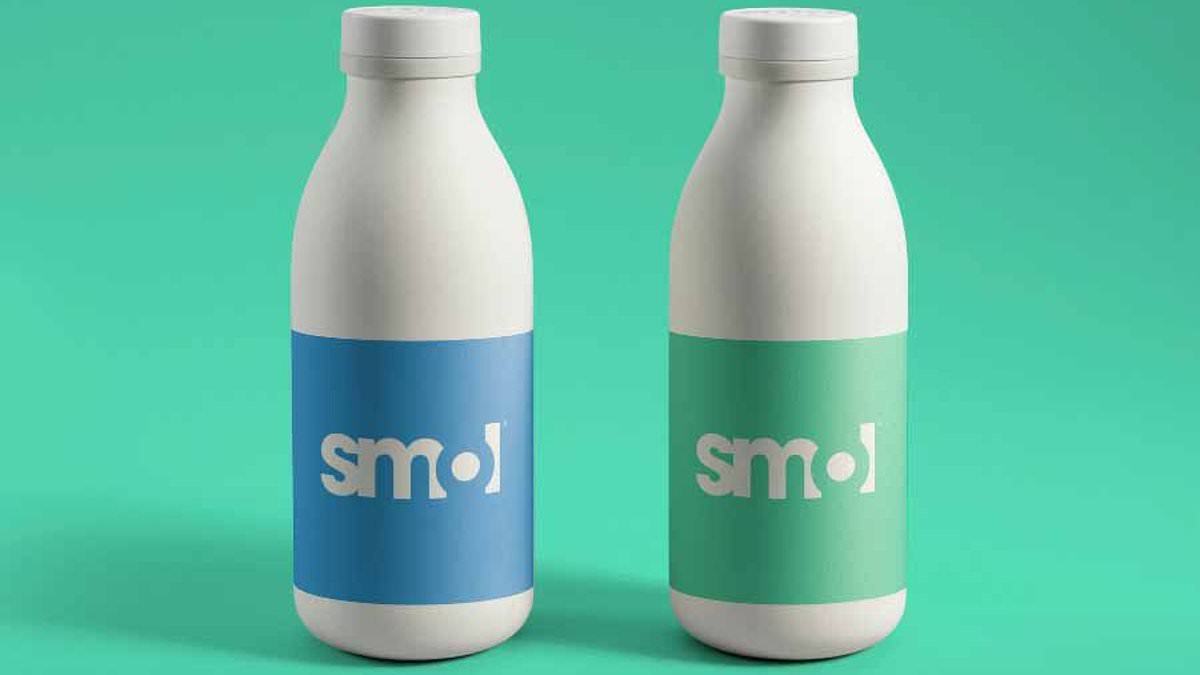
Dealing with soggy paper straws is bad enough, but Britons may soon say goodbye to plastic bottles as well.In a push to clean up the drinks industry, a partly government–funded British business is set to roll out a new line of paper bottles.Pulpex was launched in 2020 by the drinks giant Diageo and the venture company Pilot Lite, and is poised to open its first commercial–scale factory in Glasgow this month.Unlike paper straws, which quickly soften and deteriorate, the company claims its paper bottles are made from a material that is strong enough to hold liquid for months.Initially, paper bottles containing mineral water made by Purely Scottish and laundry detergent from the brand Smol will go on sale this autumn.These will be followed by a third production line shortly after, bringing total production towards a maximum capacity of 40 million bottles per year. Pulpex will start manufacturing paper bottles at a new factory near Glasgow, including packaging for cleaning product brand Smol In a push to clean up the drinks industry, a partly government–funded British business is set to roll out a new line of paper bottlesLast year, Pulpex announced it has raised £62million ($82million) to fund the new Glasgow factory.Of that, £43.5million ($57.5million) came from the government–owned National Wealth Fund, and £10million ($13.2million) came from the Scottish National Investment Bank.In the past, multiple companies have struggled to create a bottle that is both strong enough to avoid leaking and close enough to traditional paper to be recyclable.Caught between those two demands, other companies have produced bottles with a paper exterior and a separate plastic liner inside.These required consumers to take the extra step of separating the liner before the paper could be recycled, and didn't avoid plastic waste.However, Pulpex believes that its creation solves the problem once and for all.Its bottles are made by moulding wood pulp into a single–piece container and lining it with a special recyclable barrier.This barrier is made using a water–based emulsion that forms directly onto the wood fibres, making it part of the bottle.The coating accounts for about six to seven per cent of the bottle's total weight, and doesn't contain any PET or HDPE – common plastics found in waterproof containers.According to the company, this process creates a bottle that is strong enough to hold liquids for months.In the future, Pulpex told The Times it can strengthen the barrier to control the flow of oxygen so that wines could be kept fresh for up to two years.This barrier also allows the entire bottle to be recycled normally with paper and cardboard.However, the company will have its work cut out for it proving to sceptical shoppers that its radical idea holds water. The company will also produce paper bottles for Purely Scottish mineral water, with a third production line following shortly Pulpex has already gone through several iterations of failed designs in the past few years.When Diageo launched Pulpex in 2020, it said that a paper Johnnie Walker bottle would be on the shelves by early 2021.However, the bottle never appeared, and plans to create a paper ketchup bottle for Heinz also fell through in 2022.By 2024, the company said that its paper products were still in 'feasibility testing'.Even the paper bottles developed for Smol won't be entirely plastic–free as they will contain a dosing cap made from polypropylene that will need to be removed and recycled separately. Likewise, in 2020, the UK charity Green Alliance warned that the push to ditch plastics could actually harm the environment by forcing companies to adopt alternatives without considering their environmental impacts.For example, producing paper bags as a replacement for the plastic ones used to hold loose produce and baked goods typically requires four times the energy input.Meanwhile, confusion exists over the meanings of labels like 'compostable' and 'biodegradable' – with packaging made from these materials not always breaking down as expected.Similarly, a recent study found that single–use 'paper' cups release millions of microplastic and even smaller 'nanoplastic' particles when exposed to hot liquid.Experts compared two types of single–use cups: one lined with fossil fuel–based polyethene (PE), and another lined with biodegradable polylactic acid (PLA).Although it might seem like the greener option, the biodegradable PLA–lined cups actually release 12 times more microplastics than their PE–lined counterparts.
First they came for our straws…now it's our bottles! Water containers made from PAPER to go on sale in the UK
Full Article
Original Source
Read the full article at Dailymail →KhanList aggregates and links to publicly available news content. We do not host full articles from third-party sources. Always verify important information with original sources.