
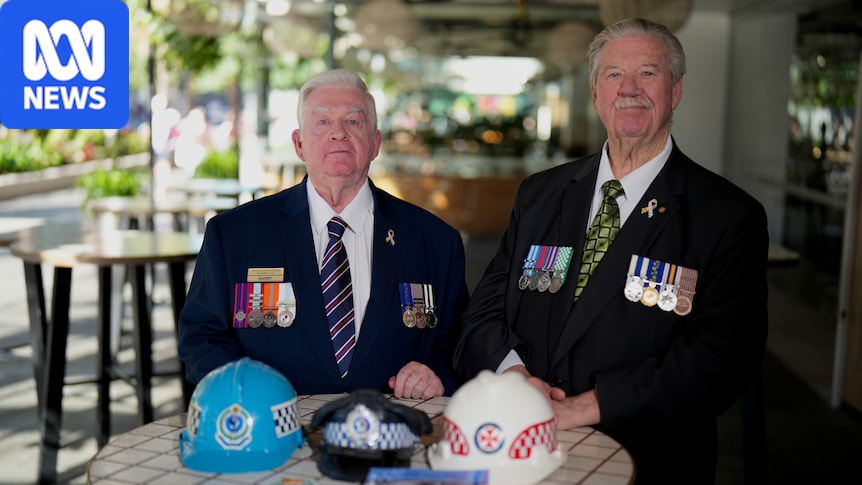
On January 18, 1977, ambulance officer Barry Gobbe was dispatched just after 8am to check on what his boss told him was "probably a hoax" in Sydney's west.That "hoax" turned out to be the worst rail accident in Australia's history.He and his partner were the first emergency workers to arrive at the scene of a passenger train that had derailed, and had been crushed by a bridge — now known as the Granville rail disaster."I [ran] back to my ambulance and I called in, 'Send all the emergency teams, all the medical teams'," Mr Gobbe said."I called the code for a disaster and it all started to happen then."Mr Gobbe says after calling in the code for a disaster "it all started to happen". (ABC News: Berge Breiland)Three carriages of the train, which was travelling from Mount Victoria to Sydney's CBD were crushed, killing 85 people, including two unborn babies and injuring more than 200 others.Pen torch helped guide woman out of trainFormer police officer Gary Raymond was also among the first responders and remembers wedging himself in the metre gap between the floor of the train and the bridge to search for signs of life."I couldn't believe that these people I saw, some had playing cards on the table in front of them, some had a Women's Weekly magazine, others had newspapers and they were just going about their normal trip into the city," Mr Raymond said.The passenger train derailed and was crushed by a bridge (Supplied: Blue Mountains City Library)At one point during the rescue effort, which lasted until about 6pm, he was ordered to leave the train by his sergeant due to concerns the bridge would collapse further onto the train."I left one of the trapped ladies I was working on, Debbie Woodgate, and gave her a little pen torch," he said.After an agonising wait, Mr Raymond was given the all clear to return to the train and crawled through the carriage back to Ms Woodgate guided by the torchlight."She said 'I knew you'd be back', and that's the trust she had that we would be," he said."That's a moment I'll never forget."Mr Raymond is still in touch with Ms Woodgate and her husband, who live just 10 minutes away from him.Mr Raymond, a police officer at the time of the incident, was among the first responders. (ABC News: Berge Breiland)Disaster sparked major reformsNearly 50 years later, Mr Gobbe and Mr Raymond are being recognised for their courageous actions that day as two of this year's recipients of the Governor-General's Australian Bravery Decorations.While being honoured, Mr Gobbe said the award was also for all the emergency workers, volunteers, crane drivers, engineers, electricians and rail crews that helped."Gary and I accept this award on behalf of all rescuers, thousands of rescuers that helped on that day," he said.The Granville rail disaster led to many lasting changes in transport management, with a subsequent judicial and departmental inquiry finding the cause of the accident was poor rail maintenance.Mr Gobbe (left) and Mr Raymond are among this year's recipients of the Australian Bravery Decorations. (ABC News: Berge Breiland)It also triggered changes to the way emergency services respond to major events, including the introduction of colour-coded helmets.Mr Gobbe said at the time it was only police and ambulance officers that had coloured helmets."Other people were turning up without helmets on, we didn't know who was who as far as the rescuers were concerned," he said.The accident also prompted further study into crush syndrome, which had been a little understood condition.Seven passengers suffered crush syndrome, which occurs when a build-up of toxins, potassium and acids from a crushed muscle are suddenly released into the body, damaging the kidneys.The train was travelling from Mount Victoria to the city when it crashed. (Supplied: Blue Mountains City Library)Superintendent Richard "Dickie" Lamb, who died in 2016 on the 39th anniversary of the disaster, is also being awarded for his brave actions.Mr Lamb was not working that day, first hearing of what was happening while in the car with his family."He drove to the scene and gave the keys to his wife and said, 'I'll be here'," Mr Raymond said.Wearing just the spare overalls he had in his car, he worked tirelessly to organise the rescue scene and free people from under the bridge.Retired lawyer among other recipientsMr Bamford is being recognised after he helped stop a man carrying a knife in the Sydney CBD. (ABC News: Berge Breiland, NSW Police)Also among the five NSW recipients of the decorations is retired lawyer John Bamford, who chased a man wielding a knife up a Sydney CBD street, arming himself with nothing but a cafe chair."It was an instantaneous thing, I didn't have time to think about it, he was disappearing up the road and I had to do something about it," Mr Bamford said.He was on his lunch break on August 13, 2019, when the man, Mert Ney, ran past him attempting to stab pedestrians in his path.Mr Bamford cast aside his legal documents, grabbed a chair from a nearby cafe and chased him for several blocks.Ney had gone on a stabbing spree after having killed 24-year-old Michaela Dunn in her city apartment, which he pleaded guilty to in 2021 and was sentenced to 44 years in prison.Ney also seriously injured a woman near King Street, before Mr Bamford and other members of the public jumped to action and eventually detained him using a milk crate."There was a sense of relief but there was also anger," Mr Bamford said.Although honoured to be recognised for his actions and glad he did not prove to be a "gutless wonder", he said it was a "team effort" to stop Ney."I wasn't really going to make a big deal of it," he said.
First responders awarded decades after Australia's worst rail crash
Full Article
Original Source
Read the full article at Abc →KhanList aggregates and links to publicly available news content. We do not host full articles from third-party sources. Always verify important information with original sources.