
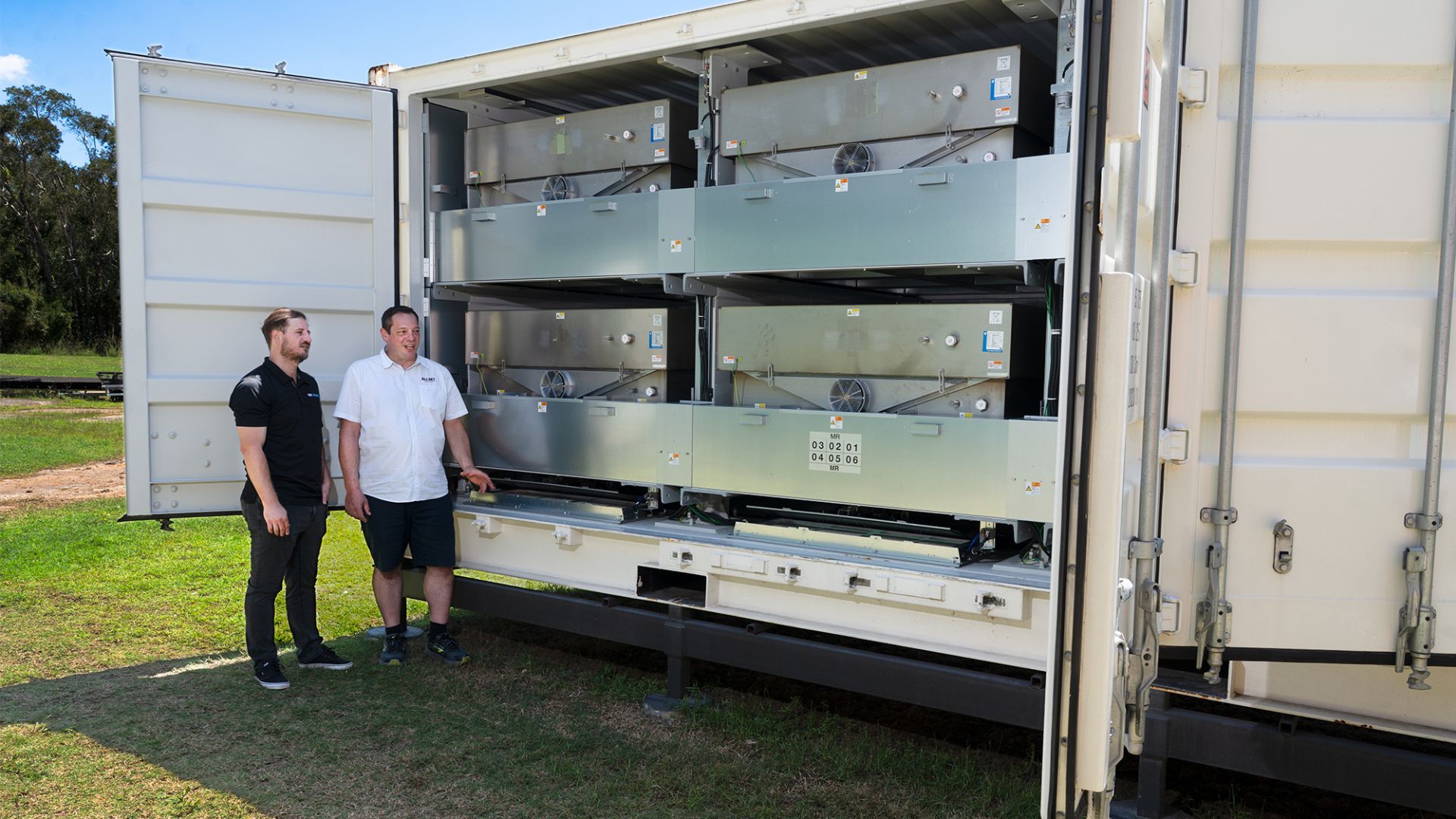
Australia has officially plugged its first grid-connected Sodium-Sulfur (NaS) battery into the National Electricity Market (NEM). Installed at Lava Blue’s Center for Predictive Research into Specialty Materials (PRiSM) in Brisbane, the 250kW/1.45MWh system marks a major turning point for the nation’s energy transition. Currently, lithium-ion mostly dominates the battery market. But lithium has limits as it is expensive, prone to supply challenges, and typically offers short-duration storage bursts of just two to four hours. Now, NaS batteries could offer a better alternative. Capable of discharging continuous power for six hours or more, sodium-sulfur systems offer the heavy-duty stamina needed to keep industry running long after the sun goes down. “The successful commissioning of Australia’s first grid-connected NaS battery energy storage system marks an important milestone for Queensland’s battery industry and for powering critical minerals refining from long-duration energy storage,” said Professor Joshua Watts, Director of the Queensland Energy Storage Technology (QUEST) Hub at QUT. First solar-powered light industrial site Sodium and sulfur are far cheaper, non-toxic, and geographically abundant than lithium, nickel, and cobalt. The NaS system is manufactured by Japan’s NGK Insulators, the global leader in commercial molten-salt/NaS batteries. The battery sits alongside an existing 200 kW solar array at the site and is physically connected to Energex’s local distribution grid. The location of the deployment is also integral. Lava Blue’s PRiSM facility refines critical minerals used in high-tech supply chains — materials essential for semiconductors, advanced manufacturing, and electric vehicles. Standard mineral processing uses sulfuric acid, a byproduct of petroleum refining. But Lava Blue replaced sulfuric acid with hydrochloric acid and ran its microgrid on solar power backed by the new NaS battery. The facility has effectively created a zero-fossil-fuel refining loop. Lava Blue Managing Director Michael McCann called it a model for the future. “PRiSM is already demonstrating our novel mineral processing methods using Hydrochloric Acid, which is a more sustainable route in a post-fossil-fuel age,” McCann said. “With the commissioning of our microgrid, the lifecycle emissions intensity of our high-purity materials are further reduced.” The installation makes Lava Blue the first solar-powered light-industrial facility in Australia. Local industry collaboration While the NaS technology itself has decades of proven commercial use overseas, integrating it into Australia’s high-voltage energy grid required local ingenuity. Australian engineering firm Allset Energy led the installation, while Queensland-based Advanced Converter Solutions (ACS) developed custom DC-DC converters to link the battery directly to the NEM. In total, over 80 percent of the purpose-built control unit was manufactured using Australian content. As energy grids worldwide struggle to balance intermittent solar and wind generation with steady industrial demand, multi-hour storage solutions like sodium-sulfur are shifting from experimental alternatives to economic necessities. In Brisbane, that shift is no longer theoretical, but it is live on the grid. Another major lithium-ion energy storage project in Queensland has cleared a key environmental benchmark after receiving a referral decision under Australia’s EPBC Act. The 180MW/360MWh Noblevale Battery, developed by joint venture ZEBRE near Ipswich, is set to reuse a former mining site and connect directly to the local Blackstone substation. Designed with koala-proof fencing and targeted vegetation protection, the project will minimize local ecological impacts while using existing grid infrastructure. Construction is planned for September 2027, placing it alongside other major clean energy storage projects within the expanding Swanbank industrial area. Get the latest in engineering, tech, space & science - delivered daily to your inbox.Mrigakshi is a science journalist who enjoys writing about space exploration, biology, and technological innovations. Her work has been featured in well-known publications including Nature India, Supercluster, The Weather Channel and Astronomy magazine. If you have pitches in mind, please do not hesitate to email her.
First grid-tied 250kW sodium-sulfur battery system commissioned for mineral refining
Full Article
Original Source
Read the full article at Interestingengineering →KhanList aggregates and links to publicly available news content. We do not host full articles from third-party sources. Always verify important information with original sources.