
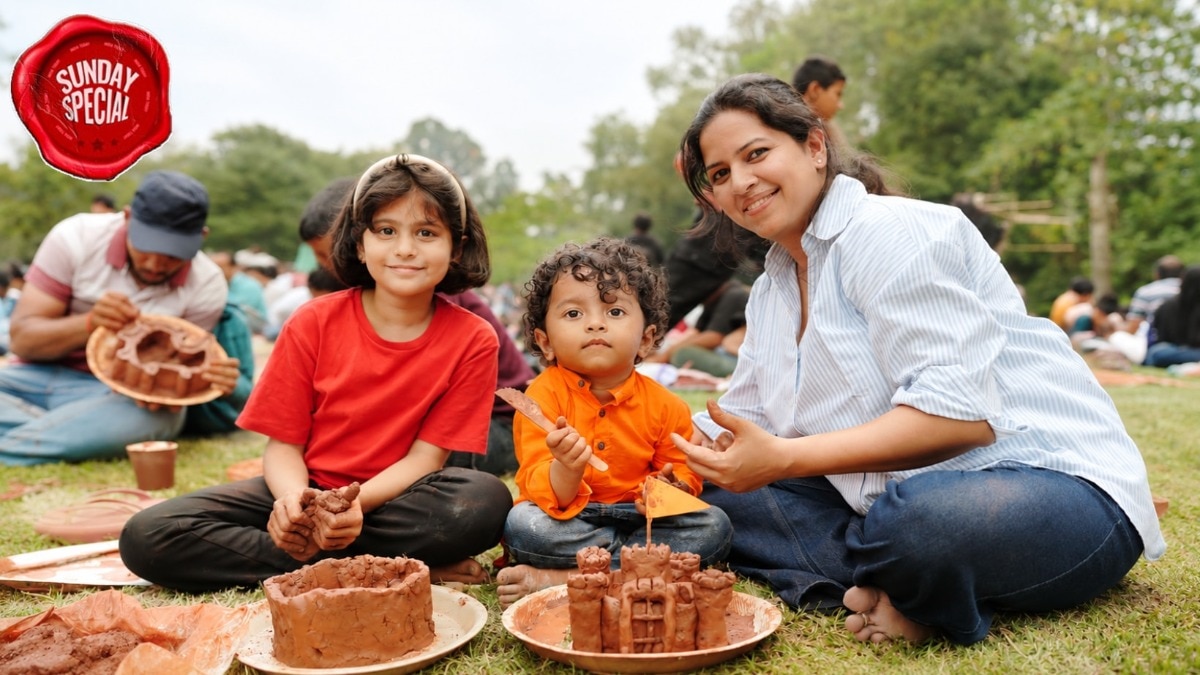
"Those were the best times! Every year, during the holidays before Diwali, we would visit my maternal uncle's vada (a traditional Maharashtrian courtyard house). My parents, uncle, cousins and I would all build a Killa," recalled 41-year-old Nashik-based Priyanka Shinde. "Years have passed, I am married now and live in an apartment. But even today, I never miss building a Killa, however small, with my 13-year-old daughter," said the IT professional on Thursday evening.It was the day of Vasubaras, which marked the beginning of Diwali festivities in Maharashtra, and Priyanka was rushing to make the final preparations. "For us, Diwali celebrations begin with building the Killa. And the first diya is placed at the very top of the fort. That's in honour of Chhatrapati Shivaji Maharaj."Over 6,500 km away, in Tokyo's prime business district, Azabudai Hills, Pune-native techie Omkar Jori, is clacking away at his keyboard and missing home. This year, he could not travel to Maharashtra for Diwali and said he missed building a Killa. Back home, Jori said, his mother Jyotsna Jori and sister Pratiksha Khirid are keeping the tradition alive, building a miniature fort and sharing their creation with the world on YouTube.Omkar, who has grown up making and watching these forts being built every Diwali, told India Today Digital, "It might appear to be just an activity, but it is an inseparable part of our Diwali celebrations and a fitting tribute to Chhatrapati Shivaji Maharaj." The unique tradition of building miniature Killa during Diwali in Maharashtra, which is known to host some of India's most majestic Maratha forts, is believed by some experts to be 300 years old, while others say it began about a century ago. The precise origins of the tradition, also prevalent in North Karnataka, remain unclear. The custom was unknown to someone like me, who comes from eastern India and works in northern India.In fact, many outside Maharashtra, the Sahyadri region and parts of northern Karnataka know little about this unique Diwali tradition, in which children and elders come together to recreate historic forts, including those built by Chhatrapati Shivaji Maharaj, and honour the legacy of the 17th-century Maratha ruler. Bengaluru-based author Aabhas Maldahiyar, who authored Babur: The Quest for Hindustan, described the Killa-making tradition as a form of living memory that keeps Chhatrapati Shivaji Maharaj's legacy alive across generations. "The Killa turns history into memory, geography into imagination and architecture into play. It brings the Maratha past out of museums and universities and into courtyards, neighbourhoods and the hands of children," Maldahiyar told India Today Digital."The first lamp is for Chhatrapati Shivaji Maharaj. Then, the lamps before the Gods," added Maldahiyar, explaining that the gesture symbolises generations of gratitude to a ruler remembered for protecting their faith and temples from invaders.Maldahiyar, linking the Killa tradition to the protection of the Hindu faith and temples, quoted a Marathi saying, which means, "The first lamp of Diwali is for this God of mine, because of whom Gods still remain in our temples today." He also invoked Chhatrapati Shivaji's court poet Kavi Bhushan's lines that "had Shivaji not been there, all would have been circumcised".Pune-based historian and Indian Navy veteran Uday S Kulkarni, who proudly shared that his granddaughter had built a Killa this Diwali, told India Today Digital that the tradition "grew out of pride in Chhatrapati Shivaji Maharaj's achievements and continues to nurture children's sense of belonging to their history".Another popular modern-day aspect of Killa-making is the competitions held both online and offline, with prize money ranging from thousands to tens of thousands of rupees for the best creations. Held at schools, housing societies and venues used by Ganesh or Durga Puja mandals, these competitions often showcase 20 to 30 miniature forts in one place, drawing families who come to admire the exhibits and, of course, get selfies and pictures clicked.In Pune, the Artwala Foundation, in collaboration with the Municipal Corporation, organised Killotsav 2026, where over 4,000 miniature forts were built simultaneously in an attempt to set a world record. Sandeep Bhamkar, the foundation's general secretary, told India Today Digital that the feat has entered into the Book of Records. These Killa were made by Priyanka Shinde, Omkar Jori, Uday S Kulkarni, Ruturaj Turekar and Sandeep Bhamkar, and their friends and families. They contributed their insights, experiences and creations for this story. So, how did this tradition begin? How did it become part of Diwali? How has it survived generations? Here we will look into the unique and important piece of India's intangible heritage, its origins and significance. We will also look into what goes into making elaborate miniature forts, the impact of smartphones and social media on the custom, and how Maharashtra continues to keep Shivaji Maharaj's legacy alive, one Killa at a time.HOW DID MAHARASHTRA'S DIWALI KILLA TRADITION BEGIN?Who built the first miniature Killa during Diwali, and when? There is no definitive historical record that answers either question. While the tradition is associated with Chhatrapati Shivaji Maharaj and the Maratha Empire, experts and historians differ on how far back its origins can be traced.Maldahiyar cited Maratha historian Ninad Bedekar, who, he said, traced the Killa tradition back roughly 300 years. Bedekar saw it as a way for people to honour Shivaji Maharaj and the forts that helped him build Swarajya, or self-rule, Maldahiyar said."Chhatrapati Shivaji Maharaj's forts were the backbone of his kingdom, centres of defence, administration and sovereignty. Over generations, children recreated this world in mud: ramparts, bastions, gates and watchtowers amid the rugged landscape of the Sahyadris," Maldahiyar explained.However, Pune-based historian-author Uday S Kulkarni gave a cautious assessment. He said he believed the custom might have begun over a century ago as a collective social and community practice, but said there was no known individual who started it or documentary evidence establishing its exact beginning."It is not a formalised tradition. It is just out of pride for the achievements of Chhatrapati Shivaji Maharaj," Kulkarni said. According to him, the practice could have emerged organically, with one family building a miniature fort and others gradually following suit.Pune-based techie Ruturaj Turekar, who grew up building Killa with his father and maternal uncle and now makes them with his four-year-old son, drew a parallel between tradition and Chhatrapati Shivaji Maharaj's approach to governance. He said, "As the Maratha ruler brought together people from different religions and castes, including Muslims and marginalised communities, to build, govern and defend his kingdom, families and kids come together and use whatever spare resources are available to build miniature forts." Raigad, Rajgad, Pratapgad and Sinhagad were all strategically located hill forts in Maharashtra's Sahyadri range that played crucial roles in Chhatrapati Shivaji Maharaj's military campaigns. WHY ARE KILLAS BUILT DURING DIWALI?Why did the tradition of building miniature forts become associated with Diwali and not Chhatrapati Shivaji Jayanti or any other festival? Again, there's no definitive historical explanation, but historians offer different theories.Author Aabhas Maldahiyar said he saw a possible historical connection with Chhatrapati Shivaji Maharaj's victory over Bijapur commander Afzal Khan near Pratapgad in 1659. The victory was a major turning point in Shivaji's rise and helped establish the military strength of the emerging Maratha kingdom."Perhaps this is why Diwali came to embrace Chhatrapati Shivaji Maharaj and his forts," Maldahiyar said, highlighting a possible parallel between the festival's symbolism of good triumphing over evil and Chhatrapati Shivaji's victory against a powerful adversary.Historian Uday S Kulkarni believes the answer could be surprisingly simple. School holidays. Children in Maharashtra traditionally enjoy a school break during Diwali, which gives them enough time to gather bricks, stones, mud and clay and build miniature forts with their friends and families.Even Pune-based IT professional Ruturaj Turekar and Nashik-based Priyanka Shinde recalled how they eagerly awaited the Diwali holidays as kids. They recalled how they used to wait for the mid-term exams to end. Schools closed, groups of friends would get busy gathering mud, stones and whatever else they could find to build their Killa. The excitement would build throughout the year as they waited for the fort-making season to return, they said.Whatever the reason, the holidays even today provide children with an opportunity to turn their courtyards into miniature Maratha kingdoms. Some recreate Chhatrapati Shivaji's famous forts, such as Raigad, Pratapgad, Sinhagad and Rajgad, while others built imaginary fortresses of their own. Ruturaj Turekar's father helped his son paint a Killa. Priyanka Shinde gets her hands muddy with her daughter. A child in Pune joins a world-record attempt alongside his grandmother. (Photos: Ruturaj Turekar, Priyanka Shinde and Sandeep Bhamkar) HOW TO MAKE A SHIVAJI'S DIWALI KILLA WITH MUD AND STONESBuilding a Killa is no ordinary Diwali decoration of glitter, garlands and sparkles. It involves mud, stones, sacks, seeds, miniature soldiers and, above all, a great deal of imagination or precision. The preparations usually begin seven to 10 days before Diwali. Historian Kulkarni, who remembers making Killa during his childhood, explained how it is traditionally done."It all starts as a heap of stones and bricks, which form the basic framework of the fort. It is then covered with layers of old jute sacks or thick fabric and wet mud. Once the mud dries in a day or two, the fort is painted and decorated with walls, watchtowers, pathways," he told India Today Digital."To make the fort look like it stands amid the forests of the Sahyadris, children plant seeds of mustard or coriander on its slopes. Within a day or two, tiny green shoots begin to emerge. That gives the miniature landscape the appearance of a jungle seen in the region. Lush green," Pune-based IT professional Ruturaj Turekar said.Apart from the miniature clay figurine of Chhatrapati Shivaji Maharaj, those of sword-wielding soldiers, horses, wild animals and villagers are added to bring the fort to life. Some even build tiny settlements at the foot of the fort, complete with roads, farms, moats and realistic-looking water bodies surrounding the bastions."Sometimes there is a small village at the base of it. Every fort was connected to a village for supplies and provisions," Kulkarni explained.At the highest point of a Killa stands a miniature Chhatrapati Shivaji Maharaj, often seated on a throne, overlooking the fort and the world created around it.Once completed, the forts are decorated with diya on Vasubaras, which fell on Thursday (November 5) this year and marked the beginning of Diwali festivities in Maharashtra. "Lighting the first diya for Chhatrapati Shivaji Maharaj, often on the fort, is a way of honouring him before beginning our own celebrations," Pune-native Omkar Jori told India Today Digital from Tokyo. It takes seven to 10 days of painstaking work to complete a Diwali Killa. (Photos: Ruturaj Turekar) In many Maharashtrian homes, the Killa and the diya remain in place until Tulsi Vivah, which falls after Diwali, Kulkarni told India Today Digital.What makes the tradition remarkable is that almost everything used to build a Killa can be found around the house or in the neighbourhood. And no two forts look exactly alike. Each carries the creativity of the children who built it and a little piece of Maharashtra's living heritage.Ruturaj Turekar said there are options even for those who cannot build a Killa themselves or lack space in their homes. "Ready-made, compact Killa, complete with miniature figurines, decorations and lights, are available in several cities of Maharashtra for around Rs 300 to Rs 1,000. This allows nuclear families with limited space to honour their Maharaj and his glory without building one from scratch," Turekar said.SMARTPHONES, SOCIAL MEDIA AND THE CHANGING FACE OF KILLA-MAKINGTo build a Killa, children need to step out of their homes, get their hands dirty and spend days with friends gathering stones, mud and bricks. But, with smartphones replacing outdoor games and open courtyards giving way to apartment complexes, is Maharashtra's Diwali tradition slowly fading away? There are signs of both decline and revival, from what we gather.While television, mobile phones and social media have drawn some children away from the tradition, the same have also helped popularise Killa-making through online competitions and social media visibility. Technology has also encouraged several children to take Killa-making-up out of reverence for Chhatrapati Shivaji Maharaj and a desire to preserve their cultural heritage.Pune-based Ruturaj Turekar told India Today Digital that Killa-making competitions organised at Ganesh mandals and large community grounds are a major attraction. "The mandals provide the space, and some also give building materials to the participants. The atmosphere is like a fair, with families bringing their children to see the forts in the evenings," he said.Ruturaj recalled visiting such exhibitions in Pune's Sambhaji Udyan with his father as a kid. On Thursday, the 32-year-old said he would soon take his son to the historic Pune park. He said that the prize money of the competitions start from tens of thousands of rupees, and can go up to Rs 1 lakh. Diwali Killa-making competitions are advertised and organised publicly. It has also become a community activity. Elaborately decorated Killas attract visitors from far and wide. (Images: Uday S Kulkarni, Ruturaj Turekar and Sandeep Bhamkar) In Pune's another historic public space, the Sarasbaug, over 4,000 people participated in a record-making miniature fort-making event organised by the Artwala Foundation on November 1 as part of Killotsav 2026. Sandeep Bhamkar, the foundation's general secretary, told India Today Digital that the organisers provided natural clay, tools and guidance, with over 200 volunteers helping participants build forts small enough to fit on a dinner plate."The turnout was so large that we had to make additional arrangements to accommodate participants," Bhamkar said. "The forts made here are small enough (made on a dinner plate) to be displayed in a showcase at home, and participants got to take their creations with them." He added, "We also kept some of the best forts on display for visitors to see for the next couple of days."The internet and social media have also added new steam to Killa-making. YouTube tutorials show how to recreate forts like Raigad and Pratapgad, set against elaborate miniature landscapes. One such YouTube channel is 'All About Home Marathi' run by Tokyo-based Omkar Jori's family back in Pune. The channel has over 55,000 subscribers.Jori said he considered building a Killa in Japan after missing this Diwali at home, but finding bricks and sacks there was difficult in Tokyo. He hoped to celebrate the next one with his family back home.So, even as smartphones and changing lifestyles might have drawn some away from Killa-making, the tradition appears to have found fresh momentum through competitions, social media and community initiatives. At large public events or in small homes, Shivaji Maharaj still occupies the highest place. The tradition has another benefit, as historian Kulkarni pointed out. It encourages children to step outdoors, get their hands dirty and reconnect with their cultural roots. As author Maldahiyar puts it, "The great forts of Shivaji Maharaj were built to protect Swarajya... Centuries later, children rebuild them not to defend a kingdom, but to ensure that its legacy is never forgotten".- Ends
First Diwali diya for Shivaji. Killa-makers keep centuries-old tradition alive
Full Article
Original Source
Read the full article at Indiatoday →KhanList aggregates and links to publicly available news content. We do not host full articles from third-party sources. Always verify important information with original sources.