
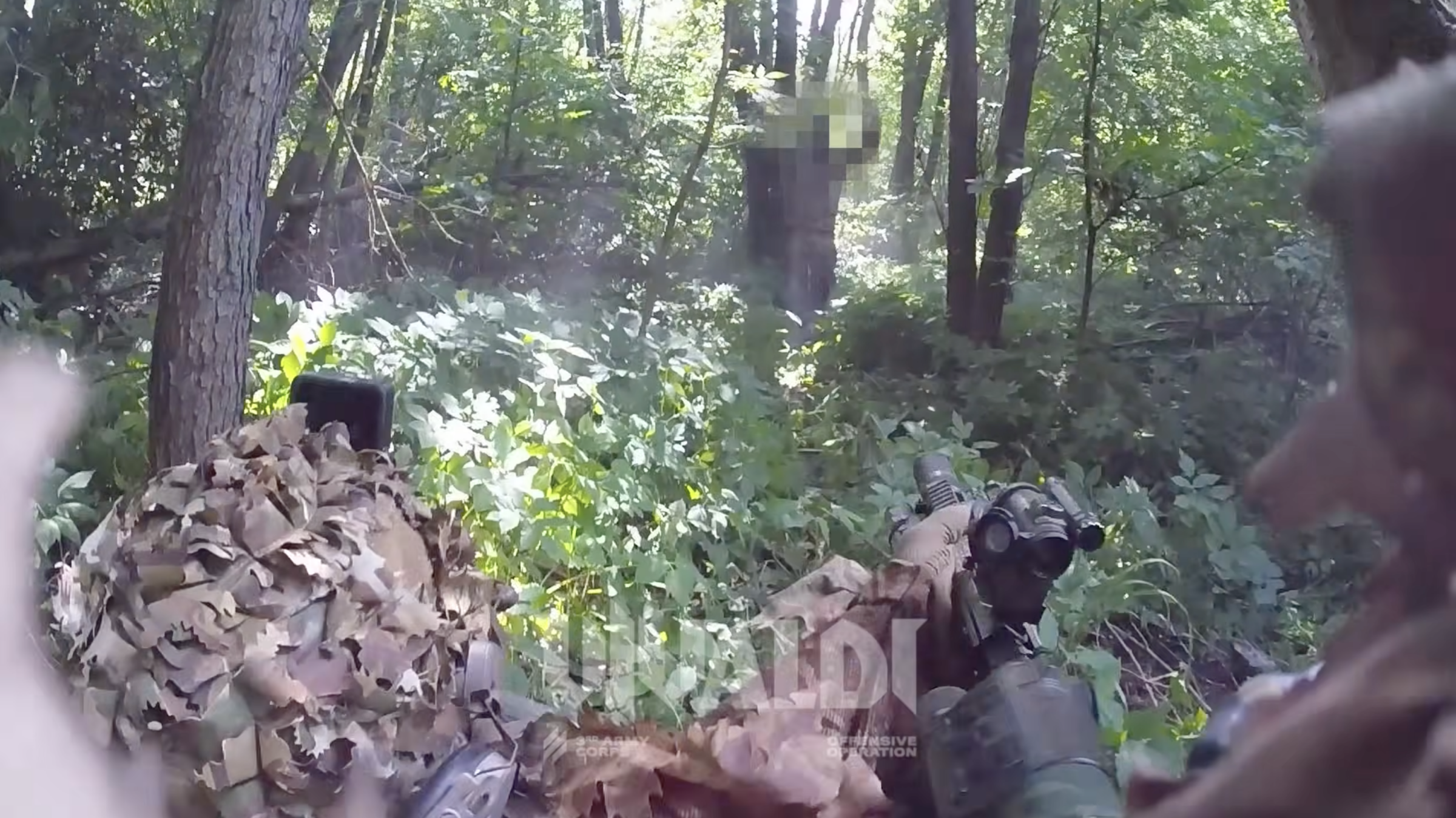
Every day, the Ukraine Battlefield update newsletter offers a clear look at how the war is unfolding on the ground. Subscribe for free here to get the full text delivered to your inbox. Why Operation Vivaldi is being described as the offensive operation of 2026 and a huge Russian disaster. Robots in the leading role. How the operation, which is not yet over, was prepared. Satellite image of the day: damaged Russian refinery. Videos of the day: a drone chasing motorcycles and a dummy used as bait. The first stages of Operation Vivaldi. Long months of preparations in complete secrecy, followed by a series of steps that proved exceptionally successful thanks to smooth coordination and modern technology, have caused the Russian army a major fiasco in its campaign in eastern Ukraine. Ukraine’s Operation Vivaldi, aimed at pushing back Russian forces around Lyman in Donbas, was long shrouded in uncertainty. A growing number of accounts from within the 3rd Army Corps now show just how exceptional the operation is. “I can say that this operation may become the most technologically advanced of all those carried out not only during the full-scale war in Ukraine, but anywhere in the world,” Ukrainian military analyst Oleksandr Kovalenko told Denník N. Розкриваємо деталі та масштаби першого сезону «Вівальді» від Третього армійського корпусу.Хто такі «флаговтики» rф і чому для боротьби з ними Трійка створила об’єднаний штаб, який на тактичному рівні координував дії спеціальних і розвідувальних підрозділів у межах єдиного задуму?Про л*квідацію інфільтрованого противника, чого це коштувало ок*пантам і як виглядають 85 км² території, очищеної від в*рога, — мовою мап і фактів Трійки!Posted by Третій армійський корпус on Tuesday, September 15, 2026 The Ukrainian website NV, which spoke to soldiers involved in it, also considers it the most successful offensive operation of 2026. Russia’s Meduza took a more cautious view, saying that Ukraine’s advance near Lyman is real, but that for now it is more accurate to speak of a series of local successes than a major strategic breakthrough. In this article, we summarise what is currently known about the operation, which is still under way, and whose name was inspired by Vivaldi’s The Four Seasons, as it is intended to have exactly the same number of stages. The opening stage, involving extensive preparations, has already ended. The first details were released in mid-September by Andriy Biletskyi, commander of the 3rd Army Corps, and further accounts gradually followed. Officially, Ukrainians spoke of the “clearing” of 75 km² and the deoccupation of 10 km² in the first stage, the loss of around 1,500 soldiers, more than 12,000 drones, and hundreds of armoured vehicles, artillery systems and vehicles. The elite Russian Rubikon drone unit was also forced to withdraw because of heavy losses. In the second stage, Ukrainian forces advanced by another 40 km² and took destroyed villages including Shandryholove, Derylove and Drobysheve. The logistics of Russian forces in this section of the front collapsed and, according to NV, which spoke to Petro Horbatenko, the chief of staff of the 3rd Corps, the supplies of Russian units had to be moved outside Ukraine. Thanks to this operation, Ukrainians have severely complicated the Russian occupiers’ ability to infiltrate in the Lyman direction. If the Russians intended to use this section of the front to capture the city and advance further towards Sloviansk, that has for now been thwarted. The fortified belt of cities in Donbas is holding, although the overall situation is extremely difficult and unbearably dangerous for the ordinary residents who remain there. The 3rd Army Corps published footage of one of its many operations. Once the “anti-drone cover” has been destroyed, the attack begins, along with the destruction of Russian armoured and transport vehicles. Палають вантажівки, танк і мотоцикли — привіт від СБУ!Під час операції «Вівальді» Третього армійського корпусу FPV спецпідрозділу «Альфа» СБУ нищили піхоту противника, незважаючи на «антидронові» плащі, які тільки більше привертали увагу.Вистежили і знищили бронетехніку та… pic.twitter.com/CHv7eu1af0— Третій армійський корпус (@ab3army) September 24, 2026 According to the 3rd Army Corps, unmanned systems units carried out 36,000 strike missions during the first stage of the operation. Unlike the unsuccessful attempt at a counteroffensive in 2023, when its plans were leaked, Ukrainians this time managed to plan the operation quietly for many months. “For Russia, this is a catastrophe. It is a huge blow, and we can see that they are currently unable to stabilise the situation. They cannot stop this operation, especially as it has in fact only just begun. This is only the first stage; others will follow. That is why its significance is so crucial,” Kovalenko said. The first task, he said, was to expand the Ukrainian Armed Forces’ zone of control between the Nitrius and Chornyi Zherebets rivers, both tributaries of the Siverskyi Donets. The salient created by the Russian occupiers between those rivers directly threatened the city of Lyman itself. “In the long term, if Lyman had been captured, there was also a risk that Russian troops would reach the Siverskyi Donets River and its southern bank. They would then have been able to put pressure on Sloviansk, and above all on the entire Sloviansk-Kramatorsk urban area. That is why it was exceptionally important for us to ensure the complete security not only of Lyman itself, but of the entire area,” the analyst from Odesa said. The second important objective was to cut off Russia’s ability to exert pressure from the south on the range of high ground stretching towards Borova, from Novomykhailivka to Pershotravneve. “By doing so, we have effectively pushed the Russians back to roughly the positions they held in October and November 2022. It can therefore be said that Russia fought for this section for almost four years, expending enormous human resources, forces and assets, only to be pushed back to its old positions within a few months,” Kovalenko said. Robots in the leading role. Kovalenko said the operation was also unique because of the new technologies deployed, which show what warfare in the near future could look like. “Until now, there has been no operation anywhere in the world in which ground robotic systems and drones have formed such a massive component,” Kovalenko said. According to him, the 3rd Army Corps became the first operational-tactical formation to use a large group of ground robotic systems for demining. “Within two days, nearly 30 km of roads were demined, mostly at night. Normally, two companies of combat engineers would need around two weeks to clear mines across such an area. All this was completed within 48 hours, mostly at night and without any loss of life, because it was all done by robots,” Kovalenko said. Later, during counterattacks and offensive operations, robotic systems again formed the vanguard, with drones in some cases dropping them into position. “Ground robotic systems were equipped with various weapons that enabled them to fire at the enemy. Many of this corps’ procedures and decisions during the offensive were based precisely on the use of these systems,” Kovalenko explained. “Improvised explosive devices were used to blow up certain buildings where you would not want to send infantry,” Major Akhmet told NV. According to him, a vehicle carrying a kilogram of explosives simply drove up and destroyed the building. Such robots were also used for logistics, evacuation, or intimidation — in the form of a robot fitted with a turret — to deter Russians from advancing further. According to Kovalenko, the 3rd Army Corps is among the most technologically advanced formations and has the highest proportion of robotic elements in the performance of various tasks. As a result, it was able to restore control over vast areas with minimal losses. How it was prepared. According to NV sources from within Andriy Biletskyi’s corps, the overall preparations lasted many months, or as long as a year. Footage of operations during Operation Vivaldi: As Rodion Kudriashov, deputy commander of the 3rd Army Corps, wrote for Ukrainska Pravda, the situation at the front first had to be stabilised and enemy infiltration stopped. “This sounds less impressive than the word ‘offensive’, but there can be no offensive without it. It is impossible to plan a complex operation if you do not know where your front line will be tomorrow,” Kudriashov said, adding that the beginning was not actually about moving forward, but about creating the conditions that would make it possible. In the more interesting part of the operation, according to Dolyna, the commander of Kraken’s unmanned aircraft company, Ukrainians first destroyed logistical support to a depth of 50 km, leaving Russian soldiers on the “zero line” without food, ammunition or fuel. “It was precisely because of the logistical failure that their drone pilots flew less often,” Dolyna told NV, describing the gradual demoralisation of Russian forces. At the next stage, Ukrainians struck logistics as far as 120 km behind the lines. “In the enemy’s rear areas, Ukrainian drones systematically attacked and destroyed fuel and ammunition depots, as well as equipment repair bases,” NV wrote of the operations divided among the extensive formation of the 3rd Army Corps. As Robert G. Rose stressed in his analysis for the Modern War Institute, former defence minister Mykhailo Fedorov had long realised that Ukraine needed to fight deep behind Russian lines because, as he put it: “Russia always operates at operational depth. Russian doctrine is built that way; Russia essentially created this concept.” According to the analyst, Fedorov therefore favoured the transition to a higher-level corps system, enabling Ukraine to fight in depth and shift from tactical attritional warfare to fighting at the operational level. A necessary prerequisite before this phase, however, was above all preparation for electronic warfare, which took nine months. Electronic warfare units systematically destroyed both large Russian drones and small reconnaissance drones, effectively “covering the Russians’ eyes”. “Fortune loves silence,” Sergeant Akhmet told NV, commenting on how they had managed to conceal preparations for such a large-scale operation from the Russians. At the front, electronic warfare specialists operated continuously, 24 hours a day. One unit member, Barista, described how they destroyed 150 enemy drones over one small area measuring 5 km. With a very limited information footprint, they managed, using drones and electronic warfare, to create confusion among Russian forces, which for a long time did not know what was happening. After creating an information blackout and destroying logistics, the infantry could move in. During operations, it often found Russians disguised in civilian clothes, while some surrendered on their own because they had neither food nor water. In war, it is assault units that capture territory, but according to the Ukrainians involved, the conditions for this had been created long beforehand. As Kudriashov, the deputy commander of the 3rd Corps, explained, “an offensive does not begin at the moment infantry receives an order to advance”. “It begins much earlier: at headquarters, with commanders, in personnel training, logistics, intelligence, unmanned systems, support and dozens of decisions, most of which never make the news.” According to NV’s findings, the key factor in the success of Operation Vivaldi was ultimately “well-developed interaction between units” — that is, seamless and smooth coordination. “This was the best cooperation I have had during the war,” Ukrainian soldier Akhmet told the Ukrainian website. “If we spot the enemy somewhere in our zone, I always know that our neighbours will help us. You do not even have to tell them; they will help you. We try to do the same,” he added. Satellite image of the day Ukrainians attacked a Russian refinery in Kuibyshev, in Russia’s Samara region, this week. The fire indicated that the attack had been successful. Satellite images published by Radio Svoboda confirmed this. They show that the strikes destroyed five fuel tanks at the refinery. In August, Ukrainians hit a record number of Russian refineries. Videos of the day When you are riding a motorcycle and a faster drone is chasing you, there are not many options. Either you veer into a ditch, risking death in a crash, or you keep going and the drone catches up with you. This video shows Russian soldiers, each choosing a different path. From the Ukrainian operator’s perspective, it was the best outcome: one drone took out two motorcyclists. A SIGNUM FPV drone operator takes out two Russian motorcycle assault troops with a single drone.Chased by the FPV, the first rider apparently panics while trying to evade it, loses control and crashes hard into the roadside. The drone then continues after the second rider and… pic.twitter.com/KUqsZCd2gH— Special Kherson Cat 🐈🇺🇦 (@bayraktar_1love) September 24, 2026 This video shows a dummy in camouflage intended to imitate a soldier. While decoys of military equipment are fairly common in war, the use of such dummies is less widespread. In theory, a drone with a poorer camera could mistake it for a soldier, but it is unclear whether this actually works. Russian decoy position with a dummy soldier.Decoy positions themselves are extremely common and widely used. Dummy Russian soldiers have also appeared from occasionally throughout the war, but still do not seem to be nearly as widespread. pic.twitter.com/cblBYVCGGR— Special Kherson Cat 🐈🇺🇦 (@bayraktar_1love) September 23, 2026 What are the losses On Thursday, no update. By Tuesday (22 September), Russia had verifiably lost 24,138 pieces of heavy equipment (24,098 on Monday, 14 September). Of these, 19,105 (19,065) were destroyed by Ukraine, 1,000 (1,000) were damaged, 1,194 (1,194) were abandoned by their crews, and 2,839 (2,839) were captured by the Ukrainian army. This includes 4,448 (4,447) tanks, of which 3,353 (3,352) were destroyed in combat. Ukraine lost 12,175 (12,143) pieces of equipment, of which 9,579 (9,551) were destroyed, 702 (698) damaged, 695 (695) abandoned and 1,199 (1,199) captured. This includes 1,464 (1,462) tanks, of which 1,125 (1,120) were destroyed in combat. Note: Neither side regularly reports its own fatalities or destroyed equipment. Ukraine publishes daily figures for Russian casualties and destroyed equipment, which cannot be independently verified. This overview uses data from the Oryx project, which has compiled a list of exclusively photographically documented equipment losses since the start of the war.
First blind the Russians, then catch them with robots: Ukraine’s Operation Vivaldi shows cutting edge of modern warfare (Ukraine Battlefield update, Day 1,674)
Full Article
Original Source
Read the full article at Euobserver →KhanList aggregates and links to publicly available news content. We do not host full articles from third-party sources. Always verify important information with original sources.