
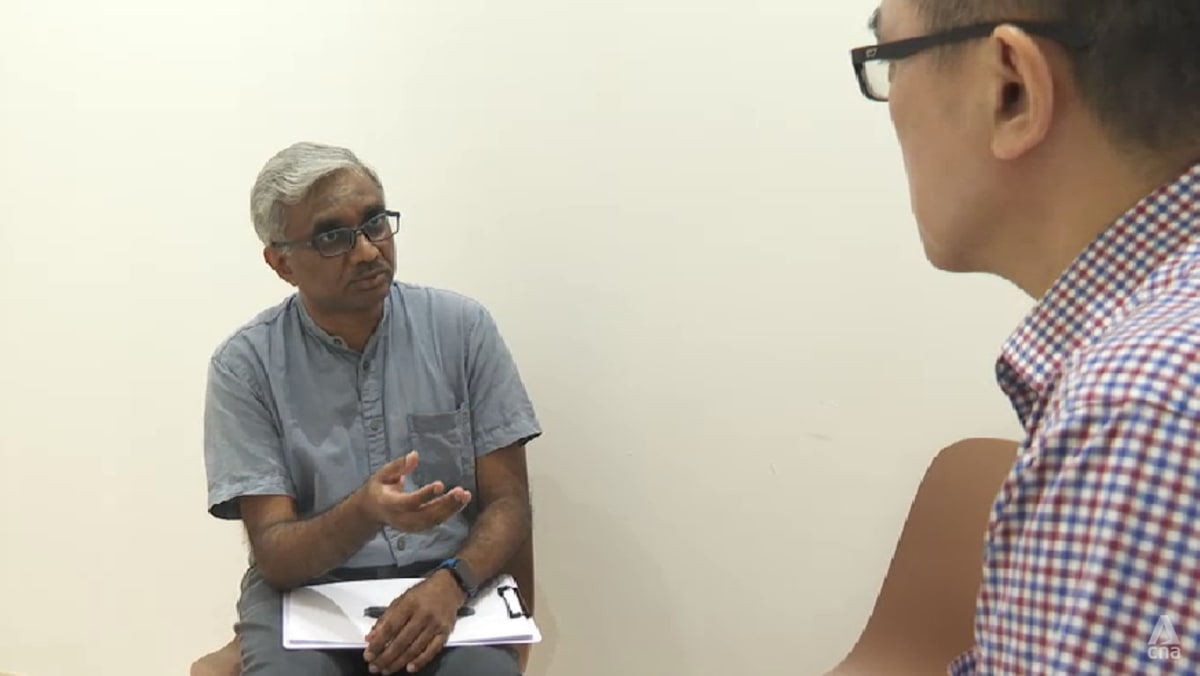
Singapore Social service organisation Kampong Kapor Community Services plans to grow its fractional workforce by more than 60 per cent over two years, while other employers are exploring similar arrangements to retain experienced workers. A counselling session at Kampong Kapor Community Services. (Image: CNA) New: You can now listen to articles. This audio is generated by an AI tool. 11 Nov 2026 09:52AM SINGAPORE: After retiring from the social work sector in 2023, Mr M Hindran, 68, returned to Kampong Kapor Family Service Centre (KKCS) this year to help manage its caseload under a fractional work arrangement.He initially worked about two-and-a-half to three days a week at the social service organisation, handling triages and a limited number of cases. He was paid according to the hours he worked.Fractional work lets people with specialised skills take on specific responsibilities or a reduced scope of work, rather than the range of duties of a full-time employee.Mr Hindran said the model worked well for both him and the organisation, giving him time for personal activities while allowing him to continue contributing his experience. “I get to do my own things. I get to do some volunteer work. I get to run my errands," he told CNA. Mr M Hindran, assistant senior social worker at Kampong Kapor Family Service Centre, speaking to CNA. (Image: CNA) Mr Hindran has since moved from fractional work to a part-time position as an assistant senior social worker.He said he agreed to increase his hours at the organisation’s request, provided he could still make time for personal activities."I like the work that we are doing … (I’ve been) doing this for many years, and I feel that I can still contribute not just to the community, but also to the staff. They get to tap my knowledge and consult with me," he said.Such arrangements are gaining interest among employers looking to retain experienced workers while addressing manpower shortages.MORE FIRMS EXPLORING FRACTIONAL WORKKKCS aims to increase its fractional workforce from six to around 10 workers over the next two years, an increase of more than 60 per cent. Half of its current fractional workers are seniors.Its fractional roles include counselling and social work, with workers taking on caseloads or time slots based on their availability and the organisation's needs.Unlike full-time staff, they are not expected to handle responsibilities outside their agreed scope, such as additional administrative duties or organisation-wide activities. Mr Martin Ho, corporate services director at KKCS, said such arrangements allow the organisation to bring in experienced workers more quickly than hiring full-time employees, which typically takes six to nine months."It definitely has addressed manpower shortages, especially in times when the case numbers go up, or at times when our staff are not able to cope," he said.But implementing fractional work requires more than simply reducing working hours.Mr Ho said some fractional workers are engaged as contractors rather than employees, meaning they may not receive staff or medical benefits, although they can receive higher pay in return.He also noted that fractional work requires employers to rethink how jobs are divided, how workers are paid and how their performance is managed."It's not for everyone, but for people who desire it, who find a fit in their life stage, this will be a highly valuable option," he said. FLEXIBLE ROLES TO RETAIN OLDER WORKERSEnvironmental services firm Chye Thiam Maintenance (CTM) already offers flexible working hours and redesigned roles for senior employees.It is now exploring fractional arrangements that would allow retiring employees to take on consultancy roles on a project or ad hoc basis.Mr Frankie Yung, its director of human resources and administration, said the company regularly seeks employee feedback to improve its policies.“The key is understanding seniors' personal and family needs before offering suitable work arrangements,” he said.For 72-year-old Jimmy Chan, an operations support officer at CTM, job redesign has meant learning to remotely operate autonomous road sweepers.His role involves monitoring the machines from a command centre and requires him to remain alert. But he said he is grateful to have the opportunity to learn new skills at his age."I think for senior workers, money is an important aspect, but the most important thing is that we still have the opportunity to work," he added. Mr Jimmy Chan, an operations support officer at Chye Thiam Maintenance, remotely operating autonomous road sweepers from a command centre. (Image: CNA) CHALLENGES AND SUPPORT FOR FRACTIONAL WORKProfessor Lawrence Loh, director of the Centre for Governance and Sustainability at the National University of Singapore (NUS) Business School, said fractional work gives employers access to people with “specialised knowledge, leadership skills and even institutional memory”."That arrangement gives you access to high-level expertise in a very cost-effective way," he said.He said companies can scale their use of fractional workers up or down according to their needs, including for projects, seasonal work or interim roles."I think for many companies, particularly if they do succession (planning), sometimes a fractional person can stay back and do the mentoring and hand-holding while the company is doing the transition."However, Prof Loh cautioned that some jobs cannot easily be divided into separate tasks, while others require close coordination among employees. Having fractional workers absent at certain times could also create bottlenecks for employers.He added that fractional work may be more suitable for knowledge-based and professional roles, while jobs involving physical demands or fixed schedules can be harder to adapt."Some work is just not amenable to be fragmented, or it cannot be modularised," he said.He added that employers adopting such arrangements need to review job responsibilities, reporting structures and performance indicators to accommodate workers who are not present full-time. Fractional work is among the arrangements covered by the proposed Flexi-Load Programme recommended by the Tripartite Workgroup on Senior Employment. The government accepted its recommendations last month.The programme will help firms cover the costs of redesigning jobs, systems and policies to accommodate part-time and fractional workers.Prof Loh said fractional work could also offer seniors a more gradual transition into retirement."One day you're working, and the next day everything just stops short,” he said."So with fractional work, what we are having is a transition period where things can continue to go (on)."
Firms explore more fractional work for seniors to retain expertise, ease manpower shortages
Full Article
Original Source
Read the full article at Channelnewsasia →KhanList aggregates and links to publicly available news content. We do not host full articles from third-party sources. Always verify important information with original sources.