
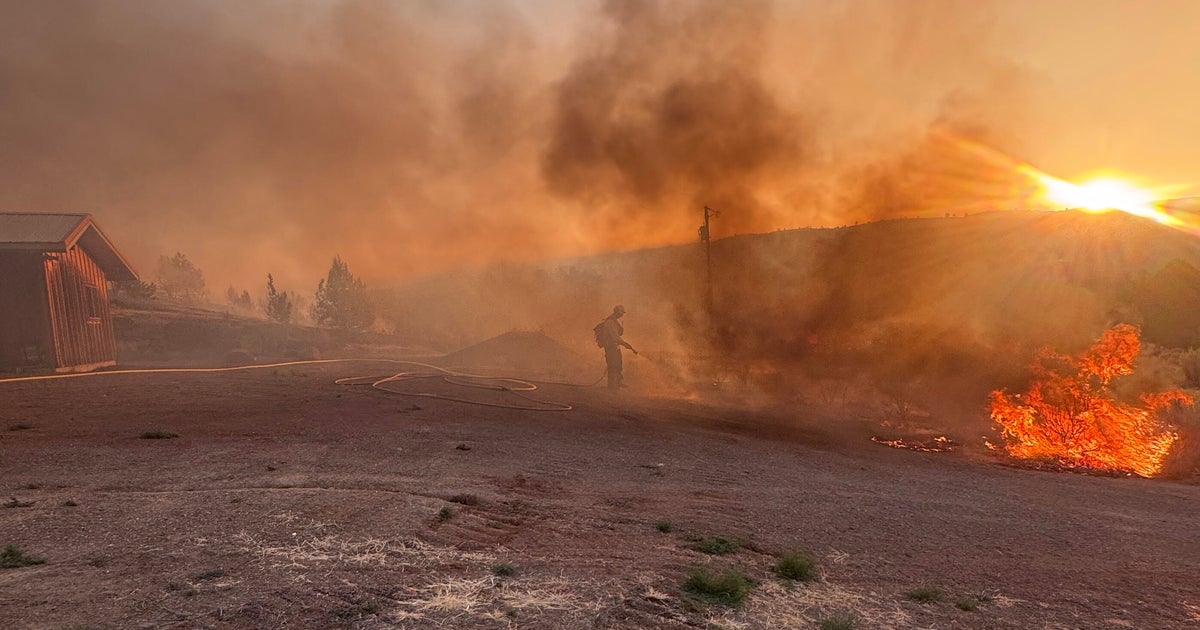
By Emily Mae Czachor News Editor Emily Mae Czachor is a reporter and news editor at CBSNews.com. She typically covers breaking news, extreme weather and climate. Emily Mae previously wrote for outlets like the Los Angeles Times, BuzzFeed and Newsweek. Read Full Bio September 19, 2026 / 8:00 AM EDT / CBS News Add CBS News on Google When Cody Turcotte arrived to fight a wildfire scorching homes in Spokane, Washington, last month, there weren't enough people at the scene to control it. His team of five engines joined just two others that had been battling the blaze alone for hours, as its flames rapidly spread."You're getting embers casting down on the bushes and on the back porch, lighting furniture on fire," Turcotte said. "And you're three people on a fire truck, and you're like, 'How the hell do I protect these eight homes?'"Sixteen hours into that shift, Turcotte said his team hadn't received an update about engines they'd requested earlier for support. At that point, he recalled, their supervisor told them: "Nobody's coming. Keep working." But, later, with houses still burning around them, the team was reassigned to another fire that had broken out nearby. No one else was there to fight it.Other firefighters have described similar circumstances this summer, telling CBS News that a nationwide shortage of resources, including firefighters and equipment, left crews struggling to manage the turbulence of this year's record wildfire season. A member of Turcotte's crew stands in a burning yard while fighting the Old Trails Fire, the first of three wildfires that formed the Spokane Complex Fire in Spokane, Washington, on Aug. 1. Eastside Fire and Rescue "The fires that we're seeing now are quickly becoming large, campaign fires, and they're happening much more frequently," said Turcotte, a firefighter for 17 years. "We're able to respond, but man, we're just running thin, and kind of moving pawn pieces around to try to cover these holes."The blazes his team came up against became known as the Spokane Complex Fire, which destroyed close to 900 structures and seared over 10,000 acres. Officials called it the worst natural disaster in the region's history.Staff shortagesFirefighters have been taxed in part because wildfire activity this year has been severe. But experienced firefighters and fire officials from local, state and federal agencies told CBS News that last year's cuts to the U.S. Forest Service under the Department of Government Efficiency exacerbated the strain. The Forest Service employs many of the nation's wildland firefighters, who specialize in responding to wildfires. Roughly 6,000 people left the Forest Service last year through a mix of terminations and buyouts, shrinking it by about 16%, according to federal employment data reviewed by CBS News. Some of the heaviest cuts fell on core wildland fire states like Colorado and Oregon. A firefighter at the edge of the Rowe Creek Complex Fire in Mitchell, Oregon, in late July 2026. Eastside Fire and Rescue The cuts followed staffing declines in recent years at the Forest Service, which lost personnel to other organizations with better pay and hours, according to multiple current and former firefighters at the agency. And while the cuts last year didn't target frontline firefighters directly, they did hit swaths of administrative employees who could serve as support staff during wildfire operations. Many handled important logistical tasks, Forest Service staffers said, like securing authorizations for equipment, land use and water supplies during wildfires."A person in a non-fire position that holds some kind of fire qualification to be able to support us logistically, that's where we've been having a hard time since DOGE," said Justin Brown, a wildland firefighter based in Nevada. "We're just lacking a lot of those people to be able to surge and come in and stand up an incident management team and give us the support we need to be able to fight the fire effectively." The Rowe Creek Complex Fire, which spread across nearly 400,000 acres in Oregon. Eastside Fire and Rescue The Forest Service is also missing many mid-level managers, like fire engine drivers, engineers, operators and captains, according to several Forest Service employees who asked not to be named out of concern for their jobs. They said those roles are vacant or filled temporarily by less inexperienced staff and last-minute contractors hired on sight for urgent operations. Record wildfire seasonWildfires have burned a record 8.5 million acres in the U.S. so far in 2026, more than ever by this time of year since at least 1983, when the National Interagency Fire Center started tracking.Because of the volatile season, most of the country's firefighters and equipment have been tied up for months, fighting major wildfires or positioned near imminent fire threats, according to the fire center. Firefighters said the setup has stretched inventory as far as it could go, with crews or equipment not always available to fight new fires and teams being pulled from one active wildfire to another.At the season's peak, in August and into early September, about 15,000 firefighting personnel were involved in active wildfire responses nationwide, the fire center said, including federal, state and some international crews.The Forest Service told CBS News that it employed more "operational" firefighters during the peak than it had in five years. It also said it has "expanded the number of non-fire employees qualified to support wildfire response." A firefighter at the site of the Rowe Creek Complex Fire. Brett Deedon/Eugene Fire Department But the agency has acknowledged its shortcomings, too, saying on its website that the 11,745 wildland firefighters it had "onboard nationwide" as of Aug. 17 wasn't "enough capacity to meet the needs of the continuing wildfire crisis." It added, however, that it couldn't support additional hires "with existing infrastructure, funding and other resources."In a statement to CBS News on Sept. 14, the Forest Service said that was "simply an acknowledgement of the reality that wildfire seasons have evolved into year‑round wildfire years.""Even with robust staffing that our budget allows us, the increasing scale and complexity of wildfire activity continues to demand more from all fire agencies," the statement said. "More with less"Whether a wildfire is managed federally or locally depends on where it sparks and how it spreads, but complicated outbreaks require coordination through unified commands, involving the Forest Service, state agencies and local fire districts.Several firefighters dispatched to such incidents this summer described waiting for reinforcements, both crews and equipment, that sometimes never arrived.Blake Miller, a firefighter from Scottsdale who was deployed to wildfires in the Pacific Northwest over the summer, said his crews faced resource scarcities battling large Oregon infernos. "You can put the order in for the resources that you would traditionally need to get certain tasks done. But if those crews or those trucks aren't available, then you just have to deal with what you have on scene there," said Miller. "There were some days that we did more with less, for sure." Firefighters respond to the Autumn Lane Fire, the second of three wildfires that merged into the Spokane Complex Fire in Spokane, Washington, in August 2026. Eastside Fire and Rescue When the Hawk Fire sparked near Reno, Nevada, on Aug. 22, requests for aircraft were repeatedly denied by federal dispatch centers throughout that first day, records show. Requests for Super Scoopers, aircraft that can dump 1,600 gallons of water over an area, and other large air tankers, were rejected seven times on Aug. 22, according to a log of canceled orders that was compiled by the U.S. Forest Service and reviewed by CBS News. The requests were returned with the code "UTF," or "Unable to Fill."And in the week it took crews to contain the Hawk Fire, requests for resources were rejected 45 times, the data showed. The requested resources ranged from airtankers to helicopters, supervisors, equipment managers, tactical support teams, ambulances and more.Days before that, a memo from the National Multi-Agency Coordinating Group, which manages how resources are allocated to wildfire responses, said "resource availability" was "critically low" amid escalating wildfire activity in multiple areas, "with commitments approaching all-time peak levels and intense competition for crews, equipment, aviation, Incident Management Teams, supplies, and other logistical support assets." Claims of delayed, disorganized fire responsesCommunities impacted by the Hawk Fire have criticized the response to it. Brown, the Nevada-based firefighter whose friends and family were in the area at the time of the blaze, said they didn't receive much information from public officials about the threat until almost 24 hours after the fire started.Brown and other firefighters said delayed, disorganized fire responses have become common around the West as staffing thinned since last year's cuts, and as climate change and urban sprawl fuel a changing wildfire landscape."When you add homes and communities and the fire behavior that we've seen over the past decade, it turns into firefighters having to figure out: either we can we have enough time to fully engage the fire and try to stop it on this ridge, or we just have enough time to try and evacuate everybody," said Brown. "And that seemed to be what was going on with the Hawk Fire."Asked at a news conference whether people were evacuated too late, Washoe County Sheriff Darin Balaam said there were "lessons learned." The Hawk Fire fills the air with smoke over northwestern Reno, Nevada, on Aug. 22. Shane Merritt/Associated Press Another firefighter who spoke to CBS News on condition of anonymity due to job security concerns said he watched the fire grow as he waited in a parking lot for four hours with about 100 other responders, before they were deployed to the flaming front. By then, the fire was starting to impact houses, as people were evacuating."It should not have happened the way it did," the firefighter said. "Failure to predict potential outcomes, led to a failure to act, led to a failure to communicate with and evacuate residents before the front hit.""I have no way of knowing the mindset of incident command in that moment, but I can't help but feel like we are failing the public," he said. Kimberly Flores, a spokesperson for Truckee Meadows Fire and Rescue, which led the Hawk Fire response before it became a unified command incident, told CBS News the district is reviewing the Hawk Fire response, which "will provide an opportunity to identify lessons learned and make any necessary changes to strengthen our response to future disasters."U.S. action on wildfire managementThe Trump administration earlier this year sought to streamline wildfire prevention and response by establishing the U.S. Wildland Fire Service through an executive order. About 5,500 firefighters are staffed under the agency, within the U.S. Department of the Interior.But Forest Service employees who spoke to CBS News said its creation has led to bureaucratic hurdles and stoked anxieties over how the reorganization of government fire resources could further chip away at staffing."It's not streamlined," Brown said about the Wildland Fire Service. "Not to say that it couldn't be later, but it feels like it's a rushed product that they're trying to get out there, and there's a lot more logistical concerns that go into that."In a statement, the Wildland Fire Service said it "has strengthened the Department of Interior's ability to respond to wildfires by bringing its wildland fire workforce, resources, and aviation capabilities into a single organization," allowing for more decisive wildfire responses and reducing "administrative barriers that can slow coordination." In: Firefighters Wildfire Nevada Oregon Washington United States Forest Service
Firefighters struggle with staffing shortages amid record wildfire season
Full Article
Original Source
Read the full article at Cbsnews →KhanList aggregates and links to publicly available news content. We do not host full articles from third-party sources. Always verify important information with original sources.