
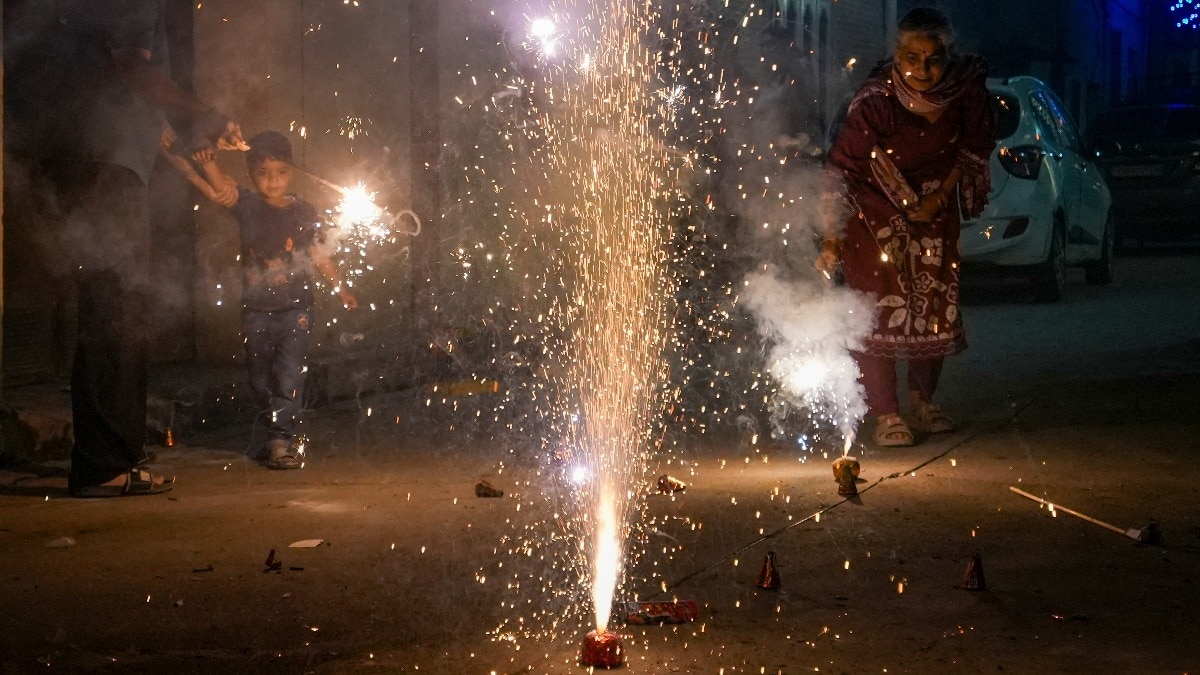
Delhi woke up to a thick blanket of smog on November 9, the day after Diwali, as its air quality remained dangerously poor.Now, an assessment by the Indian Institute of Tropical Meteorology (IITM) has pointed to the biggest contributor to the post-festival pollution spike: firecrackers. People stroll amid a thick layer of smog, a day after Diwali celebrations. (Photo: PTI) Bursting of firecrackers, according to the IITM analysis, accounted for more than 80% of the estimated pollution load during the early hours of Monday, November 9.The finding highlights how fireworks added to an already worsening pollution crisis in the national capital. Delhi's average Air Quality Index (AQI) had climbed to 376 on Diwali, November 8, making it the most polluted Diwali in five years. The situation remained grim the following morning, when the AQI stood at 371 at 10 am, with 14 of the 51 monitoring stations reporting severe air quality. People are seen bursting crackers during Diwali celebrations in Delhi. (Photo: PTI) FIRECRACKERS EMERGE AS BIGGEST POLLUTERAccording to IITM's source assessment, firecrackers accounted for more than 80% of Delhi's pollution load on November 9, while other contributors included secondary organic compounds, which formed 5.8% of the estimated pollution, and vehicle emissions, at 4.4%. A separate assessment of IITM data reported a 71.1% contribution from firecrackers to PM2.5 pollution between 1 am and 9 am.Another estimate on the government's AIRWISE-Delhi portal put the share at 80.2%, but carried a wide uncertainty range. These figures are estimates for a specific period, not a measure of the entire day's pollution. Vehicles move on road amid a thick layer of smog in New Delhi. (Photo: PTI) The impact also continued into Tuesday as pollutants from firecrackers continued to linger, accounting for 29.9% of the estimated pollution contribution between 1 am and 9 am on November 10, according to IITM.CAPITAL'S BATTLE WITH POLLUTIONThe fireworks, however, did not create Delhi's pollution problem on their own.Vehicle exhaust, industrial emissions, construction dust, waste burning and smoke from farm fires in neighbouring states all add to the city's pollution burden, particularly during winter. A commuter moves amid a thick layer of smog as air quality deteriorates in Delhi. (Photo: PTI) What IITM's assessment has done is indicate that stubble burning was not a major contributor to Delhi's pollution load on November 9.Favourable winds on Tuesday helped disperse some of the accumulated pollution, bringing the AQI down to 299 at 4 pm before it rose to 302 by 6 pm.The findings illustrate how a few hours of intense fireworks can worsen air quality in a city already struggling with multiple sources of pollution.- Ends
Firecrackers caused 80% of Delhi's pollution after Diwali, estimates shows
Full Article
Original Source
Read the full article at Indiatoday →KhanList aggregates and links to publicly available news content. We do not host full articles from third-party sources. Always verify important information with original sources.