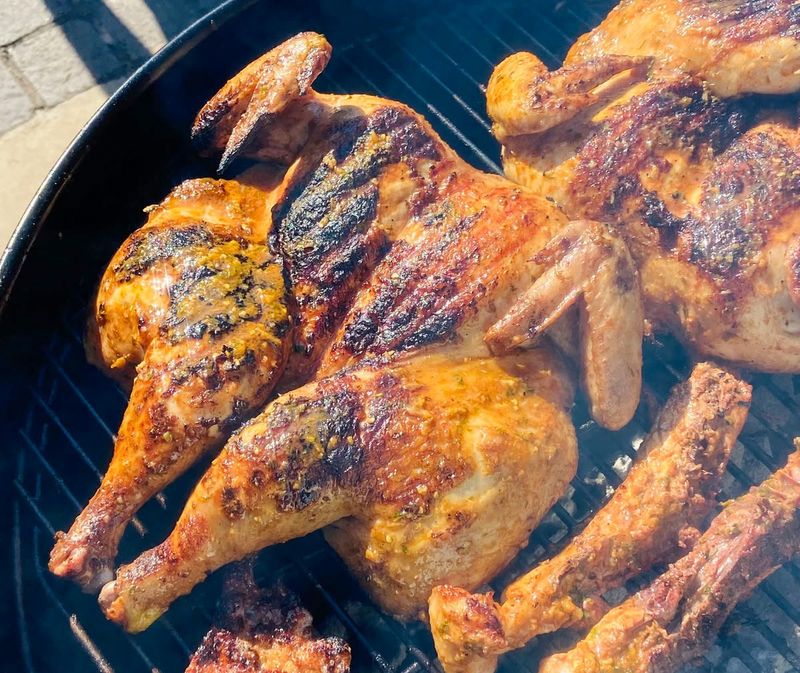
Over the past 50 years, molho de piri-piri (piri-piri sauce) has moved from its Mozambican motherland into the global gastronomic mainstream. This conquest of the world’s many and varied palates is easy to understand.Fusion food long before fusion became a restaurant cliché, it offers us an American chilli naturalised on the southeastern coast of Africa embracing Swahili fermented, spiced hot sauce traditions and the Portuguese proclivity for marinating meat with garlic, lemon and olive oil. Adjustable in strength so that each of us can find our preferred point on the scalding scale, it is distinctive yet sufficiently familiar to be accessible to almost everyone, almost everywhere.Crossing continents and contexts has changed the Afro-Lusitanean taste treasure. An E replacing I in Anglophone markets – piri into peri – is among the more minor mutations. Where once it mostly marinated prawns and chicken, it is now incorporated into everything from mayonnaise and hummus to pot noodles, pesto and pad thai. It has escaped the bottle, becoming a dry seasoning spice sprinkled onto potato crisps, popcorn and peanuts. There are even attempts to introduce it into the sweet side of the store with peri-peri (with an “e”) hot honey and peri-peri centred chocolate truffles.Of course, there are honourable exceptions, but much of this global commercial expansion has happened without acknowledgement of Mozambican provenance or equitable benefit sharing with communities who created the original offering.And none of the recent reconfigurations come close to the spatchcocked splendour of an authentic Mozambican piri-piri chicken. Not merely a meal, this is a full-spectrum sensory immersion. Smell, sound and sight precede taste. Garlic and lemon hissing against heat, chilli blooming into air, fat rendering as smoke-kissed skin catches and crisps.Piri-piri chicken plated. (Photo: Absa Kotsokoane) Then the first blissful bite: amber-hued with flecks of char, a gentle tug, flesh tender but not submissive. Strong, savoury flavour carried across the tongue by olive oil and magnificent meat juices. Gustatory joy reaches no greater height.That is the theory, anyway. Sadly, for every perfect piri-piri chicken there is a substandard, scorched-skinned, slimy-fleshed bird, bloody at the joints and seemingly seething in a rage of raw garlic. Rather than risk any more soul-destroying, malevolent meals, I enlisted Chef Freddie Dias of Annexe Bistro in Blairgowrie, Johannesburg, to teach me how to cook the real deal. In his excellent eatery Freddie favours French fare – think beautiful bouillabaisse and delicious duck liver parfait with buttery brioche toasts – but at home he is the child of Mozambican émigrés Antonio José and the late Maria Elena Dias. The recipe that Freddie made me comes from his mother. It is imbued with all the emotions that accompany such an edible apostolic succession. Mrs Dias passed away relatively recently, and her absence is intensely present as her youngest son cooks.Inheritance extends beyond immediate family into a wider Mozambican culinary context, with terroir-specific traditional knowledge at the heart of the recipe. As Freddie works, every gesture has an almost spiritual sense of muscle memory emanating from ancestral hands. Piri-piri marinade meets the chicken and, right, chef Freddie Dias. (Photos: Absa Kotsokoane and supplied) The transformative actions of acid maceration and light fermentation add to the impression of ethereal co-creation. Dried piri-piri sacana chillies are steeped for two weeks in lemon and/or lime juice, salt and olive oil. In the process, ingredients are altered and reborn. New flavours from old. Freddie has a fancy ferment crock with a one-way valve to let carbon dioxide escape without allowing additional air back in, but I have subsequently had success by intermittently burping my chilli baby in a Consol jar.The internet is full of recipes recommending all sorts of chillies, but it is worth seeking out piri-piri sacana. Just as Champagne must come from its designated region and be made with specific grapes, so too Mozambican molho de piri-piri depends for its unique flavour upon having the right ingredients, grown in the right soil by the right people.The sacana fermenting and, right, the fermented smooth base as Freddie Dias’ mother made it. (Photos: Absa Kotsokoane) The Americas are the ancestral origin of all chillies, but this tiny, ruby-red dagger-shaped landrace chilli has adapted over centuries to south-east African coastal conditions. It is a smaller, hotter, more flavoursome subset of the African Birds Eye chillies that are often available in South African supermarkets. Fresh and dried terroir matters. The Mozambican iteration evolved to suit the sauce. If you ask for them by name do not be surprised if Portuguese-speaking merchants look shocked — the suffix “sacana” translates as arsehole for obvious reasons.The name notwithstanding, piri-piri sacana supplies far more than bum burn. Macerated, fermented, flavours mellow and merge. Ferocious edges round into a fruity, full bodied, perfumed pleasure. Still strong but somewhat smoothed. Fermentation further enhances the already intense citrus sourness that is essential to the sauce’s epicurean architecture.After two weeks, the contents of the fermenting jar are blended and finished with a slosh of Scotch whisky. No one in the Dias household seemed quite sure as to why the whisky was added – beyond “because we always have”. Freddie postulated that it ups the alcohol content and consequently stops the fermentation.The late Mrs Dias used to push the resultant relish through a sieve to create a silky-smooth sauce. Her son prefers to leave it chunky. Either is exquisite. Only a small amount of the concentrated blended base is used in the subsequent marinade. The rest can be kept in the fridge for next time. Believe me, after this you will be making many, many piri-piri chickens. And even if you don’t, the purée is terrific on toast.Pounding the ingredients for the marinade, left, and adding the oil. (Photos: Absa Kotsokoane) Once macerating and fermenting is finished, the next phase is all about introducing a butterflied bird to a marinade made from the above blended base plus garlic, smoked paprika, parsley, salt, olive oil and even more lemon/lime juice. The chicken is left to luxuriate for at least 24 hours. All of the above takes time, so Freddie kindly prepared two chickens. One was placed in marinade the night before, the other he made with me so that I could observe and learn. Later, when we came to eat, the one marinated overnight had a discernibly deeper flavour and was markedly more tender than the teaching tool.The Dias family recipe values flavour maturity in both the slow fermented, macerated chillies and their chosen chickens. Freddie’s father pointed out that the original piri-piri chickens were not the plump, pale, fast-growing broilers used by modern grill chains. They were slow grown, mature, full of flavour fowls with the distinct, powerful taste and potentially tough texture that comes from exercise and the outdoors. The tenderising power of a citrus marinade is essential when dealing with such formidable creatures. A soft, youthful broiler can become acid-softened, slack and dominated by the piri-piri, but a hard-bodied older bird remains recognisably itself even as its muscles are marinated into succulence.While Tozé reminisced about Beira birds so strong that their bones were impossible to chew through, his son chose a middle path: chickens from the Sewe Slabberts regenerative farm – not quite the lean, muscular prize fighters of yesteryear, but sturdy enough to take on a punchy piri-piri.Even after a long lemon/lime bath, well-brought-up birds do not submit politely to a hurried flame. These are chickens that demand slow, controlled cooking over steady coals: turn-turn, baste and repeat. Patience is rewarded. Fat melts, skin blisters and browns, garlic sweetens as it roasts, and braai smoke gathers up equivalent notes from paprika and Scotch.Tozé made Quelimane-style coconut water and whisky cocktails as the birds were brought to the table in an ebullient confluence of tradition, technique, terroir, love, generosity and joy. A jar of mother’s magnificent, strained sauce was served on the side. This was no time for polite picking. It was face-down, elbows-out, hands-on fabulous food. Crisp, smoke-flecked skin; succulent, umami-intense meat glowing with chilli heat lifted by citrus and deepened by garlic, paprika and fire. By the end of the afternoon, my white shirt was splattered, Jackson Pollock-style, with piri-piri sauce.Beyond being deeply delicious, Freddie’s feast was profoundly humbling. As he cooked, generations of knowledge emerged in techniques repeated across time and place until they had become inherited muscle memory. The magnificence of the meal made it easy to understand why this Mozambican taste treasure has travelled so far, but also why so many of its newer incarnations disappoint. Once separated from the relationships, ingredients and accumulated judgement that created it, piri-piri frequently flattens into generic red, blunt burn.It doesn’t have to be this way. If piri-piri were accorded the same protection that the French give their great regional foods, keeping it connected to the context that gave it life would be recognised as serving the common good. Acknowledgement and an equitable share of the value generated by its worldwide success could support growers who maintain the piri-piri sacana crop, cooks and producers who preserve techniques, and communities keeping the traditional knowledge alive. These are not acts of generosity, but enlightened self-interest for anyone who wants piri-piri to remain worthy of the name.Elena Dias’ RecipeChef Freddie Dias’ piri-piri chicken. (Photo: Absa Kotsokoane) Step 1: Piri-Piri BaseIngredients500g dried piri-piri sacana chillies2 litres lemon and/or lime juice50g sea saltExtra-virgin olive oil to cover50ml Scotch whisky (Freddie says “Not your dad’s finest, but one you are still happy to drink on a rainy weekday evening.”)MethodWash the chillies to get rid of any dust or leaves.Place the chillies in a sterilised glass jar with a well-fitting lid or a fermentation crock.Add the juice and salt.Top up with just enough olive oil to cover the chillies.Keep the jar at room temperature but out of direct sunlight.Allow to ferment for 2 weeks.After two weeks, place the whole contents of the jar in a blender and whizz until smooth.Freddie’s mother then passed the purée through a potato mouli to achieve a super silky, seed-free liquid. Freddie leaves it slightly chunky. Either works for the steps ahead.Once the piri-piri base is blended, add the whisky.Step 2: Piri-Piri MarinadeIngredients50g garlic, finely chopped or crushed15g sea salt25g fresh parsley, finely chopped50g piri-piri base (see step 1)500ml lemon and/or lime juice20g smoked paprika200ml extra virgin olive oil1 large chickenMethodCombine the garlic, sea salt and parsley in a mortar and pestle and pound together. Add the piri-piri base, lemon juice and paprika.Whisk in the olive oil to loosely emulsify it. Adjust seasoning if necessary. Most of this sauce will be used as marinade but set some sauce aside to use for basting – do not use the marinade that has been in contact with raw chicken to baste.To butterfly the chicken, place the bird breast-side down on a board. Using kitchen scissors, cut along both sides of the backbone and remove it. Flip the chicken over, press firmly on the breastbone to flatten so it lies evenly. Pat dry with paper towel.Put the chicken and the backbone (which will make a surreptitious snack for those working the braai) into the marinade and massage well. Cover and rest for 24 hours.To CookCook only once the flames have died down and the coals are glowing under a light coating of ash. The heat should be steady rather than fierce. When ready to cook create a two-zone fire. Bank some of the hot coals on one side of the braai, leaving the other side with moderate indirect heat. The cooler section is for most of the cooking and the hotter area is for a final finish.Coat the braai grid lightly with non-stick spray (this will stop the skin from sticking) then lift the chicken from the marinade and let the excess drip off. Place the butterflied chicken over the cooler side of the braai, skin facing upwards and the legs pointing towards the hotter coals. Close the lid, if the braai has one. Cook gently for about 20 minutes, basting and rotating the bird occasionally so that it cooks evenly. Do not turn it over yet. Keep the breast over the cooler area and the thicker legs nearer the heat.Flip the chicken and cook for about 10-15 minutes, still mostly over moderate heat. Watch closely and move it away from any flare-ups caused by dripping fat. Baste with piri-piri sauce regularly until cooked through – at least another 15-20 minutes.You will know when the chicken is cooked through by checking the thickest parts – juices should run clear. A medium-sized butterflied chicken usually takes roughly 45-60 minutes, depending on its size and the strength of the fire.Finish over hot coals skin side down until the skin is crisp and slightly charred.Rest the bird for about 10 minutes before carving.Eat and live happily ever after. DM
FIRE POWER: The secrets of piri-piri, from a chef who knows how
Full Article
Original Source
Read the full article at Dailymaverick →KhanList aggregates and links to publicly available news content. We do not host full articles from third-party sources. Always verify important information with original sources.