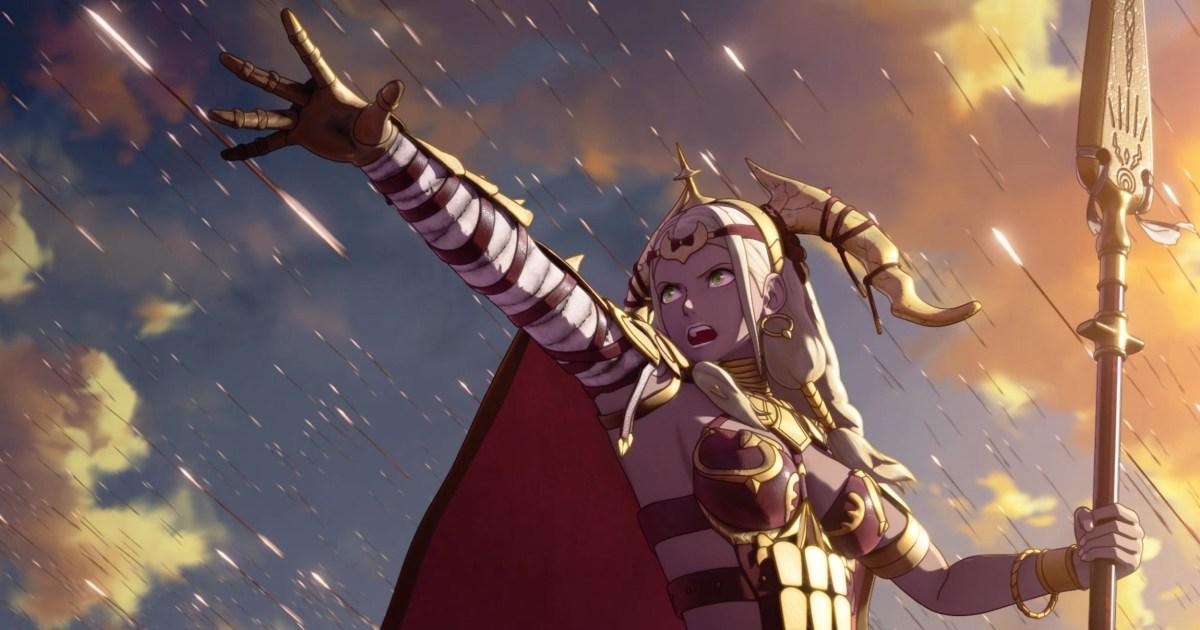
Fire Emblem: Fortune’s Weave – epic seems like an understatement (Nintendo) The new Fire Emblem for Nintendo Switch 2 is not what you’d expect in terms of story but there’s a lot of other welcome surprises, beyond just the plot. We admit that we were amongst those that questioned why a new Fire Emblem game, that on the face of it didn’t look very different from the last few, was coming out so early in the Switch 2’s career. However, Nintendo’s priorities for the system have been baffling since the start and we’re not getting into that again here. What we will say, is that while Fire Emblem is not our favourite Nintendo franchise (we don’t dislike it but we definitely prefer sister series Advance Wars) this is by far the best entry we’ve played since the 3DS era. What was odd about this hands-on preview is that it reveals a whole side to the game that was only hinted at by the recent Nintendo Direct. You might have wondered what was going on with the laser guns and the talk of a ‘true protagonist’ but the first hour of the game is a full-on sci-fi adventure. We’re not going to spoil too much (and to be honest we’re not sure we fully understand it all, since we’re yet to finish the game) but rather than the usual fantasy medieval setting of the series there’s suddenly not just laser pistols but giant laser turrets and what’s implied to be artificial beings and crashed spaceships. We honestly have no idea where any of it is going – and after the prologue that side of things barely comes up again in the 10 or so hours we’ve played – but it is a drastic change of pace for the series that also brings with it some surprisingly deep questions about religion and faith. It also has the usual Saturday morning cartoon style dialogue and paper thin character work of the series, so there’s a lot that is familiar in Fortune’s Weave, but so far we’re very intrigued. We were allowed to play up to Chapter 5 of Part I of the game, but across each of the four main playable characters. We’ve no idea how many Parts there are, so we’re not sure how far into the game we got, but our best guess is not very. There are faults to point out with Fortune’s Weave, but value for money is definitely not one of them. Not just in the sense that it seems to be very long but because it’s absolutely stuffed to the gills with features, content, and different plotlines. Sometimes to its own detriment, given how much is thrown at you at once. We can’t be too critical of a game that’s trying to do so much though and while there were still some details we were unclear on, even hours into the game, the most important thing is that it’s all very enjoyable and engrossing – more so than 2023’s divisive Fire Emblem Engage and 2019’s Three Houses – which many fans seemed to love but we were more critical of. Expert, exclusive gaming analysis Sign up to the GameCentral newsletter for a unique take on the week in gaming, alongside the latest reviews and more. Delivered to your inbox every Saturday morning. Three Houses is definitely the template for this game and while Fire Emblem games (this is the 18th mainline entry) are rarely direct sequels, with many set in different or alternate worlds, this one takes place in the same universe, with many references to the continent of Fódlan and its politics. At least so far, that’s little more than a story detail, so you don’t need to have played Three Houses to appreciate this new game, but the two titles do have a lot in common in terms of their semi-freeform nature and the option to control multiple characters with their own stories. In Three Houses you had three characters to choose from but could only play through their stories one at a time, from start to finish. In Fortune’s Weave you have four characters and you can flit between any of them relatively easily. This is because the true protagonist, revealed in the Nintendo Direct, travels back in time as a dove (stay with us) in order to change the fates of the four main characters, who are the only ones that can save the world back in the present. Although there’s a similar structure to each storyline, with many of the same sidequests, other elements, and even some gameplay mechanics, are unique (or maybe everyone get access to everything by the end but, like we said, we didn’t get that far). Each protagonist has a magic weapon or item, that’s tied into the central plot, with Leda the musician able to summon demons with her guitar, Queen Theodora has a magic arm that is due to send her mad in 10 years, Cai the Harry Potter-esque child protagonist has a magic gem stuck in his palm, and Dietrich the devastatingly handsome edgelord wields a sword with a storied past. There are multiple fathers to avenge across all the protagonists (Nintendo) The first two or three chapters are all very different for each of the characters, but eventually all roads lead to the capital city, where a months long fighting tournament is going on. Everyone has their own spurious reasons for wanting to join in, with the event overseen by various gods (well, mostly goddesses) who are portrayed as relatively normal looking humans. The whole setting has a clear Roman influence, including the fact that the gods are not omnipotent but instead have their own machinations and petty vendettas to pursue. There’re so many extraneous systems and complications that it’s easy to lose sight of the combat at the core of Fortune’s Weave, which is fundamentally the same as every previous game. You take part in turn-based battles, on a grid-based map, moving characters and attacking in what is, in terms of controls, a very simple system. The tactical considerations are vast though, especially as the game diminishes the rock, paper, scissors relationship between different weapons. Arrows are still best against flying creatures, and some units are more vulnerable to magic than others, but the considerations are no longer so black and white. Weapon degradation has always been a thing in Fire Emblem but here it’s more important than ever, since using a weapon damages it slightly, but so does using a combat art to perform a more powerful move. The lead characters also all have a unique magic move that varies from debuffing enemies to distance or area of effect attacks. It’s a well-constructed system of rules and mechanics that outwardly seems very simple but reveals increasing depth the more you play, especially as you open up more class types. Battles are impressively fast-paced (Nintendo) What’s also impressive is how snappy the combat is, with even battles involving large numbers of enemies never dragging on. Traditionally, the Fire Emblem series has always featured permadeath for its characters but while that is an option here we wouldn’t advise turn it on. Characters never actually die, as they still turn up in cut scenes, and it’s just that you can’t take them into battle anymore – as they’re quietly removed from your roster with zero fanfare. Luckily, you can switch permadeath on and off by replaying the prologue, which doesn’t take long. Nevertheless, the idea that you need a constant stream of new recruits is key to the game and you’re constantly running into potential new allies while you explore the capital city. After you play a few of the other characters you realise most of these people are already their allies, and that’s why it’s so hard to recruit anyone but a few token mercenaries, but technically you can do it – via a bizarre process that involves giving them presents and then raising your renown enough to impress them. Like Three Houses, the game gives every impression that it wants to be a secret dating sim but for some reason holds back, instead opting for a sort of sub-Persona style approach in terms of strengthening the bonds between allies, both on and off the battlefield. It’s all very silly and plays out like a low-rent anime, complete with very basic voice-acting, where you can tell only a very small number of actors are doing all the voices. A good script would really elevate the game, either turning it into full-on camp (most of the characters are already dressed like they’ve just stepped off a carnival float) or embracing the more serious themes the game flirts with. As it is, the tone is all over the place, with a lot of low level swearing and more than one of the protagonists executing prisoners for no good reason. And yet a couple of minutes later they’re joking and laughing, and running around town trying to work out whether a potential ally will help you slaughter a cadre of bandits if you give them a bunch of flowers. Pleasingly, though, you can keep that sort of thing to a minimum, as the tournament creates a structure where you’re literally given free time – several in-game weeks – between battles to do whatever you want, whether it’s going out to explore the world map (which is blank at first, until you start travelling its roads), doing sidequests, or training up teammates. This is where many of the characters’ unique abilities come to the fore, whether it’s Queen Theodora’s option to recruit and use battalions of soldiers or Dietrich’s ability to detect hidden foes with his sword. Many of the story quests take place outside of the capital and sometimes they involve exploring third person dungeons, which is an odd new feature for the game, where combat is resolved in something resembling a Dragon Quest style role-playing battle, with both sides lining up politely opposite each other. Weirdly, you can’t control which enemy you attack, and it always seems very easy, but since it’s also sometimes used outside of dungeons, perhaps it’s a system that evolves as the game goes on. Like we said, the game is absolutely stuffed with ideas and mechanics and they’re not all going to be hits – or at least not necessarily at first. Even so, we enjoyed Fortune’s Weave a lot more than we expected to, and certainly a lot more than the last two games, even at this relatively early stage. We’re eager to play more too, because if this is only Part 1 we can’t wait to see what happens next. Formats: Nintendo Switch 2Price: £58.99Publisher: NintendoDeveloper: Intelligent SystemsRelease Date: 17th September 2026Age Rating: 7 The open world capital has lots of secrets (Nintendo) Email gamecentral@metro.co.uk, leave a comment below, follow us on Twitter. To submit Inbox letters and Reader’s Features more easily, without the need to send an email, just use our Submit Stuff page here. For more stories like this, check our Gaming page. Arrow MORE: Games Inbox: When will The Elder Scrolls 6: Sentinel be released? Arrow MORE: Hogwarts Legacy 2 officially announced by Warner Bros. but there’s a catch Arrow MORE: Ghost Of Yōtei story DLC and roguelike mode coming in October reveals Sony GameCentral Sign up for exclusive analysis, latest releases, and bonus community content.
Fire Emblem: Fortune’s Weave preview – breaking the formula with a sci-fi twist
Full Article
Original Source
Read the full article at Metro →KhanList aggregates and links to publicly available news content. We do not host full articles from third-party sources. Always verify important information with original sources.