
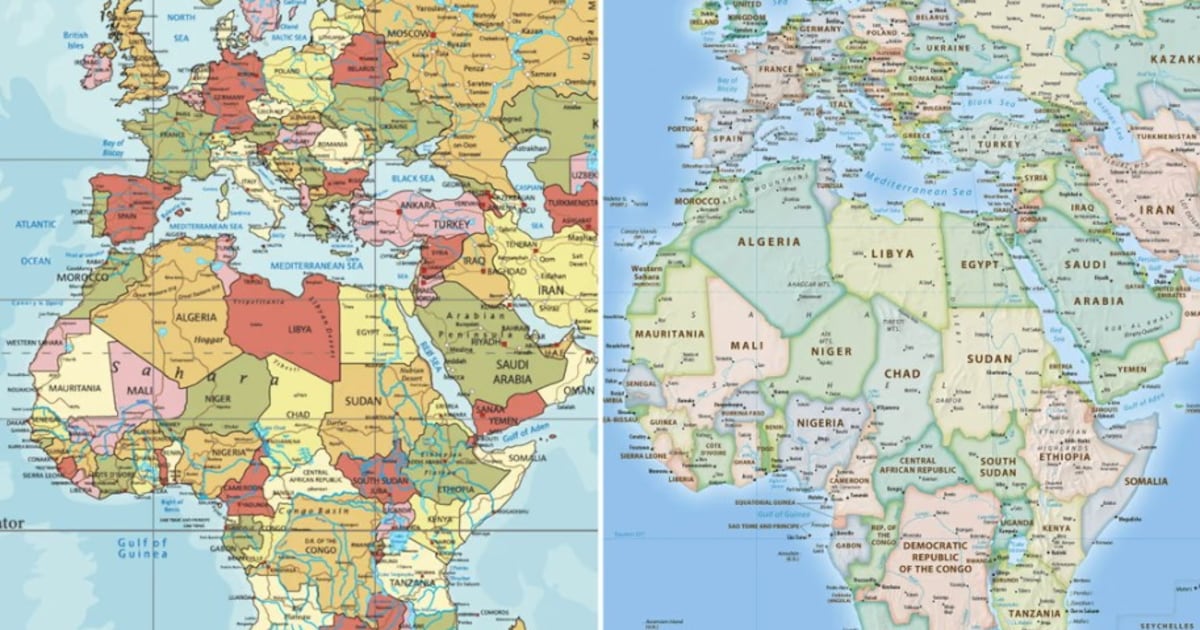
You may have noticed that Ireland just got a lot smaller. The United Nations has formally endorsed the Equal Earth map that corrects the distortions of the one we’ve all used for centuries. Among these misrepresentations was the bigging-up of the Emerald Isle. Ireland is now being brought down to size.For 500 years, the atlas represented the globe in two dimensions by using the Mercator projection. It shows the northern hemisphere much bigger than the southern, and the western continents far more prominent than the eastern. As a consequence, it imprinted on our brains an inflated notion of Ireland’s place in the world. It gave us notions.On this old map, for example, Ireland looks about two-thirds the size of Madagascar. Ireland is 84,421sq km. Madagascar is 587,041sq km – seven times our size. Which, on the new map, is pretty much how it looks. But this shift in perspective is not just a matter of relative scale. It’s about position. The Mercator map has us slap bang in the middle of the planet. On the Equal Earth map, Ireland looks a lot more northerly and a lot less central. Because it gives a truer picture of the size of the southern hemisphere, it pushes Ireland upwards, much closer to the fringes of the Arctic. READ MOREWhich rather inconveniently diminishes our global brand. In 2017, the then Taoiseach Leo Varadkar featured on the cover of Time magazine with a bold quote from the interview inside: “An island at the centre of the world.” His message was that “One hundred years ago we were an island on the periphery of western Europe. In the next hundred we will be a nation at the heart of the common European home we helped to build; an island at the centre of the world.” This image was taken up, in particular, by IDA Ireland. Ironically, this topographical narcissism was validated, not just by the visual trick of the Mercator map, but by the legacy of British imperialism. Britain’s long life as the dominant world power made its central position on the Mercator map look like a fact, not of mere geography, but of God-given historic destiny. This idea was formalised in time as well as space. In 1884, the Prime Meridian Conference set the point of zero-degree longitude at the Royal Observatory in Greenwich, making London the point of origin from which both global travel and global time zones deviate.And if Ireland wasn’t precisely at this centre, it was just a shade off it. Ireland, too, could be the fixed point in a series of concentric circles. In a Portrait of the Artist as a Young Man, James Joyce’s alter ego Stephen Dedalus, a child growing up at the height of the empire, writes his address in his copybook: “Class of Elements Clongowes Wood College Sallins County Kildare Ireland Europe The World The Universe.”We left the empire but did not depart from this mindset. On the back of my brick-coloured school copybooks, full of compound interest, irregular verbs and days at the seaside, was a map of the world. At its centre was Ireland, and arcing out of Ireland like shooting stars were lines leading to Australia, North America, Argentina, Africa − the contours of a spiritual conquest that had begun in 1802 when Edmund Ignatius Rice founded the Christian Brothers in Waterford. Shining over it all was the radiant five-pointed star of the Brothers’ logo.This was our empire, our answer to the British maps of the world in which the colonies glowed scarlet in every continent, while more unfortunate countries skulked in dull and watery hues. And it’s remarkable how persistent this idea of a spiritual empire has been, from Éamon de Valera’s belief that Ireland was a beacon to a fallen world to Varadkar’s claim in 2017 that: “I would like Ireland to become what Michael Collins described as the shining light unto the world.”Yet this exaggerated self-image masked profound uncertainty about where Ireland belongs. Myles na Gopaleen’s map of Ireland in An Béal Bocht has Corcha Dhuibhne much closer to Springfield, Massachusetts, than to Dublin – which in a way, it was. In 2000, Mary Harney, as tánaiste, posited that “Geographically, we are closer to Berlin than Boston. Spiritually, we are probably a lot closer to Boston than Berlin.” Postcolonial intellectuals, meanwhile, liked to suggest that Ireland was really part of the Third World and therefore not even in the northern hemisphere. Thus, on the one hand, Ireland could be imagined as the fixed centre of the world and, on the other, as Laputa, Jonathan Swift’s flying island that could land here, there and everywhere. In particular, of course, we have a continuing uncertainty about whether we are an island just off Europe or just off North America.[ Where is the next ‘best city in the world’? (And sorry, it’s not in Ireland)Opens in new window ]The hyperbole and the anxiety are symptoms of the same neurosis. Our mental geolocation devices have been overloaded, trying to get a fix on where we are in relation to Christendom, empire, the Celtic world, Europe, America, the diaspora, the Missions, the international community. It was easier to take refuge in the pompous swagger of a fantastic Hibernocentric world.[ Paul Gillespie: If the population of the world lived like the Irish, we’d need 3.3 Earths to accommodate usOpens in new window ]Before Galileo, there was a terracentric universe – the sun and all the planets revolved around Earth. Then there was a heliocentric universe – everything revolved around our sun. And then there was a centreless universe in which Earth is merely one tiny rock orbiting one of an endless number of suns. Similarly, our Hibernocentric world is being replaced by one in which the whole idea of a centre is radically subverted.[ In a Word ... PopulationOpens in new window ]As, indeed, it should be. A multipolar world is one in which even the great powers can no longer claim to be the centre of all things. The Equal Earth map shows us not just where we are but who we are – a small but still visible fragment of the human mosaic, a necessary piece of the great jigsaw puzzle of life on a precarious planet.
Fintan O'Toole: The new map of Earth is a wake-up call for Ireland
Full Article
Original Source
Read the full article at Irishtimes →KhanList aggregates and links to publicly available news content. We do not host full articles from third-party sources. Always verify important information with original sources.