
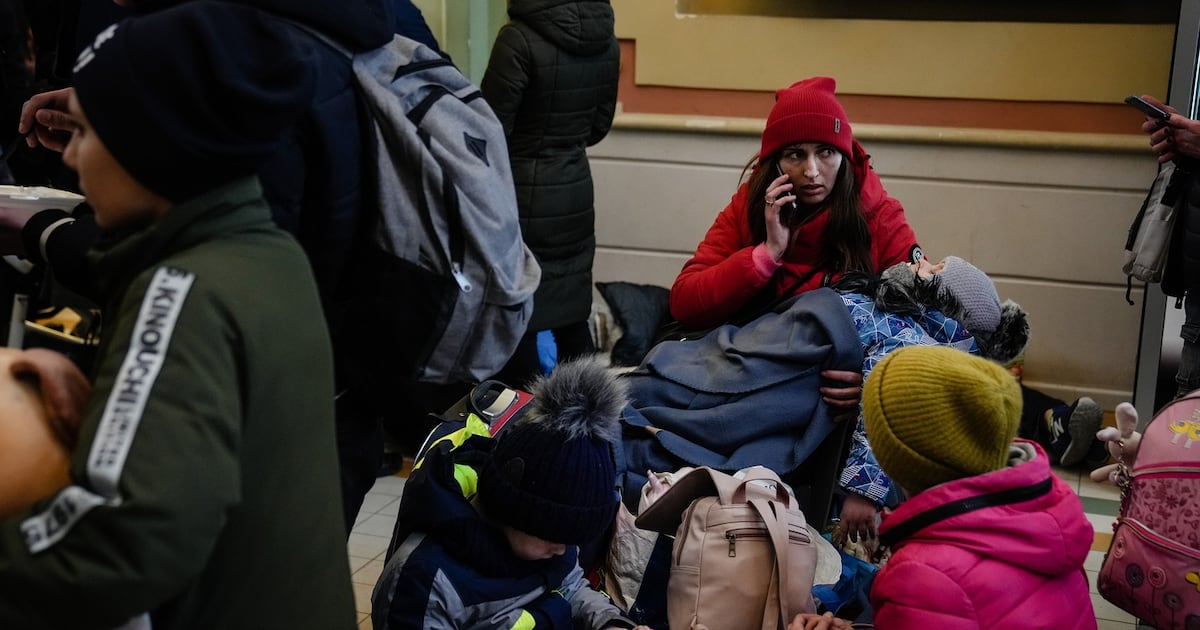
As the old song doesn’t quite have it, compassion for Ukrainians is a treasure when first it’s new. “But as love grows older, love grows colder/ And fades away like the morning dew.” The State loved our Ukrainians, but it has gone awfully cold on them. Enthusiasm has dribbled into ennui.I remember listening to Morning Ireland in March 2022, a month after Russia’s full-scale invasion of Ukraine. Then-minister for agriculture Charlie McConalogue was talking about how Ireland was going to respond to the consequent refugee crisis. We would, he said, take in as many as 200,000 people.At that point, my heart sank. This was, evidently, an Irish paroxysm of enthusiasm, an uncontrolled emission of bonhomie and affability – entirely sincere and entirely unreal. Everyone knew Ireland wasn’t going to take in 200,000 Ukrainian refugees for the simple reason that it couldn’t. That’s the population of Limerick and Galway cities put together. Ireland had – and has – a huge housing crisis and almost every aspect of public provision, from healthcare to transport, is under massive strain. READ MORESo if the Government was saying that it was going to take 200,000, you just knew that this was not a plan or a proposition. It was an expression of our self-infatuation with our image as the world’s most compassionate nation. The not-very-hidden subtext was: aren’t we a lovely people all the same?To be fair, Ireland did take about half the fantastical number projected in the immediate aftermath of the invasion. (About 120,000 came here at some stage and approximately 84,000 have stayed.) And Irish families and communities responded not just with heartfelt generosity but with real practical help.Some of this response was and is almost miraculous. I spend most of my time these days in the small village of Ballyvaughan in Co Clare and I attend the medical centre there. The village has a population of 361 people. A study by the University of Limerick’s school of medicine found that between March 22nd, 2022, and February 22nd, 2024, the Ballyvaughan medical centre acquired 491 Ukrainians as new patients.[ Ireland’s refugee hotels: ‘We have more Ukrainians than Irish people in Ballyvaughan now’Opens in new window ]They have high levels of medical need – they required 3,551 consultations. About a quarter of them suffered hypertension and/or cardiovascular disease. There are also high incidences of depression and (perhaps because of proximity to Chernobyl) thyroid problems.How could a small medical centre in a small rural village possibly cope with this influx of demand from traumatised people who have been violently displaced from everything they know? The answer is: magnificently. I’m in awe of the way the staff at the centre have managed to take the strain, integrating Ukrainian medical practitioners, treating the refugees with dignity and compassion and – just as importantly – avoiding the creation of a local narrative of the natives being “swamped”.And this same spirit of practical fellow-feeling has been evident all over the country, in schools and sports clubs and churches and community organisations – and especially in homes. As of last February, close to 19,000 Irish families were hosting nearly 44,000 Ukrainians in their own homes. Even without the fantastical numbers projected in 2022, the scale of this local effort has been remarkable. It’s been characterised not by virtue signalling, but by bloody hard work. And – though this may be part of the problem – it has been heavily concentrated in the west of Ireland.In Jim O’Callaghan’s Dublin Bay South constituency, Ukrainian refugees currently make up less than half of 1 per cent of the population. Where I am writing from, in north Clare, they make up more than 5 per cent. In Glenties, it’s also 5 per cent; in Connemara 3 per cent; in Kenmare an extraordinary 7 per cent. [ ‘We are abandoned’: Ukrainian family with permission to stay but nowhere to goOpens in new window ]So it’s mostly the people of small rural towns and villages on the western seaboard who have made this thing work. They’re the ones who have salved the nation’s conscience. Taking in refugees is Ireland’s contribution to the European response to Vladimir Putin’s war of aggression – and it’s the west that has been most awake to it.But Dublin officialdom is now bored with it all. Emotional spurts don’t sustain themselves. The war of attrition has gone on too long. Outrage and empathy have both faded away like the morning dew.It makes sense that the Government should gradually reduce the overall level of supports for Ukrainian refugees. Just over 30,000 of them now have jobs in the Irish economy, so they’re able in broad terms to support themselves. It’s worth noting, however, that most of them are employed in jobs that don’t match their qualifications: they have mean weekly earnings of just €573. That doesn’t go far in the Irish housing market.But there are also very large numbers of children (33,000 under 19) and of older people (11,349 over-65s). The children need to stay where their schools and friends are. The older people need to stay where the medical centres have Ukrainian-speaking staff who, literally, know where they’re coming from.[ ‘Whatever Trump and Putin agree, we’ll fight the invaders’: Inside the dugouts powering Ukraine’s drone warOpens in new window ]O’Callaghan, however, seems hell bent on phasing out all accommodation supports for the refugees. The budget allocation for this purpose has been slashed from €1.16 billion in 2024 to €606 million this year to €177 million for 2027.In particular, O’Callaghan is ending the accommodation recognition payment for private hosts of Ukrainian refugees by the end of next March. The 40,000 people living in private homes have been told to make their own arrangements – which is to say, find a place to rent in rural or small town Ireland. In Co Donegal alone, we are talking about more than 5,000 people being thrown on to a vastly overcrowded rental market. How does that make any sense, even in fiscal terms?[ ‘I feel broken’: Ukrainians in Ireland face an uncertain futureOpens in new window ]But there is an underlying logic: the inverse relationship between hyped-up gestures of infinite bounty and real, long-term commitment. Ukraine’s fight for survival is now one long, monotonous note in the background noise of the global polycrisis. The very success of local communities in coping with the influx of refugees has made their presence a political non-issue. No success must go unpunished.
Fintan O'Toole: Dublin officialdom virtue-signalled about Ukraine. People in rural Ireland did the work
Full Article
Original Source
Read the full article at Irishtimes →KhanList aggregates and links to publicly available news content. We do not host full articles from third-party sources. Always verify important information with original sources.