
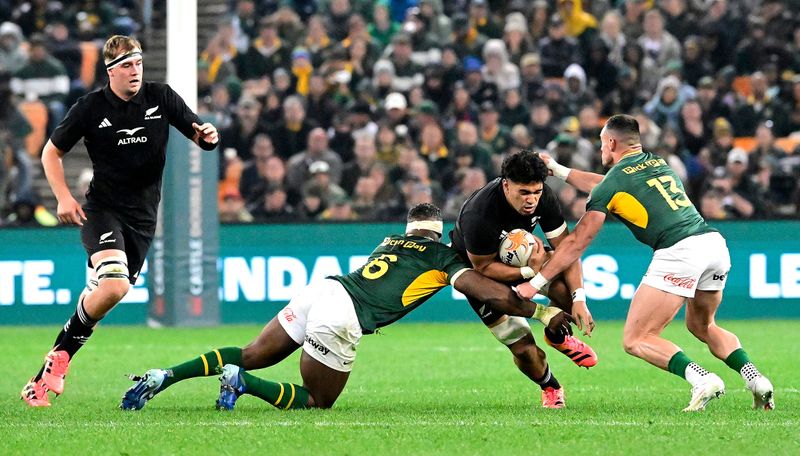
Reaching the top of the game is one thing, staying there is another proposition altogether and the Springboks must keep finding ways to fuel their drive to stay at the summit of rugby.There are proven ways of doing this such as refreshing the playing squad, bringing in new coaches with new ideas and creating new goals.The Boks have done all these things since winning Rugby World Cup 2023, just as they did that after winning Rugby World Cup 2019.And they’ve worked as gameplans have evolved and the quality of the playing group has deepened through constant tweaking.All these aspects matter over a medium and long-term outlook, measured over months and years.But when it comes to winning crucial one-off matches, such as Saturday’s third Test against the All Blacks in the Greatest Rivalry series, the difference is often down to something more intangible than a gameplan and a long-term strategy. Bok No 8 Jasper Wiese carries into contact with All Blacks centre Jordie Barrett (left) and wing Will Jordan tackling him. (Photo: Sydney Seshibedi / Gallo Images / Getty Images) Tapping into emotionRugby, perhaps more than any other sport, is always an internal battle between head and heart. It’s a game of such physicality and raw, ruthless power that it requires a unique physical courage to compete at any level, but especially at the top end of the sport.Every collision has the potential to end a career, or worse. And there are upwards of 200 collisions per game, placing unique demands on the body and mind.Professional players must constantly strike a balance between playing with emotion, by producing extraordinary physical feats through sheer willpower, while also carrying out tactics in a calm and calculated way in the middle of the mayhem.And often, in tight games when the technical difference between the teams is marginal, it comes down to mining just a little deeper into that internal well of resolve.There has been almost nothing to choose between the Boks and All Blacks in this series. They have contrasting styles of play, but in terms of the scoreboard it has been tight.Springbok coach Rassie Erasmus. (Photo: Lefty Shivambu / Gallo Images) Springbok coach Rassie Erasmus is a master at directing the players’ thoughts inward, to find their purpose beyond being good rugby players.In 2019 it was personal – about each player producing his best to acknowledge where he had come from and those who had helped him reach that point. It resonated with the players. It gave them a greater sense of purpose.In 2023, there was another narrative – of giving hope to South Africans. Against the backdrop of huge unemployment, rolling blackouts and civil unrest in the two years preceding RWC 2023, Erasmus and Jacques Nienaber gradually built up the “hope” narrative.The Boks weren’t trying to win the World Cup for themselves as they had done in 2019, they wanted to win it for ordinary South Africans.For SowetoAnd on Saturday, before the third Test of the Greatest Rivalry series, Erasmus and captain Siya Kolisi found another story to inspire the team.Forget the fact that the FNB Stadium isn’t technically in Soweto, its proximity to the area was enough for the Boks to find a hook to give them purpose in the must-win clash.Given Soweto’s place in South Africa history, a clash 3km away featuring the Springboks and All Blacks was always going to have some cultural and political significance. And Erasmus and Kolisi used the opportunity to give the team just a little more fuel.“I was unbelievably emotional today [Saturday] because I wanted us to come to Soweto and take it to the people, and then I thought when we got here, ‘They don’t have the money to come into the stadium,’ and then we had a chat about that,” Erasmus said.Perhaps the next Bok fly-on-the-wall documentary will reveal how emotional that “chat” was, but it would have been special. Bok skipper Siya Kolisi led the charge against the All Blacks at FNB Stadium during the third Test. (Photo: Floris van Schouwenburg / Gallo Images / Getty Images) Kolisi echoed Erasmus’ words, as he basked in the glow of the 29-24 win and going 2-1 up in the series.“Driving through Soweto, seeing how the kids were sprinting to come see the bus, like they can’t afford to come and see us,” Kolisi said. “But seeing that and understanding the history that has happened here in Soweto – people fought for me to be able to sit here, for us to be here today.“That’s why we wanted the game here, and we wish more people could come and see the game, but it was encouraging to see the kids just chasing the bus on the way and waving at us, and that’s really special, and that’s [who] we play for.“Not only the ones that can afford [tickets], but also every South African, and the way we had to fight today. That’s what made it even more special.“We are really grateful that we came here, and hopefully in the future when we come back here again, more people from here can come in and get to watch us play.”Bok centre Jesse Kriel scored a great try against the All Blacks during the third Test. (Photo: Sydney Seshibedi / Gallo Images / Getty Images) Work to doWhile the Boks were able to tap into that resolve needed to win the match when they turned the screw in the last quarter, the series has also highlighted some areas of weakness that must be addressed.A try count of 13-8 in New Zealand’s favour over three Tests shows that the Boks’ once watertight defence is leaking.All Blacks captain and No 8 Ardie Savea scores his second try in the third Test. The All Blacks scored 13 tries in three Tests in South Africa. (Photo: Floris van Schouwenburg / Gallo Images) Admittedly, the All Blacks’ attack has been breathtaking – their handling, speed and precision is truly jaw-dropping at times. No other team would’ve lived with them.Even so though, the Boks will be looking for ways to mitigate against conceding so many tries.The All Blacks would seldom have scored four tries in back-to-back games and lost both, as they did in Cape Town and Soweto, but that’s what happened because the Boks scored seven tries of their own over those two matches.Besides shoring up the defence, the Boks showed that when they decide to attack, as they did in the third Test, they can ask more uncomfortable questions for the opposition to answer.Flyhalf Manie Libbok unlocked the Boks’ attack when he came on. Here he leaves All Blacks centre Quinn Tupaea in his wake. (Photo: Johan Orton / Gallo Images / Getty Images) Manie Libbok’s early introduction to the match last weekend after Cheslin Kolbe was injured, saw the Bok backline purr for the first time in the series.The Boks relied more on their set piece and their direct running over the bulk of the series, but in Soweto two of their four tries were scored from ambitious wide attacks.There is something in that for the coaches to ponder, although tight games are always going to come down to firstly doing the fundamentals well.And of course, finding a meaning greater than winning or losing to fuel their charge. DM
FINDING PURPOSE: Boks drew on deep well of resolve and perspective to fuel another victorious moment
Full Article
Original Source
Read the full article at Dailymaverick →KhanList aggregates and links to publicly available news content. We do not host full articles from third-party sources. Always verify important information with original sources.