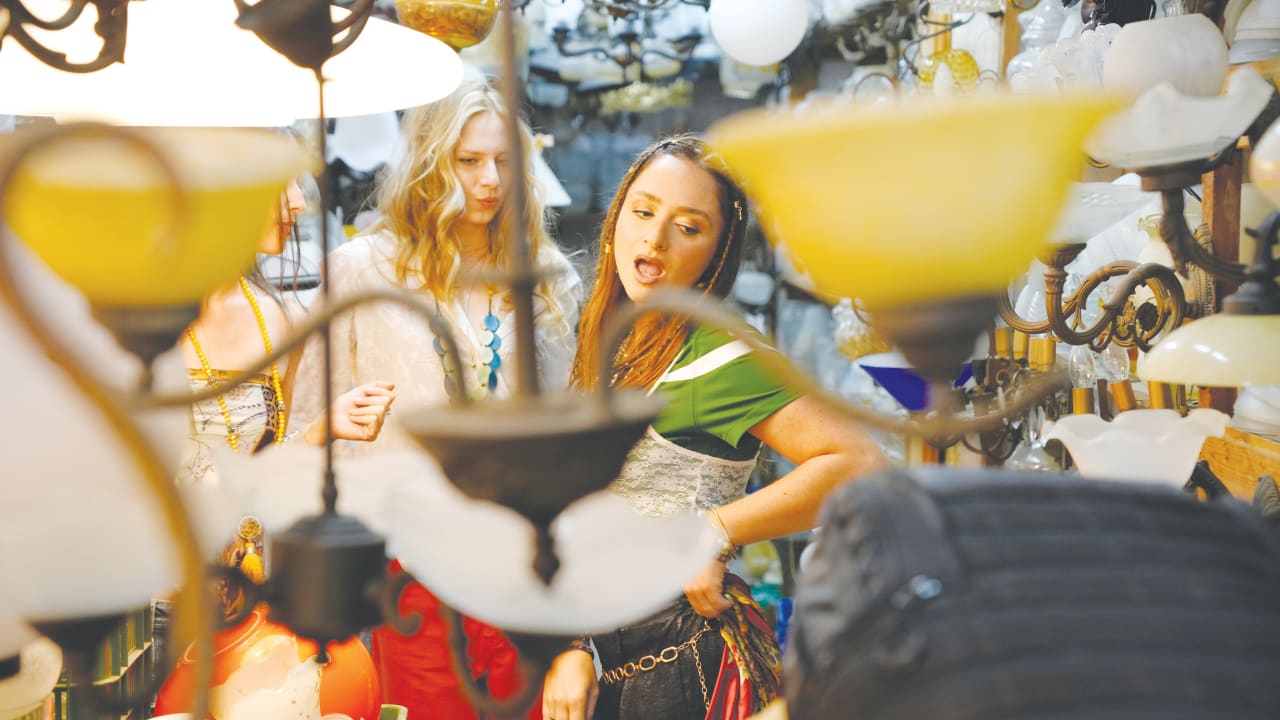
BySHANNA FULDJULY 26, 2026 18:53The lights are up in the Jaffa music video set. The crew is assembled and busy with its work. Camera and lighting producers are present. The style team is arranging accessories, the still photographer is catching playful moments, and the extras are laughing while they jump around on the leather couches.This is all the direction, design, and vision of international music artist Nicole Raviv.Raviv is in full-blown pop-star character as she flirts with the camera. She then laughs as she jumps onto the coffee table. It is set with authentic props - a Moroccan tea set that once belonged to her grandmother; a tray of sunflower seeds, because it’s Israel’s national snack. Stylish young women in colorful kerchiefs flow with Raviv as she takes them through the scene at one of three shooting locations.Her new song “Hayati” is playing loudly on repeat. Raviv sings over it. In Arabic. Then in English. Then in Arabic again.The single is part of an album expected to be released by the end of 2026. “Hayati” is Arabic for “my life.” It’s equally as popular in the Arab world as its Hebrew equivalent - “haim sheli” used as a term of endearment by Israelis everywhere. The song is a flirtatious, sun-soaked pop anthem that blends modern production with Middle Eastern sounds. It’s a love song. And it’s about a woman calling for her love to take the reins, claim her, and display his love.In her ideal kitchen, surrounded by her most meaningful Judaic family heirlooms. (credit: Leia Jospe)Raviv realizes she was constantly translating, not between languages but identitiesThe music video moves through Jaffa’s colorful streets, stopping for hummus, wandering through carpet shops, and lingering over details that are both unmistakably Israeli and, according to Raviv, deeply personal. It’s catchy enough to become the summer’s soundtrack.But beneath the polished visuals is a story that took decades to write, with many of the pages having been turned in different places.“I’ve had a really long artistic journey to get to this point,” Raviv told the Magazine. “I needed to try different styles before I understood what was actually true to me.”The journey began thousands of kilometers away in suburban Montreal, where Raviv spent her childhood bouncing between her mother’s Romanian phone calls and replying to her parents in Hebrew and measuring up to the French board at primary school.She calls herself a “third culture kid,” a term used to describe children raised between cultures in a new and foreign country to their parents. Hebrew filled the house because her parents were raised in Israel, despite her mother being born in Romania and her father in Morocco. Even though they were up against cultural battles - dealing with an environment where Ashkenazi and Mizrahi Jews didn’t typically end up married. The teenage couple had to push their folks to accept their love.They had met on the stage of a theatrical youth production in Jaffa in the 1970s, performing as actors in an original Hebrew play called The Panther, based on the Mizrahi Jews’ HaPanterim HaShchorim (The Black Panthers) protest movement. The Black Panthers worked to call out ethnic discrimination against the Middle Eastern/North African Jews, who found themselves operating within an Ashkenazi-dominated Israeli society.Raviv’s parents’ story defied the stereotypes of their day, and, in fact, they lived out the greater message of the show... after having a performance kiss that would set the stage for a lifetime of real-world love. The young couple went on to become dentists in Israel and later raised a family in Montreal.“I could answer the phone in English, hang up, and immediately switch to Hebrew,” she said. “Then my grandparents would call, and another language would come into the conversation.”Raviv remembers her father telling her grandparents not to speak to her in Arabic, because she wouldn’t understand.“Which part of this is mine? What is theirs? And what do I wanna keep from each side?” Raviv asked.For years, she didn’t think of those experiences as something artistic. They were simply her norm. Looking back, however, she realizes she was constantly translating - not only between languages but between identities.Like many young performers with Broadway dreams, Raviv packed her bags for New York after she turned 18. She enrolled in a musical theater college, determined to build a professional career in one of the world’s most competitive entertainment capitals.New York delivered discipline, resilience, ethicNew York delivered exactly what she hoped it would. She learned discipline, resilience, and the relentless work ethic required to survive and earn a buck in the industry. She sang at weddings, played character roles at Ellen’s Stardust Diner for hungry Broadway lovers in Times Square, and got tapped to join a jazz band with Billy Joel’s original saxophone player, Richie Cannata.She landed major singing opportunities, including performing the national anthem for the NFL’s New York Jets and serving as the exclusive anthem singer for every home game of hockey’s New York Islanders for two seasons. In under a decade, she built a résumé that many aspiring performers spend a lifetime chasing. But there’s one thing that the big city didn’t give her. An artistic voice.“As a singer, you’re delivering somebody else’s material,” Raviv explained. “You’re telling somebody else’s story. As an artist, you have to stop worrying whether people understand you. You have to express what you actually feel.”It was in Israel where she truly did that.After making aliyah and moving to Tel Aviv in 2021, Raviv would also move away from the identity of “singer” into what she considers the identity of an “artist.”Mizrahi music poured from cafés and taxis. Arabic rhythms drifted through markets. Traditional instruments that had once sounded folky now felt strongly connected to her own family history.Instead of borrowing the new sounds, Raviv decided to study them - and claim them.She enrolled in music school at Al Sheikh in Tel Aviv’s Yemenite Quarter and spent nearly three years immersing herself in Middle Eastern musical traditions, for which the school specializes. She studied maqamat, the melodic system that forms the backbone of Arabic music, listened to Lebanese and Egyptian repertoire, explored Andalusian influences, and learned alongside musicians who had grown up with these sounds.“I didn’t want to fake it,” she said. “If I was going to use these musical elements, I wanted to understand where they came from.”Those years happened almost entirely out of the spotlight.In an era when artists are expected to constantly show up on social media, release content and new music every few weeks, and remain permanently visible online, Raviv deliberately stepped back.“I took a break from industry expectations,” she said. “But not from working.”She wasn’t lost, though at moments it felt like it. She was preparing. Writing songs. Seeking to recreate the creative professional team she had grown to rely on and express herself with in New York. She finally found them - two music producers named Ben Shopen and Doron Plascow, a sound engineer she met at Shabbat dinner, Israel’s finest instrumentalists pulled from her paid gigs, fellow creatives she could draw energy from, and other Israeli talent with whom she would share the stage sometimes while on the road.Then she became a mother.And a moment later, she was living through war.Suddenly, the planned timeline for a new album wasn’t as important anymore.“Motherhood during a war will mess you up,” she said with a laugh that quickly turned serious.Pregnancy, a newborn, canceled performances, and the emotional weight of life in Israel forced Raviv to slow down in ways she hadn’t expected. However, motherhood, she says, stripped away many of the insecurities that had quietly followed her throughout various stages.“I stopped caring so much about other people’s opinions,” she said. “I started asking myself what kind of artist I actually wanted to be.”Those questions became even more meaningful after her daughter was born.“I want her to feel like she can do whatever she wants,” Raviv said. “I want her to be proud that she’s Jewish. Proud that she was born in Israel. Proud of where our family came from.”Before the baby was born, Raviv had an album written and a handful of demos recorded. Following the birth and Oct. 7, some songs on the album no longer resonated. But “Hayati” still did.The song is being called the “summer banger” by listeners and social media followers who had been getting a taste of the music through released video shorts on Instagram while awaiting the song’s final release at the end of June.Working with her stylist Lioz Cohen, Raviv opened her closet and quite literally sorted through the chapters of her life to make the video happen. One item immediately stood out: the jerseys she wore while singing at New York sporting events years earlier. They had made it into the suitcases when Raviv and her husband packed up their lift for Israel. Instead of leaving them behind as relics of her previous chapter, she brought them into the video, layering them with lace, silk trousers, and Middle Eastern costume jewelry sourced from her mother’s jewelry box.“It’s layering my identities,” she said.Even the decision to film in Jaffa carried symbolic weight. This ancient port city is a host to multiple cultures, religions, and languages. It mirrors the story Raviv wants her music to tell.Jaffa a place where different cultures live together“I didn’t choose Jaffa only because it’s beautiful,” she said. “It’s a place where different cultures live together. That’s the Israel I want people to see.”For an international audience, that message matters.Before releasing “Hayati,” Raviv built a growing online following by translating Israeli pop songs into English. She translated and sang Omer Adam’s “Malkat Hador” (“Queen of the Generation”), Noam Bettan’s 2026 Eurovision submission and runner-up “Michelle” (which mixes three languages), and pop sensation Eden Ben Zaken’s “Rolex v’ Casquette” (“A Rolex and a Visor Cap”).The project quickly resonated with Diaspora audiences who love and desire Israeli music but don’t honestly understand the lyrics.“They were thirsty for the culture,” she said. “I think that by showing these Israeli visuals and by showing Judaism in my own way in my own cool, sexy, fun way …that it humanizes us. I think it gives us a unique and beautiful portrayal of who we can be versus the headlines and what is being said about this region in a negative way.”Raviv says she is calling on more people to tell their stories through their art.“We are the light to the nations,” Raviv said.The positive feedback through views and comments on social media shows that there is an appetite for Israeli culture beyond politics and breaking news. And not just from Jews. People of all faiths and backgrounds gave the video their time.And that’s exactly what Raviv plans to bring overseas once her upcoming album is complete.Her vision isn’t just to host a concert of her own original music, but to bring an authentic, modern, and sexy Israeli experience to people who previously understood Israel to be greasy falafel and “Hava Nagila.”“I want people to feel like they just stepped into our world,” she said.She imagines audiences walking into a venue that feels like Tel Aviv for an evening, complete with live Middle Eastern instruments, modern pop production, dancers, collaborations, and perhaps even food. The goal isn’t simply entertainment. It’s an invitation to Israel today - a place that many haven’t set foot in since Oct. 7.That world, however, does include Arabic.For some artists, releasing a song featuring Arabic lyrics in today’s climate feels risky. Since Oct. 7, language itself has become emotionally charged for many Israelis.“It’s just what this mood is about… and this mood needed Arabic in it,” Raviv explained.Haaretz published a magazine article in 2025 covering some Arab Israelis in Haifa. The characters noted that they had decided to stop speaking Hebrew in the wake of mounting Arab-Jewish tension in the country. Similarly, many with Arab backgrounds (especially from Yemen) have denounced their country of origin (or parents’ country of origin) in the wake of the attacks from the Houthis, which attracted nationwide support and antisemitism throughout Yemen.Raviv understands this new reality. Before Oct. 7, she had visited her father’s hometown in Morocco on a family trip for his 70th birthday. She recounts the experience as having been warm and friendly with Muslim Moroccans, telling her they missed the Jewish community, which used to light up their neighborhoods decades ago.Before the State of Israel gained independence, some 300,000 Jews lived in Morocco. Today, there are only a couple of thousand. Morocco had the most Jews in any Arab country in modern times.Raviv expected criticism when she released “Hayati” and considered someone might accuse her of cultural appropriation... or suggest Arabic wasn’t hers to use.Instead, she found something else.“So far, it’s actually been incredibly positive. I don’t want people to be afraid of a language,” said Raviv. “I’m in a place where I’m deciding not to play it safe and to take risks as an artist.”Looking around the set during the filming of “Hayati,” all of Raviv’s identities coexist.The tea glasses sit beside sneakers.Arabic blends into English.A New York football jersey shares the screen with a kaftan from Morocco.Years ago, Raviv thought she had to choose between those worlds. Now she understands that the magic happens when they all appear in the same frame.“Hayati” is the sound of an artist who finally stopped trying to fit into someone else’s musical category.“Hayati,” or “My Life,” is a simple yet great English translation for a song title… that actually represents Raviv’s new genre all too perfectly.Follow us on Google
Finding her own genre: Nicole Raviv blends Hebrew, Arabic, and pop into a new Israeli sound
Full Article
Original Source
Read the full article at Jpost →KhanList aggregates and links to publicly available news content. We do not host full articles from third-party sources. Always verify important information with original sources.