
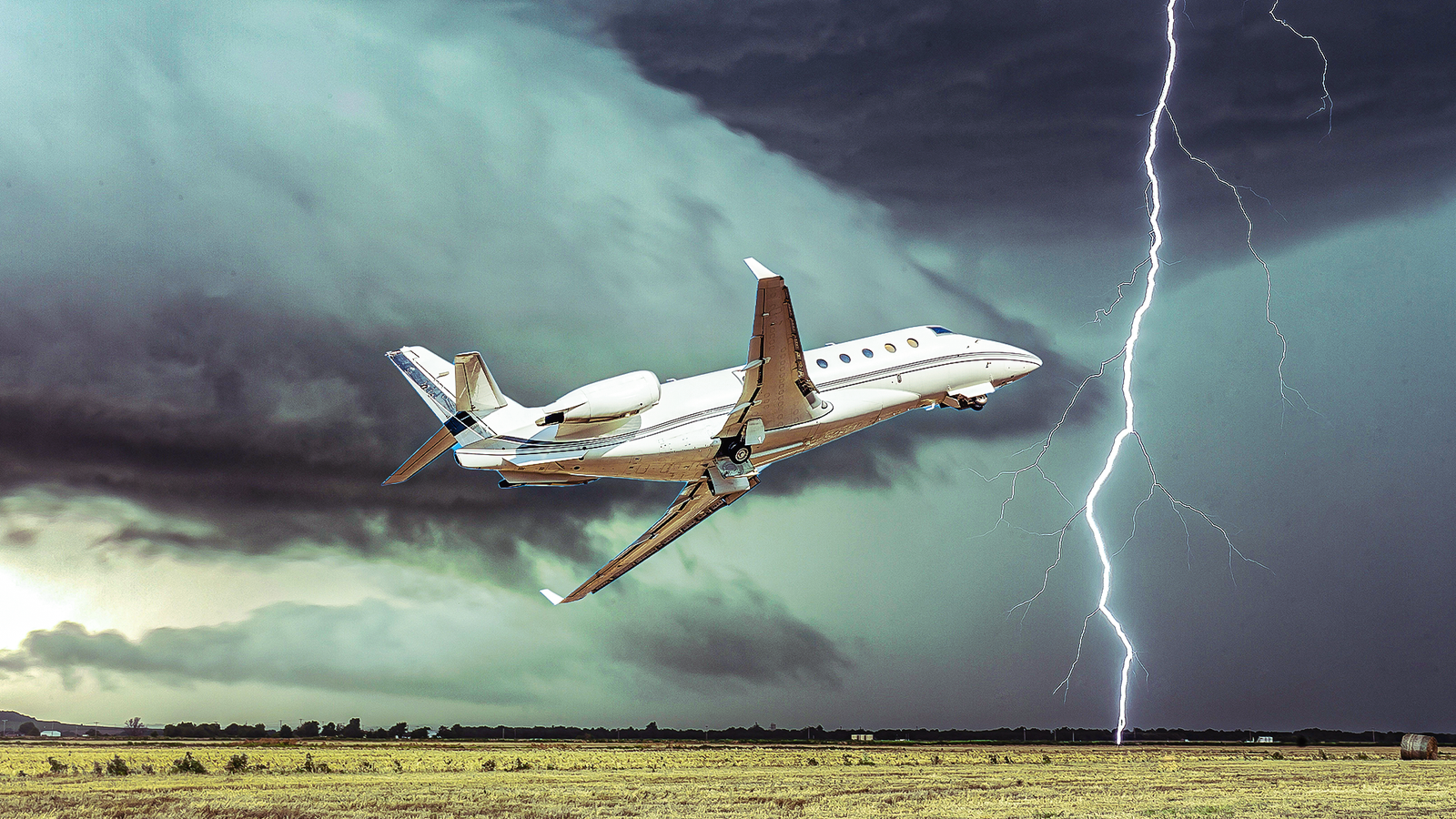
Published Nov 13, 2026, 3:00 PM EST Paul has had a career of 25+ years focused on the international technology sector, which has taken him to over 100 countries. Along the way, he developed a deep love for aviation, with a travel bucket list measured by aircraft types flown rather than destinations reached. Now he brings that avgeek passion, along with the journalism experience he accumulated early in his career, to write insightful pieces for Simple Flying. On September 3, a JetBlue Airways captain climbing out of Fort Lauderdale faced an extraordinary choice: follow ATC instructions toward what appeared to be a severe thunderstorm, or take matters into his own hands. When the controller refused his requested alternative heading, citing conflicting traffic, the captain declared an emergency and began turning away. The incident was notable enough that it was reported by View From The Wing at the time, which concluded that "declaring an emergency is no longer asking for permission: it is telling air traffic control what they are doing." It would also resonate just two months later when a Learjet 60 with nine people on board crashed after encountering severe turbulence in the same South Florida airspace. It subsequently emerged that the ill-fated aircraft had a history of miscommunicating severe weather with ATC. The JetBlue confrontation demonstrated a fundamental principle of commercial aviation: although pilots ordinarily follow ATC clearances, ultimate operational responsibility belongs to the aircraft's captain. Federal regulations recognize circumstances in which pilots may override instructions, sometimes without advance permission. From the Miracle on the Hudson to a deadly collision over Germany, aviation history reveals why that authority exists, and what can happen when pilots do not exercise it. The JetBlue Captain Who Refused To Fly Into A Thunderstorm Credit: Felix Mizioznikov | Shutterstock JetBlue flight B61971, operated by an Airbus A320 with the registration N715JB, departed Fort Lauderdale for Austin (AUS) 76 minutes late. During its climb, ATC assigned a 270-degree heading, but the crew believed that course would take them into severe weather. The pilots requested 250 or 240 degrees instead. The controller refused, explaining that other aircraft occupied the requested airspace and that her display showed a gap in the precipitation. JetBlue's captain challenged that assessment, asking whether the controller intended to send them through a severe thunderstorm. The controller responded that she saw only "light precipitation" on the designated heading, to which the pilot responded: "Not from the air, ma'am. So we declare an emergency, making a left turn heading two-six-zero for severe weather avoidance.” ATC acknowledged the emergency, and the pilot subsequently reported new headings as the aircraft turned through 240 and 230 degrees. The pilot later explained to the controller that the severe weather on the previous heading was why they had declared an emergency, saying that "you do what you gotta do, we gotta do what we gotta do here." The Federal Rule That Gives Pilots The Final Say Credit: Denver International Airport The authority exercised by JetBlue's captain originates in 14 CFR 91.3. It establishes the pilot in command's ultimate responsibility and permits necessary deviations from Part 91 rules during emergencies requiring immediate action. Meanwhile, 14 CFR 91.123 provides explicit exceptions to ATC-clearance compliance, and 121.557 grants airline captains emergency operational authority. These provisions do not permit arbitrary disregard of instructions. Controllers have substantial responsibilities of their own. They must maintain separation between aircraft, even when crews request weather deviations. FAA Order JO 7110.65 instructs controllers who cannot approve a requested deviation because of traffic to seek another solution that accommodates weather avoidance. Regulation / Guidance What It Establishes Practical Implication 14 CFR 91.3(a) Final operational authority Captain is ultimately responsible 14 CFR 91.3(b) Emergency deviation authority Necessary deviations from Part 91 permitted 14 CFR 91.123 Clearance compliance and exceptions Emergencies and TCAS advisories permit deviations 14 CFR 121.557 Airline emergency authority Captain may take necessary safety action FAA JO 7110.65 Controller weather procedures ATC seeks weather-safe alternatives while separating traffic That helps explain the JetBlue controller's concerns: approving the crew's preferred heading without resolving conflicting traffic could have introduced another danger. These principles extend into airline procedures. Airline Flight Operations Manuals will document the captain's responsibility for safe operations and command over the crew. Some manuals explicitly direct captains to declare emergencies in the event of severe weather that cannot otherwise be avoided. The FAA's foundational statement behind this is unequivocal, and concludes that "the pilot in command of an aircraft is directly responsible for, and is the final authority as to, the operation of that aircraft." Is Declaring An Emergency Necessary To Override ATC? Credit: Wirestock Creators | Shutterstock, Simple Flying Most disagreements never reach the emergency stage. Pilots typically request amended headings, routes, or altitudes, explaining why an assigned clearance is unsuitable. The word "unable" is used to communicate that an instruction cannot safely be accepted. The FAA explicitly encourages pilots to challenge instructions that would jeopardize safety. Meanwhile, aviation training guidance emphasizes the importance of saying "unable" rather than reluctantly complying. That distinction emerged recently in an incident involving dangerous weather for United Airlines. Flight UA471's crew rejected a proposed route during pre-departure discussions in San Antonio (SAT), saying "we're unable [to take] the route" before ATC accepted an alternative. Pilot Response Typical Situation Operational Consequence Request amended heading Weather ahead ATC considers alternative Say "unable" Proposed instruction unsafe ATC seeks another solution Request priority handling Developing operational problem ATC assesses assistance needed Declare emergency Immediate safety threat Captain may exercise emergency authority Act immediately, notify ATC No time for clearance Necessary action taken; ATC advised promptly JetBlue's captain faced a more immediate airborne conflict, so he declared an emergency instead. History demonstrates why communicating an emergency clearly matters. On January 25, 1990, Avianca Flight 52 exhausted its fuel while approaching New York (JFK) after lengthy weather-related holding. Despite communicating fuel concerns, the crew failed to convey the emergency adequately, and the Boeing 707 crashed, killing 73 people. The NTSB identified poor fuel management, inadequate emergency communication, and deficiencies in ATC traffic-flow management. The disaster illustrates the potentially fatal consequences of ambiguity. Other Times Pilots Have Challenged ATC Over Severe Weather One particularly dramatic confrontation occurred on May 4, 2010. American Airlines flight 2, a Boeing 767 arriving at JFK, was assigned Runway 22L despite winds from 320 degrees at 23 knots, gusting to 35. The captain considered the crosswind unacceptable and demanded Runway 31R. When ATC did not immediately accommodate the request, the crew declared an emergency, as follows: Tower: “Alright I will pass it along, fly runway heading for now.” AA 2 heavy: “Okay, we’re declaring emergency, we’re gonna land 3-1-right. We’re going to the left and then coming around.” Tower: “American 2 heavy, just fly runway heading.” AA 2 heavy: “Clear the area.” Tower: “You say you’re declaring emergency?” AA 2 heavy: “Three times I’ve told you that. Three times we’re declaring an emergency.” Tower: “Okay, I just want to verify, I know you said if you didn’t get 3-1-right you have to declare an emergency. Okay, understand, fly runway heading and I gotta get you a turn!” Tower: “Fly heading 1-8-0” AA 2 heavy: “American 2 heavy, we are turning around to the left here and landing on 3-1. Remove everybody from our way. We’ve declared an emergency. We’re on a visual.” Tower: “Alright, American 2 heavy, cleared to land, 3-1-right, 3-1-0 2-4 gusting to 3-4.” AA 2 heavy: “Cleared to land, runway 3-1-right, American 2 heavy.” A more recent incident demonstrates how differently such situations can unfold. In May last year, IndiGo flight 6E2142 requested an alternative routing near the India-Pakistan border, but military and civilian controllers denied the requested airspace access. The Airbus A321neo subsequently encountered hail and severe turbulence, damaging its nose before landing safely in Srinagar. Date Airline Aircraft Type Weather And ATC Issue Pilot Action / Outcome May 2010 American Airlines 767-200 Strong crosswinds made the assigned JFK runway unacceptable to the crew. Declared an emergency, rejected Runway 22L and landed on Runway 31R. August 2015 Delta A320 Incomplete weather information as the aircraft approached thunderstorms over Nebraska. Encountered damaging hail, declared an emergency, and diverted to Denver. July 2023 Allegiant A320 ATC directed a weather deviation and issued a late descent restriction amid developing convection. Encountered severe turbulence; six injured. Declared an emergency and landed at St. Petersburg. July 2023 Delta 767-300ER Crew requested a deviation after encountering heavy rain and hail during climb from Milan. Windshield cracked and aircraft damaged. Declared an emergency and diverted to Rome August 2023 Delta A350-900 ATC deferred a requested weather deviation until after a waypoint on approach to Atlanta. Encountered severe turbulence, injuring 17. Declared a medical emergency. May 2025 Southwest 737-700 ATC warned of nearby storms, but onboard displays showed no dangerous weather directly ahead. Encountered hail and turbulence; aircraft substantially damaged but landed safely. May 2025 IndiGo A321neo Requested weather deviations were denied by Indian military and Pakistani ATC authorities. Encountered severe hail and turbulence, damaging the radome; landed safely in Srinagar. November 2026 United 737-700 Crew challenged proposed pre-departure routing through severe thunderstorms. Rejected proposed routing, consulted dispatch and obtained an alternative clearance. The underlying difficulty is that controllers and crews may have different, incomplete weather pictures. FAA guidance warns that ATC radar does not detect turbulence and that some precipitation displays can lag actual conditions by six minutes. Delta flight 1889's hail encounter also exposed failures in weather-information sharing. The FAA recommends avoiding severe thunderstorms by at least 20 miles (32 km), recognizing that dangerous turbulence can extend beyond visible precipitation. When The Danger Isn't Weather: Sully And The Austin Near-Miss Perhaps the most famous demonstration of independent cockpit judgment occurred on January 15, 2009. After bird strikes disabled both engines of US Airways Flight 1549, Captain Chesley Sullenberger concluded that the Airbus A320 could not safely reach an airport. Despite ATC offering LaGuardia (LGA) and Teterboro Airport (TEB) landing options, he chose the Hudson River. The extraordinary ditching saved all 155 people aboard, illustrating why the captain must ultimately judge an aircraft's capabilities. Two more recent incidents underscore that an ATC clearance doesn't guarantee a safe landing. In July 2017, Air Canada flight 759 nearly landed on an occupied San Francisco taxiway, initiating a go-around just before ATC also instructed one. Incident Date Aircraft Danger Pilot Decision Outcome US Airways 1549 January 2009 A320 Loss of engine thrust Rejected impractical airport options; ditched All 155 survived Air Canada 759 July 2017 A320 Approach aligned with occupied taxiway Initiated go-around Collision avoided; descended to roughly 60 feet FedEx 1432 February 2023 767 Southwest departing on landing runway Initiated missed approach Collision avoided; separation approximately 150–170 feet In February 2023, a FedEx Boeing 767 crew initiated a missed approach after spotting a Southwest Airlines 737 departing from the same Austin runway, avoiding a potentially catastrophic collision in dense fog. The examples differ from JetBlue's explicit refusal, but establish the same wider principle. Pilots must assess risks from engine failures, runway obstructions, terrain, and conflicting traffic, even after receiving valid clearances. The FAA emphasizes that ATC authorization is not permission to conduct an unsafe operation. Sometimes the appropriate response is another request: sometimes it is an immediate go-around or emergency maneuver. The responsibility to recognize that distinction remains in the cockpit. The Fatal Midair Collision That Proved Why ATC Cannot Always Come First The consequences of conflicting instructions became devastatingly clear on July 1, 2002. Bashkirian Airlines Flight 2937 and DHL Flight 611 collided over Überlingen, Germany, killing all 71 people aboard the two aircraft. A controller had instructed the Bashkirian Tupolev Tu-154 to descend, while its Traffic Collision Avoidance System instructed the crew to climb. Meanwhile, the DHL Boeing 757 received a coordinated TCAS instruction to descend. The DHL crew followed its automated advisory, but the Tupolev crew continued descending in accordance with ATC instructions, rather than the pilot-in-charge heeding the automated warnings. German investigators identified shortcomings in ATC operations and inconsistent procedures governing conflicting TCAS and controller instructions. The disaster reinforced the importance of following TCAS resolution advisories, which take precedence over incompatible ATC vertical instructions. US regulations explicitly recognize TCAS advisories as an exception to normal clearance compliance. Nearly a quarter of a century later, the JetBlue captain faced a different danger, but one that also demonstrated why aviation cannot depend on unquestioning obedience. Air traffic controllers coordinate movements and maintain separation, while captains retain responsibility for their aircraft's safe operation. The safest cockpit is therefore not one that follows every instruction, but the one that recognizes when an instruction can no longer be safely followed.
Final Authority: The Pilot-Ceding Rule Every Air Traffic Controller Is Taught At Birth
Full Article
Original Source
Read the full article at Simpleflying →KhanList aggregates and links to publicly available news content. We do not host full articles from third-party sources. Always verify important information with original sources.