
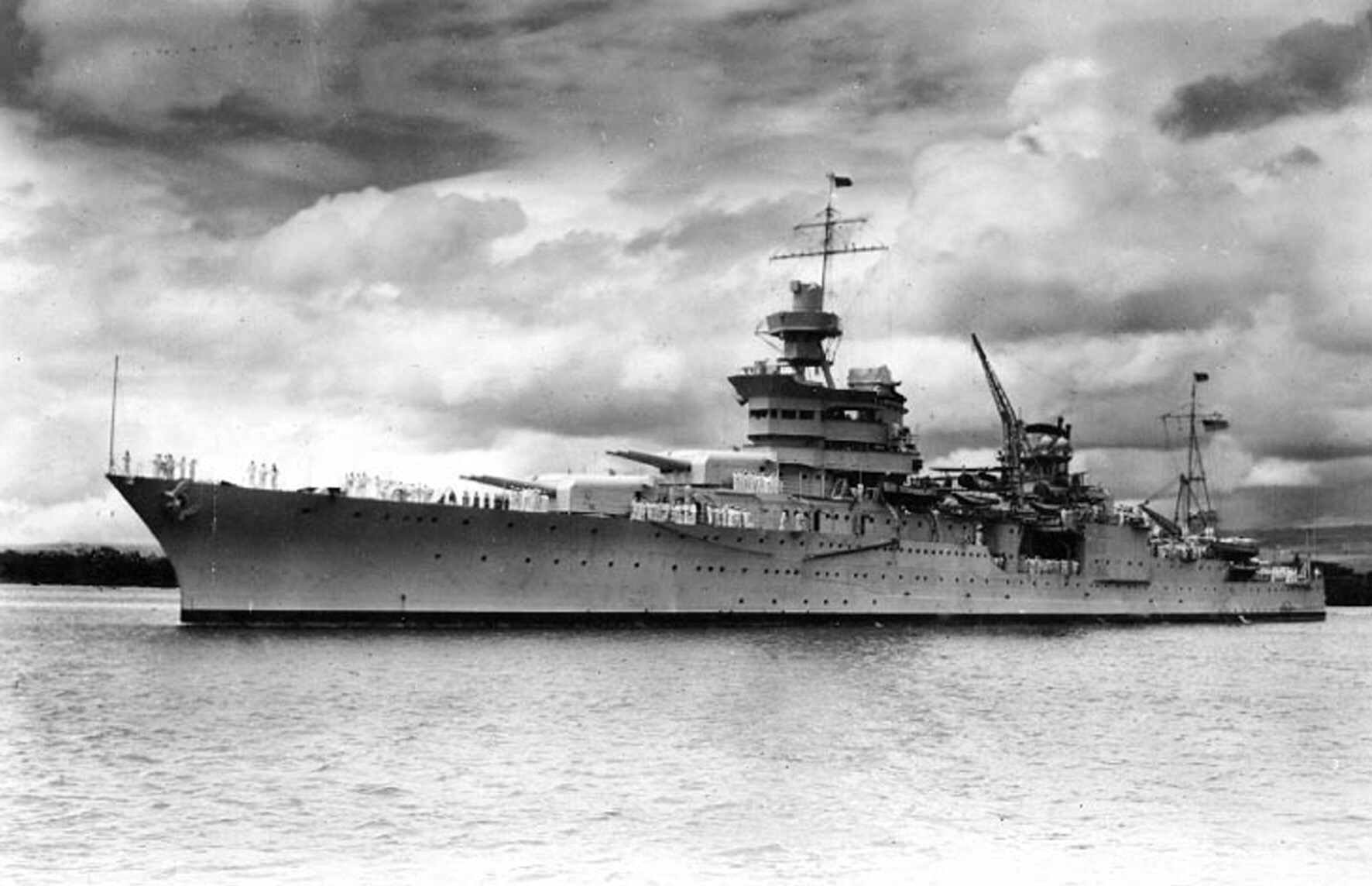
Eighty-one years after the sinking of the USS Indianapolis, the last eight men whose fates remained unclear on that catastrophic evening have been identified. Yet, there is a tragic twist to the historic confirmation. According to the USS Indianapolis Legacy Organization, those men had been recovered and identified through fingerprints decades ago, but “no documentation has been found confirming their families were ever notified,” according to the organization’s recent release. Now, that organization is seeking surviving relatives and descendants of these sailors to not only close the final lingering unknowns, but to honor and provide closure to the sailors’ families. “After 81 years, having answers about the fate of these eight men is incredibly meaningful, especially for the families whose loved ones never came home,” Sara Vladic, honorary survivor and board member of the USS Indianapolis Legacy Organization, said in the release. “But our work isn’t finished. We’re still searching for several of these sailors’ families, and we hope that by sharing this story, we can reach them and offer some measure of peace. Every one of these men had a name, a life, and people who loved them. They deserve to be remembered, and their families deserve to know what happened.” The eight sailors identified are: Leonard William Barenthin, Illinois Clinton Columbus Cavitt, Missouri Alford Edward Cox, Colorado Donald William Fleischauer, Nebraska Charles Lee Myers Jr., Michigan Amos Selman, Alabama Homer Leroy Smith, Indiana Lowell Elvis Speer, California The sinking Just after midnight on Monday, July 30, 1945, the first Japanese torpedo slammed into the USS Indianapolis’s starboard bow. Then another. The ship had recently completed a top-secret mission to Tinian, one of the Northern Mariana Islands, delivering components for the “Little Boy” atomic bomb that would be dropped on Hiroshima, Japan. None of its crew, even its commander, Capt. Charles B. McVay III, knew the specifics regarding the materials at the time. With its delivery mission complete, Indianapolis sailed to Guam and then got underway for the Philippines. Within 12 minutes, the heavy cruiser sank — taking hundreds of its crew with it. Only 316 men of the original 1,195 were alive, making the sinking the greatest loss of life at sea in American military history. Some 300 sailors were immediately trapped in the hull of the ship as it went down, with 880 men expelled into the ink-black ocean. Over the next five nights and four days, roughly 300 surviving sailors coalesced into a single, large mass. “Some of these men only had life jackets; others, nothing at all. Other survivors were fortunate enough to find floater nets and rafts equipped with meager rations, flares, fishing supplies, and flashlights,” writes Lynn Vincent and Sara Vladic in the bestselling book Indianapolis: The True Story of the Worst Sea Disaster in U.S. Naval History and the Fifty-Year Fight to Exonerate an Innocent Man. “There was a lot of speculation and conversation about what had happened and how long it would take to find us,” recalled Harold Bray, who today is the last living survivor of that wartime catastrophe. “Everyone thought we would be picked up the next day or in a few hours. Well, none of that came to be true. “The first day in the water was pretty horrific for this first-time sailor. Sharks — I had not in my wildest dreams thought I would ever be that close to those creatures, but there they were! The men with bad wounds or burns did not last very long. During the day the sun was very hot, and at night it was very cold. After a while, the men developed saltwater sores and blisters, and they would drink the salt water and get blisters inside their mouths and throats. “Around the third day some of the guys started to act and talk kind of strange, so I stayed to myself as much as I could. At night I would get up in the middle of the net, so if I did happen to fall asleep, I wouldn’t float away. We lost a lot of good young men the first three days in the water.” As many as 150 sailors may have been killed in shark attacks. By mere happenstance, Wilbur “Chuck” Gwinn, a U.S. Navy pilot, was flying over the Philippine Sea in his Lockheed PV-1 Ventura bomber on the morning of Aug. 2. Gwinn had ducked into the belly of the bomber to help his crew untangle a new trailing antenna when he looked down — and spotted people. From there, calls went out to help the survivors. Bray recalled to Military Times that he knew he would survive when he saw Gwinn’s PV-1. At the time, rescue ships recovered 91 bodies and buried them at sea, with many initially unidentified, according to the release. Throughout the decades, however, most of those 91 were identified, with 13 of those unknowns further identified in 2022. That left the final eight sailors unaccounted for. Through the efforts of Chief Rick Stone and the Family Charitable Foundation, who worked in tandem with the USS Indianapolis Legacy Organization, the answer lay in previously unavailable government records. Stone’s investigators were able to even establish the exact time, recovery ship and geographical coordinates of one sailor’s burial at sea. “This was a spectacular accomplishment by our team,” Stone said in the release. “Hopefully [this] will now bring final closure to all eight families.”
Final 8 sailors identified from 1945 USS Indianapolis sinking
Full Article
Original Source
Read the full article at Militarytimes →KhanList aggregates and links to publicly available news content. We do not host full articles from third-party sources. Always verify important information with original sources.