
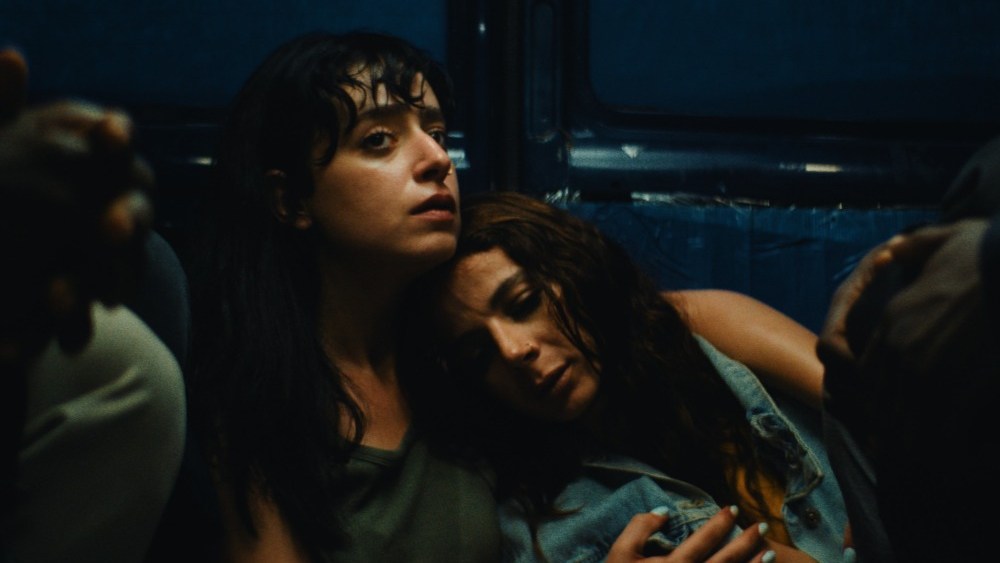
There’s a line in the screenplay of Lebanese filmmaker Rami Kodeih’s heist thriller “Furies” describing how its protagonists, two sisters plotting an overnight bank heist, move as though they are on borrowed time. It reflects as much the film’s frenetic pace as it does the experience of living in contemporary Lebanon. “There’s an uncertainty day to day, living through a history of conflicts,” the film’s co-writer Nora Mariana tells Variety. “So it does feel like you’re on borrowed time, which makes you take advantage of time in a very unique way.” Kodeih’s feature debut, Lebanon’s official submission for the 2027 Oscars, screened at the second edition of the Doha Film Festival. The husband and wife creative duo channel the collective anger and anxieties born of Lebanon’s economic collapse through a genre they have long loved — the heist. “We love it because there’s always a reason for why the main characters in a heist film are committing the heist,” says Kodeih, citing such influences as Stanley Kubrick’s “The Killing,” Jules Dassin’s “Rififi” and Jean-Pierre Melville’s “Le Cercle Rouge.” In “Furies,” the money the protagonists are attempting to steal is their own. Blocked from accessing her savings to pay for her younger sister Dalia’s (Maria Nakouzi) life-saving surgery, single mother Maro (Rym Mroue) enlists the help of a former militia member and a truck driver to stage a daring bank robbery. The premise was Mariana’s idea, born of the couple’s own experience when Lebanon’s banking crisis erupted in 2019, just as she herself needed surgery. “Frustration is a very mild word. It was devastating,” Kodeih recalls. “We were relying on some of our savings that were in Beirut to take care of that surgery. And, overnight, we were prevented from doing that.” Ultimately, Mariana’s family was forced to sell her grandfather’s home to cover the medical expenses. Seven years later, the couple have yet to recover their savings. “In a way, this is one of the biggest heists in history. It’s just that it’s a government that did it,” she remarks. The filmmakers’ indignation extends to the political establishment that emerged from Lebanon’s brutal 1975-1990 civil war. “The same warlords are the ones who, once the war stopped, they became the government,” Kodeih says. “So that’s the irony in all this.” Lingering sectarian divisions surface throughout the film, alongside smaller manifestations of the economic crisis, such as Maro cutting open a tube of toothpaste to get the last of its contents. “If the system is fundamentally unjust, how does that trickle down and affect the lives of ordinary people?” Mariana asks. “How do they take justice into their own hands? And that’s a messy human process.” “Does it create fractures within a community or does it create solidarity? It does both, we feel,” she continues. Even as they plan the heist, the sisters have to contend with everyday concerns. Maro uses Legos to map out the robbery rather than the traditionally elaborate map seen in the genre, while navigating a custody dispute over her son. “The whole point is, how would ordinary people pull off such an extraordinary situation?” Kodeih says. “To survive,” Mariana interjects. Balancing the film’s political and emotional weight with the thrills and humor of the genre came naturally to Kodeih. “Once the characters are solid and are human beings, they’re not figures. They’re just human beings that could exist outside of the film’s world,” he explains. Kodeih, who also edited the entire film, assembled some 300 pages of shot lists before filming. The eclectic soundtrack reflects his own musical upbringing, from his conservatory training and experience playing percussion in a school band to listening to his father’s collection of classical music records. The film was equally personal for much of the crew, most of whom had also lost access to their savings. “This was the hardest moment of our lives when the bank crisis happened, as a couple,” Mariana reflects. “This film is an act of resilience and catharsis.” A month into pre-production in the fall of 2024, the filmmakers were forced to halt preparations and evacuate as Israel escalated its bombing campaign against Lebanon. Mariana attributes some of the actors’ on-screen chemistry to the experience of living through a war together. Amid the bombardment in Beirut, the group sought refuge through watching films together, shutting out the sounds of the airstrikes that resonated outside. “You’re just realizing what an amazing art form this is,” she says. “It’s helping us survive.” During filming in 2025, the first assistant director alerted the filmmakers to imminent Israeli airstrikes nearby. The decision to continue filming was a collective one. “There is a very unique energy on set of, like, we want to make something meaningful. We want to make something beautiful, despite what’s happening in the world around us,” Mariana recalls. “We always appreciated the opportunity to make this feature, but there was this extra respect for the art form because it helped us get through a really difficult time.” The Lebanese-Brazilian co-production hails from RT Features and Nausika Films, with Rodrigo Teixeira and Berta Marchiori producing. According to Mariana, Teixeira connected with the screenplay in light of Brazil’s own banking crisis in the early 1990s. George Clooney and Grant Heslov joined as executive producers after the filmmakers shared a cut with their production company, Smokehouse Pictures. Le Pacte handles worldwide sales and French distribution, with The Plot Pictures distributing in MENA and Vertigo Releasing in the U.K.
Filmmakers Behind Lebanon’s Oscar Contender ‘Furies’ on Cinema as ‘an Act of Resilience and Catharsis’
Full Article
Original Source
Read the full article at Variety →KhanList aggregates and links to publicly available news content. We do not host full articles from third-party sources. Always verify important information with original sources.