
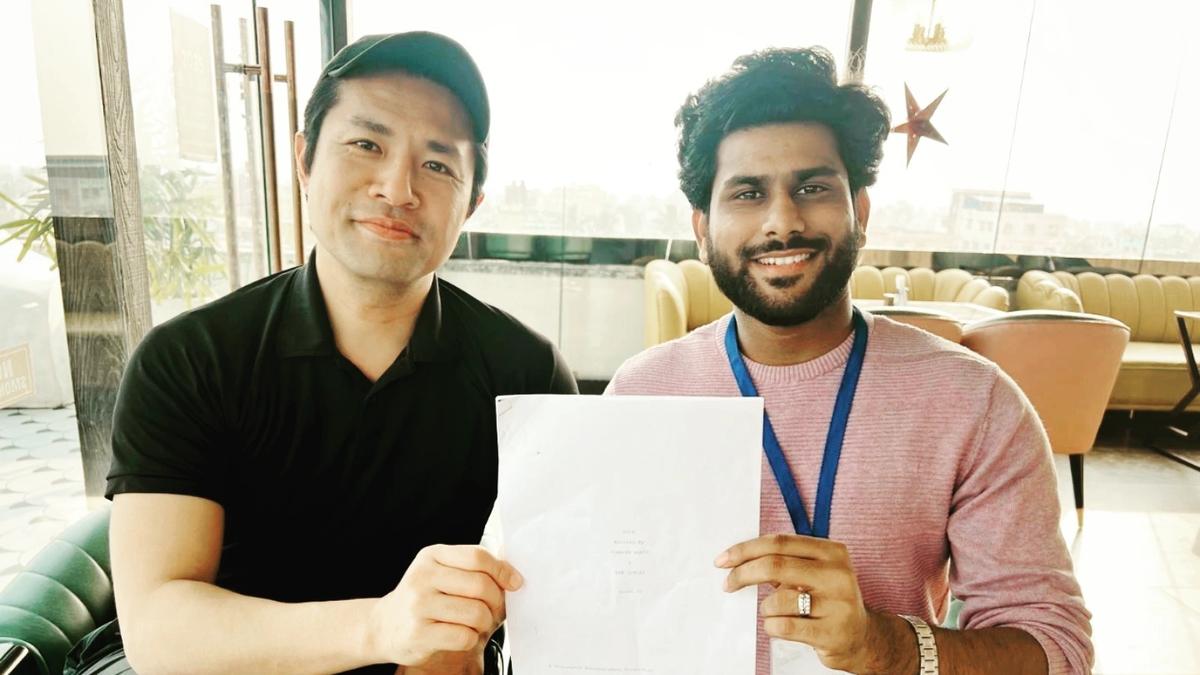
The first camera filmmaker Junayed Alavi remembers carrying was his father’s Nikon Coolpix. He was 13, in ninth grade, growing up in Rampurhat, West Bengal. He used to take it to school and film his surroundings, drawn to the possibilities of the moving image. Around that time, Jurassic Park had just been released and left its imprint on his imagination. And now, a conversation with a producer associated with Paranormal Activity , a collaboration with Ken Ochiai, and a science-fiction project with Peter Cameron have set the stage for Junayed's next phase. With Deathbed expected in January 2027 and Sapiens around June 2027, Junayed has two films lined up for release.“I had an inclination towards filmmaking right from my school days. I would take my father’s camera to school and shoot videos. I started studying visuals, researching and understanding how films were made,” he says.The boy who spent his school days looking through a camera lens was, however, expected to take a more conventional route. His parents wanted him to study engineering, a profession that promised security. So Junayed moved to Kolkata. But even as he pursued his degree, he kept making films.In his third year, an opportunity came along to work as an assistant director on the Bengali film Ei Ami Renu (2021). While his classmates prepared for job interviews, he chose the film set. “I thought, let me take this opportunity and see what I can learn. I wanted the experience.”It was an education, though not the kind he had anticipated. Junayed recalls a hostile working environment where junior crew members were poorly treated and women were objectified. The experience left him disenchanted with the industry he had hoped to enter. Junayed Alavi | Photo Credit: Special Arrangement Seven screenplays in lockdownIn 2020, Junayed graduated. The pandemic arrived in the same year, bringing film productions to a halt. He lost his job as assistant director and returned to Rampurhat. With the world retreating indoors, he turned to the pen. By the end of that year, he had written seven feature-film screenplays, moving between horror, science fiction and coming-of-age stories.Another door opened through Coverfly, a film literary agency, where he began working remotely as a literary agent. His job was to read scripts, prepare coverage reports and send selected projects to studios for consideration. The submissions ranged from short films to features.“We would receive scripts from a pool of nearly a thousand submissions. A team would shortlist around 12 or 13, and we would upload them on the portal for further consideration,” he says.“It was a different kind of film education. Reading scripts introduced me to the mechanics of storytelling and the workings of the Hollywood development system. I began building relationships with literary agents, managers, and studios. In time, the people whose scripts I had once evaluated would become part of the professional world in which I was trying to make films,” recalls Junayed. A poster of Terror Tales (2026) | Photo Credit: Special Arrangement One such connection was Japanese filmmaker and producer Ken Ochiai. When the two discussed collaborating, Ken asked Junayed to pitch an idea. He presented an anthology, Terror Tales (2026), of nine films, which the producer liked, decided to back and encouraged him to develop.Around the same time, Junayed made a short film titled Hunger in 2021; he sent it to American screenwriter and producer Peter Cameron, celebrated for his work on multiple Marvel Cinematic Universe (MCU) projects. Peter had recently completed work on Marvel’s Moon Knight and was working on Werewolf by Night. Peter responded to the storytelling, came on board and sent Junayed notes on revisions. The short subsequently travelled to film festivals, along with Festival del Cinema di Cefalu in Italy in 2023.Their association continued with a science-fiction project, Sapiens, which Peter joined as a co-producer. The film remains in development. Junayed also began conversations with one of the producers of Paranormal Activity (Junayed is unable to take names because he has signed an NDA), about making a feature film. Those discussions, together with his collaboration with Ken, led to Deathbed, which is set to release roughly in January 2027, while Sapiens will be released around June 2027. A small town to an international set“A psychological horror film centred on an Indian-American family, Deathbed is being developed as an international collaboration backed by Ken and one of the producers of Paranormal Activity. Casting conversations are underway in Kolkata, while the team is looking to bring in its composer and technical crew from abroad. Production is scheduled to begin in January 2027,” says Junayed. Junayed and Ken in Rampurhat striking the famous Shah Rukh Khan pose from Dilwale Dulhaniya Le Jayenge (1995) | Photo Credit: Special Arrangement The film is expected to be shot in India, with Mumbai and North Bengal under consideration. Much of the story unfolds in a single location, making the choice less about geography than production requirements and the different policies governing film shoots in India and the US.There is something circular about Ken travelling to Rampurhat, the town where Junayed’s journey began, to visit the locations where they shot.“He even came to Rampurhat and saw the places where we shot. I feel lucky that we made this film,” Junayed says. A still from Terror Tales (2026) | Photo Credit: Special Arrangement His other ambitious project, Sapiens, is expected in June 2027. Co-produced by Peter, it will be shot in Bengal, drawing on the region’s cultural landscape while inhabiting a dystopian world reminiscent of Blade Runner. In this imagined future, cyborgs have taken over. Every family is assigned one to help it adapt to the new order. At the heart of the story are two rival households — one Brahmin and the other Dalit — whose relationship forms the starting point of the narrative.The real world beneath the fantasticJunayed’s attraction to horror and science fiction goes back to childhood. Among the filmmakers who shaped his imagination was Steven Spielberg. What stayed with him was the way Spielberg placed ordinary people in extraordinary circumstances without losing the texture of everyday life.“What fascinated me about Spielberg’s films was that he used ordinary people in extraordinary situations. The characters were very grounded, just like people in real life, but the situations they found themselves in were extraordinary,” he says. A still from Terror Tales (2026) | Photo Credit: Special Arrangement “It is this tension between the familiar and the fantastic that I want to explore in my work,” notes Junayed. Horror, for Junayed, can be more than a story of ghosts and fear. Beneath its surface, it can hold the memory of the Bengal famine, farmer suicides, the darker realities of the film industry or the failures of the education system.“You might be watching a horror film, but beneath that surface there should be something very earthy and real. The idea is not to spoon-feed the audience. These elements should become part of the narrative,” he says.Science fiction offers another way of approaching the world around him. “In Sapiens, the cyborgs and the apocalyptic landscape provide a setting to explore caste and entrenched social divisions,” explains Junayed. Alongside his feature projects, Junayed continues to make short films for his YouTube channel, returning to the genres that first drew him to cinema. Ken, Junayed and crew memebers in a behind the scenes moment | Photo Credit: Special Arrangement Seeing his visionJunayed believes his international collaborators have been willing to look beyond the limitations of a project and recognise the filmmaker’s intent. He sees this as an important distinction in the way Hollywood approaches emerging talent.“People like Peter see the vision in everything. You may not have the budget or the resources, but they look at the intent. In Hollywood, they have structure, budgets and resources. What matters to them is what you are trying to do and how you are approaching it,” he says.He believes Marvel, too, has increasingly recognised filmmakers who come from low-budget backgrounds. Peter, he feels, saw that intent in his work.His relationship with the Bengali film industry, meanwhile, remains unresolved. Junayed has not ruled out making Bengali films, but his early experiences have left him wary. He recalls a horror-comedy project for which the rights were acquired and an advance paid, only for the film never to be made. The people involved, he says, eventually stopped responding.For now, his stories are travelling further than the boy with the Nikon Coolpix could have imagined. However, the impulse remains the same: take the familiar, place it in an unfamiliar world and see what emerges. Somewhere between the school corridors of Rampurhat and the dystopian Bengal of Sapiens, Junayed is still looking for the extraordinary hiding inside ordinary lives.
Filmmaker Junayed Alavi's journey from Bengal’s Rampurhat to Hollywood
Full Article
Original Source
Read the full article at Thehindu →KhanList aggregates and links to publicly available news content. We do not host full articles from third-party sources. Always verify important information with original sources.