
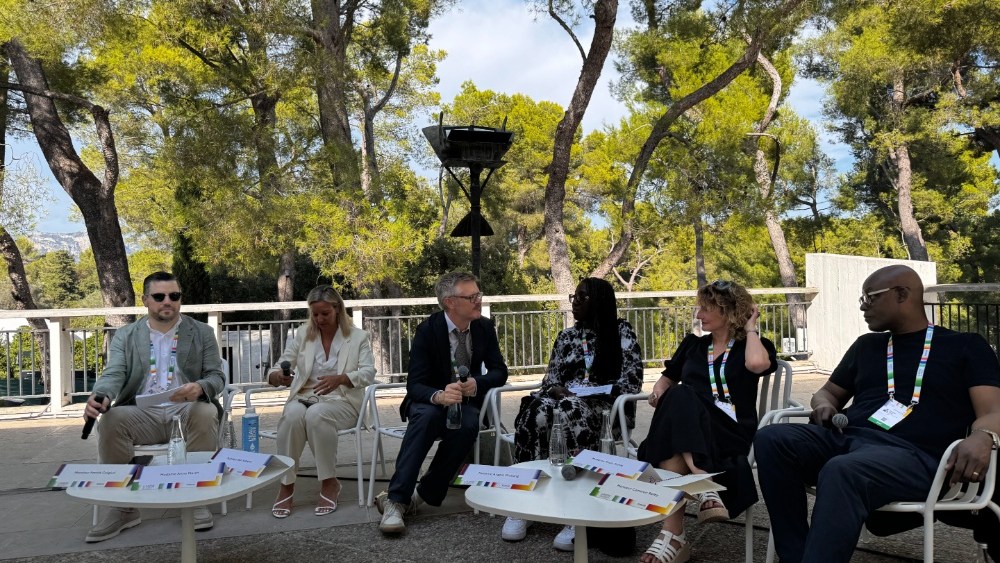
Women held 17% of key behind-camera roles when the Celluloid Ceiling study began tracking the figure in 1998. Last year, that number stood at 23%. Six points in 27 years. That statistic opened a panel at the Lumière Summit on Monday titled “Safer Sets, Different Stories: Why Gender Balance Matters,” where leaders from StudioCanal, Canal+, the BFI, the Berlinale and the Toronto Film Festival called for structural accountability measures and argued that the failure to include women is as much a creative loss as a moral one. “The cinema industry should not be considering this as a constraint or a concession,” said Anna Marsh, chief executive of Studiocanal and deputy chief executive of Canal+. “It should be about cinema investing in its own future.” Fifty percent of film school graduates are women, Marsh noted, but by the time filmmakers reach their third feature, only one in six directors is a woman. A woman director’s budget runs, on average, at 44% of that assigned to a male director. Canal+ has extended its development budget by €1 million over three years specifically to finance projects from female writers and directors, Marsh said, and a film about silent cinema pioneer Alice Guy, to be directed by Anne Le Ny, is in development. Popular on Variety Ben Roberts, director general of the British Film Institute, drew on the BFI’s own Sight and Sound “Greatest Films of All Time” poll to make the case. In 2012, just three of the top 100 films were directed by women; by 2022, that had risen to 11, with two each by Agnès Varda and Chantal Akerman. “That tells me two things,” Roberts said. “Women are as capable, if not more capable, than men of making incredible cinema. So, the inequality is tragic.” He pointed to the BFI’s Inclusion Standards, dating from around 2014, and the new Creative Industries Independent Standards Authority as structural measures. “Work travels, employment travels,” Roberts said, calling on international co-production partners to align on shared minimum standards. Berlinale festival director Tricia Tuttle cited her own festival’s data. In 2005, women directed 0% of films in Berlinale competition. By 2015 that had reached 15%, and by 2025 it stood at 40%. “Transparency makes you very aware, as a curator and as a decision-maker and a cultural gatekeeper, of what you’re doing,” Tuttle said. She added that data consistently shows films made with greater gender balance perform better commercially. “That’s a lot of creative energy that gets wasted,” Tuttle said, referring to the effort women are forced to spend justifying the conversation rather than making work. Cameron Bailey, chief executive of the Toronto Film Festival, said the festival’s programming team has maintained around 50% women for more than a decade and that TIFF’s 2026 selection stands at 35% films directed by women, up from 25% a decade ago. He traced the Share Her Journey initiative – launched at TIFF in 2017 by his sister Maxine Bailey – to a conviction that gatekeepers must actively surface work by women. “That kind of stuff is still out there, and it’s quite prevalent, actually,” Bailey said, recalling hearing Academy members ask why they would want to watch Sarah Polley’s “Women Talking” during its Oscar campaign. Angèle Diabang, a filmmaker from Senegal, described founding the Mousso Institute in 2022. “Competence is a form of emancipation,” Diabang said. “I don’t want a woman on set because someone wants to tick a box. I want her there because she knows her craft.” Working in cohorts of six in Casamance – her home region, deliberately chosen over the capital Dakar to decentralize opportunity – the institute trains women as cinematographers, sound engineers, lighting technicians and editors, entirely free of charge. Two cohorts, 12 women trained. France’s CNC has required all cast, crew and technicians on French productions to undergo gender-based violence training since 2021. From 2027, a bonus-penalty mechanism will link CNC funding to gender targets: productions with fewer than 40% women crew face penalties, while those that meet or exceed the threshold receive a bonus. Canal+ was the first company to join the Safe Place movement, which supports women who are victims of violence both on set and in their daily lives, Marsh noted. Moderator Patrick Caligiuri, a producer and media advisor, closed by expressing a hope that a future Lumière Summit would not need to hold the panel again.
Film Industry Leaders Demand Structural Fix for Gender Gap at Lumiere Summit
Full Article
Original Source
Read the full article at Variety →KhanList aggregates and links to publicly available news content. We do not host full articles from third-party sources. Always verify important information with original sources.