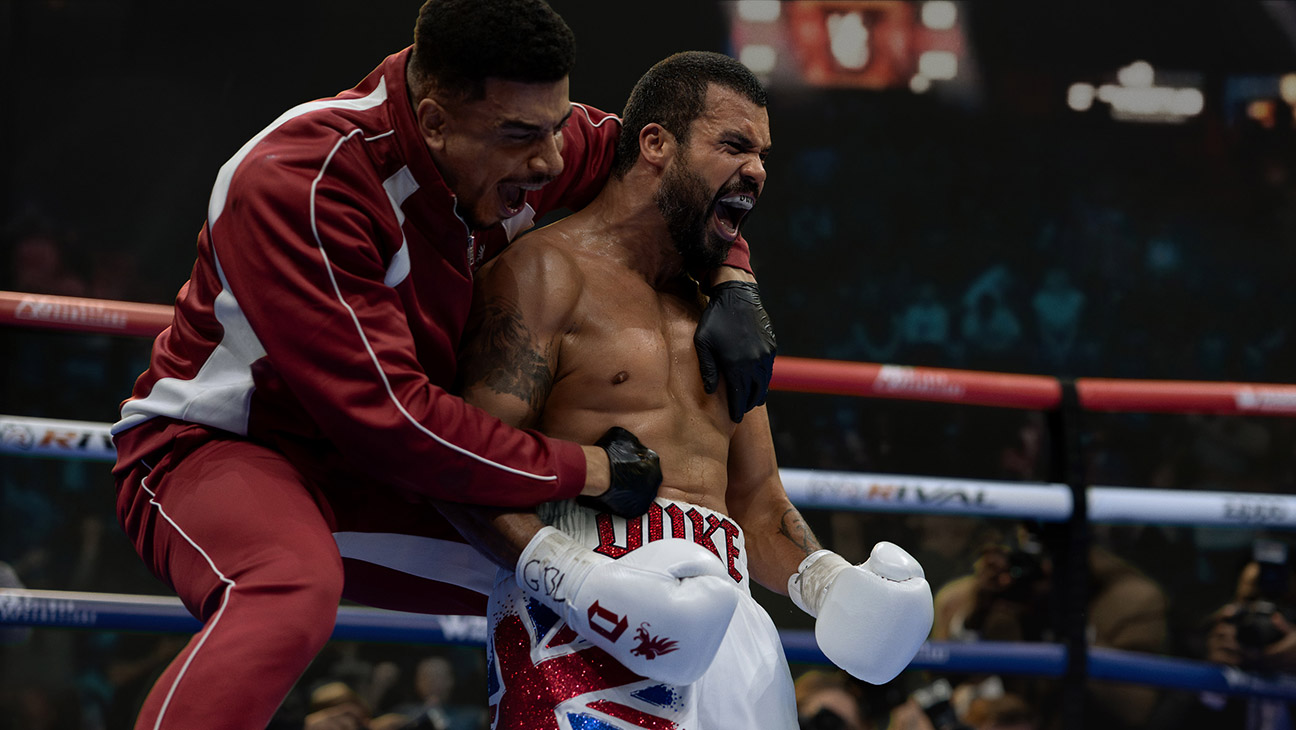
Logo text I’m sure that Curtis “50 Cent” Jackson and the team behind Starz‘s new drama Fightland have some appreciation for the worlds of professional boxing and London’s criminal underbelly. But somewhere in the show’s creative journey and the blending of British television veterans and scribes from inside Jackson’s Power-verse, a lot of the specificity vanished into the ether. The series premiering on Starz is, more than anything else, blandly familiar, mining all the tropes of several popular genres without finding anything distinctive in the combination. More often than not, Fightland feels like a show made by people who watched a lot of other TV shows — Peaky Blinders, Mobland, The Gentlemen, Gangs of London, A Thousand Blows and, naturally, Power all come frequently to mind — and not people with a specific passion for this milieu or these characters. Fightland The Bottom Line Far from a knockout. Airdate: Friday, July 31 (Starz)Cast: Howard Charles, Deborah Ayorinde, Charles Babalola, Anita-Joy Uwajeh, Tahirah Sharif, Tyler Conte, Richard Pepple and Nicholas PinnockCreators: Daniel Fajemisin-Duncan & Marlon Smith and Damione Macedon & Raphael Jackson Jr. It can still be enjoyed on its generally broad terms, but Fightland is the first Starz show in memory that I’ve felt needed to push its content to greater extremes; the material here demands more violence, more sex, more florid dialogue instead of this tepid, borderline-PG-13-level waltz through ostensibly rough moral terrain. Howard Charles stars as Duke Kilroy, a London-based boxer who, in the first scene of the pilot, is fighting for the heavyweight title in Las Vegas. Duke wins and it seems like his life’s aspirations are coming together: He has a belt, an attractive girlfriend (Deborah Ayorinde’s Joy) and plans to sign with a new promoter (Clarke Peters pops up a couple of times, adding only his inherent Clarke Peters-ness) and take his career to the next level. The problem: That girlfriend is actually married to Kingsley Marshall (Nicholas Pinnock), Duke’s current manager. And Kingsley is a bad, bad man, using his boxing business as a front for an ascending drug empire run out of London. The night of the title fight, Duke is attacked by two thugs who smash his hand with a hammer and, in the ensuing chaos, kill somebody close to him. Duke responds with an act of impulsive violence that leads to nearly eight years of incarceration. Duke is released and heads back to London seeking revenge. But when he gets there, he discovers that Kingsley has disappeared and his empire is being operated by Kingsley’s son (Charles Babalola’s Zeek) and daughter (Anita-Joy Uwajeh’s Cebella), who are struggling to expand the reach of the family’s boxing enterprise while holding together a loose criminal consortium of Russians, Irish and Albanians. Fightland was created by Daniel Fajemisin-Duncan and Marlon Smith, whose resumés include the British dramas Save Me and Run, and Damione Macedon & Raphael Jackson Jr. of Power and Genius: MLK/X. It’s impossible to know how this collaborative process actually worked, but only Macedon and Jackson are credited as writers for the pilot, which has a very “connect the dots and don’t ask too many questions” sensibility when it comes to Duke, his legal circumstances and his motivations. Charles gives Duke an effective glowering intensity, but Duke’s single-minded purpose gives the star very little else to play, and the series keeps pairing him with one-dimensional supporting players — starting with the one-dimensional cartel kingpin (Miguel Álvarez’s Amado), who connects him to a single, one-dimensional cartel henchman (Sebastián Capitán Viveros’s Lazaro) operating out of London and aiming to topple Kingsley. I’m not entirely sure that the stuff with Amado, Lazaro and the cartel is even necessary. It’s right there in the title, but Fightland feels disengaged with the boxing side of the story, with pilot director Otto Bathurst delivering a brief, muscular bout in the opening moments before the various gyms and pugilism-centered spaces become mere backdrops for showdowns with an assortment of flatly written, cardboard gangsters with hammy accents. The boxing material, heightened by Cebella’s attempts to bring sports betting to the U.K., is the part of Fightland that intrigues me most and the part that feels least like 10 other contemporary London crime dramas. But it’s the part that’s barely an afterthought. Charles has some good scenes with Richard Pepple as Gazzer, Duke’s gym-owner father, but the relationship is underwritten, as is Duke’s longtime friendship with Tyler Conti’s Jay, who has his own demons that are only occasionally relevant as more than contrivance. The opportunity for the series to mine the geographic and linguistic contrast between the working class London of Duke’s upbringing (and Gazzer’s gym) and the more polished, ersatz business that Zeek and Cece are manufacturing as a front for their nefarious enterprise is largely lost. The pilot sets up interesting tensions between Duke and surrogate father Kingsley and a livelier adversarial role for Pinnock, but Kingsley is gone for the majority of the six episodes (out of eight) sent to critics and Pinnock’s absence is felt. Neither Zeek nor Cebella has a consistent enough character for them to work as adversaries on their own, and after the promising introduction, Joy is largely irrelevant to the drama other than introducing a plot point that the show treats as a surprise even if viewers will instantly guess long before its big reveal. Nor will viewers be surprised by the secret harbored by ring-girl Kim (Tahirah Sharif), whose interest in Duke is both predictably motivated and generally chemistry-free. Actually, if you’re waiting for anything in Fightland to surprise you, you’ll have to stick around for the fifth episode, in which several characters who seemed like they were meant to be important (despite never being provided with personalities) are killed off in set pieces that are entertaining if never inspired. The plot of Fightland is straight out of Gangs of London, but the action scenes sadly are not. Even when people are being killed off willy-nilly, the violence is tepid and perfunctory — though less so than the various sex scenes, which all have the exact same structure, with a couple of chastely steamy close-ups, a generic R&B needle drop and a hasty cut to non-descript establishing shots of London. The series’ blend of soapy melodramatics and rough-and-tumble underworld menace will be familiar to anybody who has watched Power, but Power and its spinoffs have always been confident in their only-for-adults depictions of adults-only situations. Fightland feels incongruously sanitized throughout, without actually being appropriate (or engaging) for all ages. The end of the sixth episode suggests that the boxing might move back to the forefront in the rest of the season. If that leaves me speculating that Fightland could improve, chances are good I’ll have forgotten every other detail in the series by the time I can watch those last two episodes. Lacking sufficient grit, intimacy and visceral impact, the show offers little to hold onto that isn’t being done better on too many other current shows to list here.
‘Fightland’ Review: 50 Cent’s London-Set Starz Drama Blends Boxing and Crime Clichés in Forgettable Ways
Full Article
Original Source
Read the full article at Hollywoodreporter →KhanList aggregates and links to publicly available news content. We do not host full articles from third-party sources. Always verify important information with original sources.