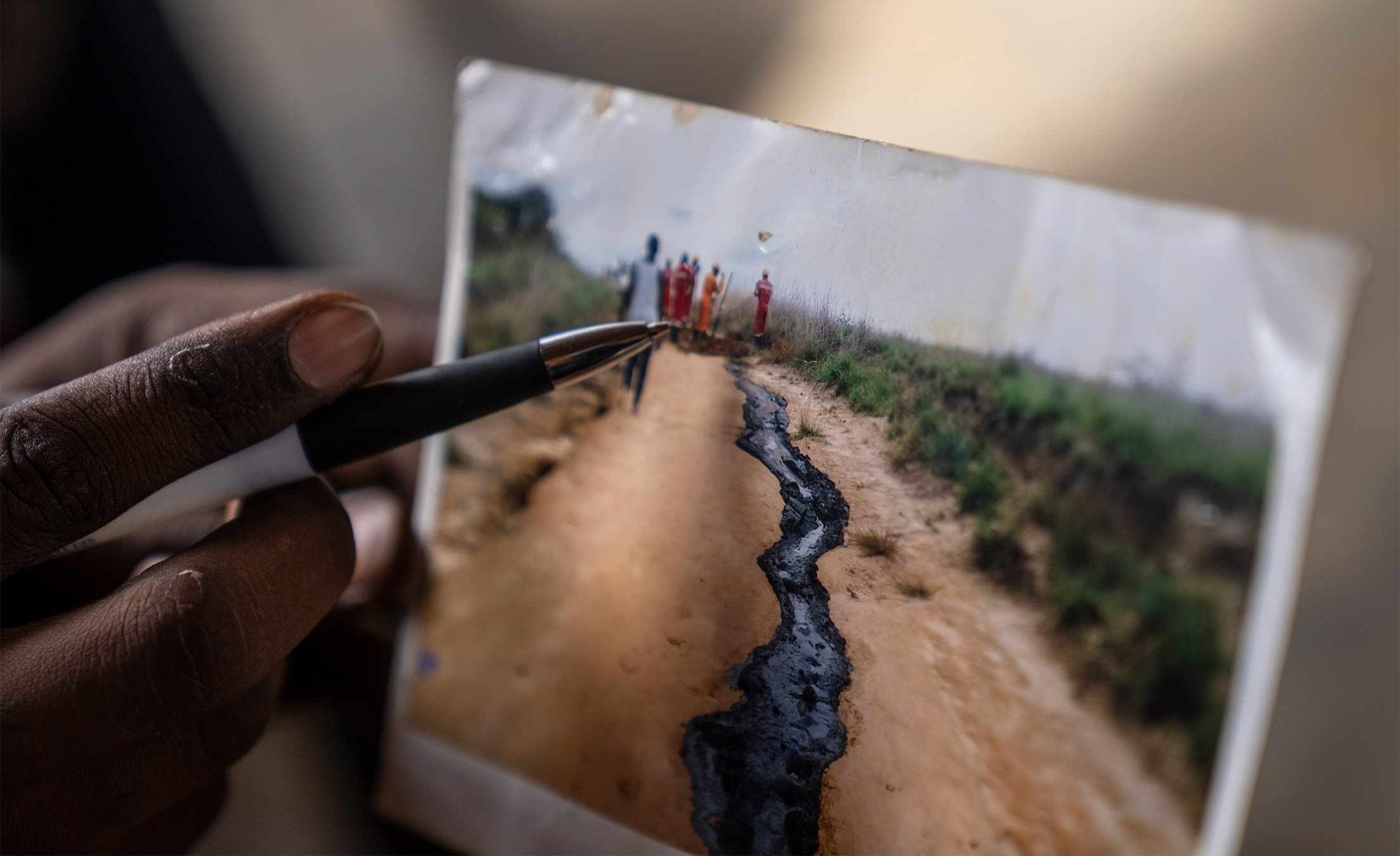
Pascal Mirindi is a Congolese environmental activist fighting oil exploitation in the Democratic Republic of Congo.In 2022, as the Congolese government promoted new oil blocks in eastern DRC, Mirindi and his friends created a movement to raise community awareness of the dangers of fossil fuel exploitation.In late 2024, the Congolese government initiated a green corridor expanding from the eastern to the western side of the country, aiming to establish the “largest protected tropical forest in the world,” yet a few months later, the country launched new oil blocks covering 60% of the entire country’s surface.Mirindi spoke with Mongabay in June about his activism and the future of the DRC. Pascal Mirindi is a young environmental activist based in the Democratic Republic of Congo, born in Goma. He was a member of a nonviolent movement, La LUCHA, fighting for democracy in the DRC. La LUCHA initiated him into nonviolent activism, but he used that opportunity to fight for Congolese ecosystems. Since 2024, Mirindi has been one of the main resistance forces against mineral, oil and gas exploitation inside the Congo Basin. Through campaigns and community awareness, he and his colleagues have successfully driven out oil exploration inside Virunga National Park. Now, Mirindi is fighting against the exploitation of 30 new oil blocks that cover 72% of the Congo Green Corridor, the country’s most emblematic conservation project, which spans a large part of the Congo Basin, home to thousands of animals and a lifeline for many communities in the DRC. Mirindi spoke with Mongabay in June, discussing what it means to resist from the inside and make a difference on a global scale, protecting the homes of endangered species such as mountain gorillas (Gorilla beringei beringei) and okapis (Okapia johnstoni), endemic to the region. Pascal Mirindi’s first visit to the director of Virunga National Park Emmanuel de Merode, in 2022. Image courtesy of Pascal Mirindi. This interview has been translated from French, edited for length and clarity. Mongabay: Who is Pascal Mirindi? Pascal Mirindi: I am Congolese; I was born in Goma in 1999. I have been an activist since I was 15 years old. I started in the citizen movement LUCHA. LUCHA deals first and foremost with social issues: demanding access to water, access to electricity and access to work. Later, with the Congolese political situation, being Congolese, we were also obliged to look at those questions. And that is how, around 2016, we launched our campaign demanding that the president at that time, Joseph Kabila, respect the Constitution and organize elections without taking another term. Because Congolese law is clear. The presidential mandate is renewable only once. That is where I began my activism. Of course, there were ups and downs. There were arrests and injuries that led me to the hospital. Today, I coordinate a citizen campaign called Our Land Without Oil [Notre Terre Sans Petrole]. In 2022, the Congolese government launched the sale of oil blocks in protected areas such as Virunga National Park. At that time, we decided to launch a campaign. It is a very large campaign. There are more than [210] member organizations that have signed the charter. We try to mobilize communities to make them more demanding, to ask their leaders to be accountable. We also try to give communities space to enjoy their community identity as the primary sovereign. I also work on Green Corridors, directly with the government entity that manages the corridor, which is the Virunga Foundation. I believe that communities must be at the center of all our thinking. Communities must be consulted before any action, because it is said that if you do something for me, without me, it is likely to end up as though you did it against me. Mirindi’s team holds a discussion with the community in Tshopo province. Image courtesy of Pascal Mirindi. Mongabay: How did you come to be involved in environmental activism? Pascal Mirindi: For me, LUCHA was my school. It was a space where I learned how to claim my rights and why to claim them. LUCHA helped me direct my energy, to guide me while remaining respectful of the law. And when we had the first elections, for some of us, it was a success. I remember one day I went to see a friend who was also one of my comrades in creating Extinction Rebellion [DRC]. I went to see him in Rutshuru, where some of my LUCHA comrades had been invited because they did not agree with certain things happening around Virunga. There were conflicts related to demarcation, to the boundary of the park, which created many problems. LUCHA did not have time to reflect on purely environmental issues, because of course there were many fronts in the DRC. I went to see him to see if we could negotiate with Virunga and find solutions. When I arrived, I went through Virunga; it was too beautiful. I realized there was a serious problem with the coexistence of humans and the environment, and this problem was around communication. I discussed with my comrades: Guys, can we do something to try to move things forward? We are facing a serious problem where the park risks being attacked by communities and destroyed by communities. Is it possible that we can position ourselves in the middle to help communities understand that this park does not belong to Emmanuel de Merode, who is the director of Virunga?’ It is not a park for ICCN [the Congolese Institute for Nature Conservation]; it is our park, it is our source of breathing, for us as communities. So that was the beginning for me. After that, I visited almost all the villages around Virunga National Park to understand what the community’s problem was. The big problem was lack of communication. That is when we began to initiate dialogue with the Virunga Foundation, the communities and the Congolese state. Shortly after, I began working on fossil-related issues and community rights. Activists march in the street of Goma city to demand climate justice and an end to oil exploration in the Virunga National Park. Image by MNKF Creatives / 350.org via Flickr (CC BY-NC-SA 2.0). Mongabay: Why should people care about the Congo forests? Pascal Mirindi: I ask the question: Why should we care about our source of breathing? We all know that if there were no trees, we would not have the air we are breathing. We all know very well what the world is experiencing in terms of global warming, and the two great forests we have left today are the Amazon and the Congo. These are sources of life. Caring for these forests means caring for the children we will bring into the world, it means caring for future generations. That is why I say people must care about these forests, their source of life, everything they can leave to their children. It would be unfortunate if tomorrow their children ask them: Dad, what did you do when the forests of Congo were facing deforestation, oil exploitation? It would be unfortunate if we are unable to answer our children at that time. I always tell people: Demanding respect for these forests today means leaving a better future for our children. Mongabay: What can the average Congolese know about the dangers of oil exploration or exploitation in the Congo Basin? Pascal Mirindi: Congo is one of the countries where oil is exploited in Africa, something many Congolese do not know. For almost 40 years, oil has been exploited in Muanda, in the western part of the DRC, the only area where the DRC touches the ocean. If you go to Muanda, the communities do not even have access to clean drinking water, electricity or roads. If the economic model that has always been praised, linked to fossil fuels, were real, today Muanda would perhaps be like Saudi Arabia. But this has shown that the oil model is not a model that works. We organized a campaign called STAND UP MUANDA where we did three days of walking, from Kinshasa to Muanda. We started with about 40 people in Kinshasa, Goma and others, and we arrived in Muanda as about a hundred. In 2022, the Congolese government praised itself, setting up slogans like ‘DRC, country of solutions.’ I agree that the DRC is a country of solutions, but for whom? It should be a country of solutions for humanity. And we Congolese are part of this humanity. It was a good slogan but empty of meaning. The government launched the sale of oil blocks covering Virunga National Park, Upemba Park and other areas. It was [27] oil blocks and three gas blocks. We started mobilizations and put strong pressure on the government. In the end, the Congolese government admitted it was a bad idea. In 2024, the government accepted that it would stop the sale of oil blocks. But afterward, it promised to review a new mapping of oil blocks. What is painful is that they came back with a new mapping of oil blocks covering more than 60% of the Congolese territory. Everything that should be done to protect the forests is in contradiction with oil exploitation. The DRC must protect its forests and establish a green economy. What the Congolese population must know is that the government continues to lie to us by saying it is doing things for us, but it is not. It is doing them to continue stealing state money, to steal what they were supposed to leave behind. If our leaders were truly statesmen, they would think about what they would leave to the DRC, to future generations. That is what a statesman is. But unfortunately, they remain politicians who only think about their stomachs, who only think about what they will give to their children. For me, that remains very sad. And I remain convinced that the only entity capable of preventing our forests from being mortgaged is the population. How can we make the population stop authorities from mortgaging our forests? By guiding them toward mobilizations, helping them build policies, making them aware of their power as primary sovereigns, using active nonviolence of course. As long as we do not have a demanding population, it is difficult to have accountable authorities. Everyone always wants to exceed the power given to them, especially when there are no safeguards. Mongabay: What is the purpose of Notre Terre Sans Pétrole? Pascal Mirindi: Notre Terre Sans Pétrole is a coalition created in 2022 when the government launched the sale of oil blocks, and we needed a space where we could put in place a strategy, coordinate our actions. In May 2023, we all met in Kenya, where we discussed what strategy we should adopt, because some among us said: We are against the exploitation of all fossil fuels in the DRC. Others said: The DRC can exploit its oil, but not in protected areas. After many discussions, we finally agreed — unanimously — on the idea that we need a fair, community-based, green economic development, and not a development model linked to fossil fuel exploitation. At that time, we officially launched Notre Terre Sans Pétrole. And we carried out many activities in Goma, Kinshasa and Beni. The idea was to make communities responsible, to say no to the sale of oil blocks, and to bring economic, social and political alternatives. That is how the Kivu–Kinshasa Corridor was born. Notre Terre Sans Pétrole is not just there, as we say in Swahili, kapinga pinga [just opposing everything]; we are not simply denialists. We are there to say no to the sale of oil blocks, no to an oil model, but we also propose alternatives. The idea is to put in place a model — economic, political, social and environmental — where the DRC can do without oil. So the DRC can develop through everything that does not destroy the environment, everything that respects the rights of Indigenous peoples and Congolese communities. It is also a reminder that there is a model that has failed: The oil model that exists in Muanda. We should not repeat things that have failed. DRC is a country of solutions with enormous potential to be shared with humanity, but in return, it must also receive money. Mongabay: What is your current campaign about, and why is it important now? Pascal Mirindi: Notre Terre Sans Pétrole has several sub-campaigns: on the gas block in Lake Kivu; the oil block in Muanda with the exploitation by Perenco; in Ituri, where there is exploitation; also the oil pipeline with Uganda; and on the Central Basin. Some of these campaigns should have been done earlier. In the case of Muanda, this should have been done long ago. But we cannot turn back time. People are suffering. Everything is in a very bad state. And yet millions of dollars, I would even say billions of dollars, go through oil exploitation. There is pollution and degradation. Agricultural yields are affected, fishermen can no longer fish and people should have mobilized earlier to demand water. It is unfortunate that we are starting today, but we are trying to do our part. The reason we are targeting gas blocks is that it is not normal to exploit gas in Lake Kivu. It is an abnormal and irresponsible form of exploitation. We must show that there are reliable economic models that can be used for Goma. In fact, Goma is proof that if there is political will, it can be developed. Goma now has green electricity 24 hours a day. The other reason we are doing this: The Central Basin is an area that has the highest potential to fight climate change and greenhouse gas emissions. I want to draw attention to this because some people say we can exploit oil and still protect the environment. This is false. I was in California, one of the U.S. states where oil is exploited. I have seen people suffering from respiratory diseases because of oil exploitation. Oil exploitation and environmental coexistence do not exist. The United States has one of the most advanced legal systems and technologies. But these technologies have never been able to protect populations living near large-scale oil exploitation. If even in the United States they are unable to ensure responsible oil exploitation, what about us? Mongabay: What impact has Notre Terre Sans Pétrole made? Pascal Mirindi: It is a success that the Congolese government withdrew the sale of these oil blocks. It is we who pushed the leaders to step away from the wrong path they were beginning to take. Of course, today we are facing another issue, the EACOP projects [crude oil pipeline]. We have managed to block about 15 banks that wanted to finance the EACOP project. We are proud that we continue to bring sparks of hope, not only for the Congolese people but for humanity as a whole, which will be responsible for protecting Africa. Mongabay: What do you hope to achieve after a successful campaign? Pascal Mirindi: Positive change is a long process that does not happen instantly. Nonviolent action, nonviolent mobilization, is what leads to real change. The first phase is to show communities that the life they are living is not normal. Some people tell you: Congo e kufa n’ango kala: The Congo has been dead for a long time, so you are not the one who will change it. That is not normal. Having a country where millions of barrels are exploited per year and communities do not have access to drinking water, schools and so on: That this is not normal. In Muanda, there are villages where, when you arrive, you can smell gas. Where rivers are polluted. There are pipelines, oil pipes that leak and the oil invades everything: the maize fields, the cassava, the corn. So a mother who spent a month planting her cassava loses everything she planted. We go to the communities and tell them: What you are living is not normal, it must change. And after a long exchange with them, they begin to understand. Mongabay: What are the biggest challenges you face? Pascal Mirindi: Political manipulation. There are places where you go, and people have received an order from the chief. If you say no to it, you are labeled as someone who does not love the leader. That is the first challenge. The second is infrastructure. Sometimes you have to go into forests to speak with Indigenous peoples, so you walk for days and days on foot. It is exhausting. Mongabay: What are your thoughts on the Kivu-Kinshasa Corridor after learning about the new oil block deals? Pascal Mirindi: There is a lack of vision from the government toward the population. You initiate a project called the green corridor, a community-based protected area, while environmental law prohibits any exploitation or even exploration of oil in a protected area. Then you tell me you have launched oil exploitation in this entity. I see a contradiction on all levels. Because it is clear that in a protected area, we cannot carry out exploitation. If the Kivu-Kinshasa Corridor is to succeed, the government must stop the process of awarding oil blocks in the Central Basin and everywhere else. That is the first thing. The second is that if this corridor is to succeed, there must be community participation in its design, in everything related to the corridor. I remain skeptical, I remain open, and I remain positive about the corridor. It is not only about the environment but also about protecting communities. It is also a space where we try to support farming communities who grow cocoa and palm oil, to help them sell their products and process them locally. I think the corridor can allow the DRC to have a production hub for its agricultural resources. I am afraid that mismanagement by the authorities could interfere with it, and then it will fail. If it becomes too politicized, I fear it could fail. Mongabay: How do you deal with security issues related to your work as an activist and how do you deal with your fears? Pascal Mirindi: I am not going to say that I am a superhuman. Yes, we are afraid. Our daily life is always complicated. It means constantly changing houses; sometimes we do not sleep at home, we sleep outside. It is a life of threats. It is a life where we do not know what tomorrow will be. We do not really know who is behind us. We keep looking behind us a bit to know who is around us. But we keep hope. We are doing it for future generations. For me, it is not just my fight. I am just someone whom God used to start this story. I am sure that even if I had to die, someone else would continue this fight. I like to say it like this: Either we fight today to find solutions for our children tomorrow, or we do nothing and let our children remain slaves. I have accepted to put my freedom at risk, because I want to leave a better Congo, a beautiful Congo, a responsible Congo for my children. Mongabay: Is there anything else you would like to add? Pascal Mirindi: To remind people that this Congo has given us everything: identity, a name, a faith, everything we can have. Being Congolese, being what people call a geological scandal, being a country that is a solution for humanity, is something big. We must fight for it. We must fight for this country. We must fight to find its place. It is not others who will change this country. It is not others who will build this country. It is us who dream. Each of us has a vision for this Congo. Each of us has what they would like to see in this Congo. Which means each of us has something to give to this Congo, so that it becomes a dream country. Let us work to leave to our children something model, real, concrete, beautiful and great … like the greatness of this country. Banner image: A man displays a photo he says shows toxic chemicals spilled due to oil drilling, in Muanda, western Democratic Republic of Congo, 2023. Image is unrelated to the story and used for representation purpose only. Image by AP Photo/Mosa’ab Elshamy. Locals in the dark about oil auctions in DRC: report Credits Topics
Fighting new oil blocks in the Congo Basin: Interview with activist Pascal Mirindi
Full Article
Original Source
Read the full article at News →KhanList aggregates and links to publicly available news content. We do not host full articles from third-party sources. Always verify important information with original sources.