
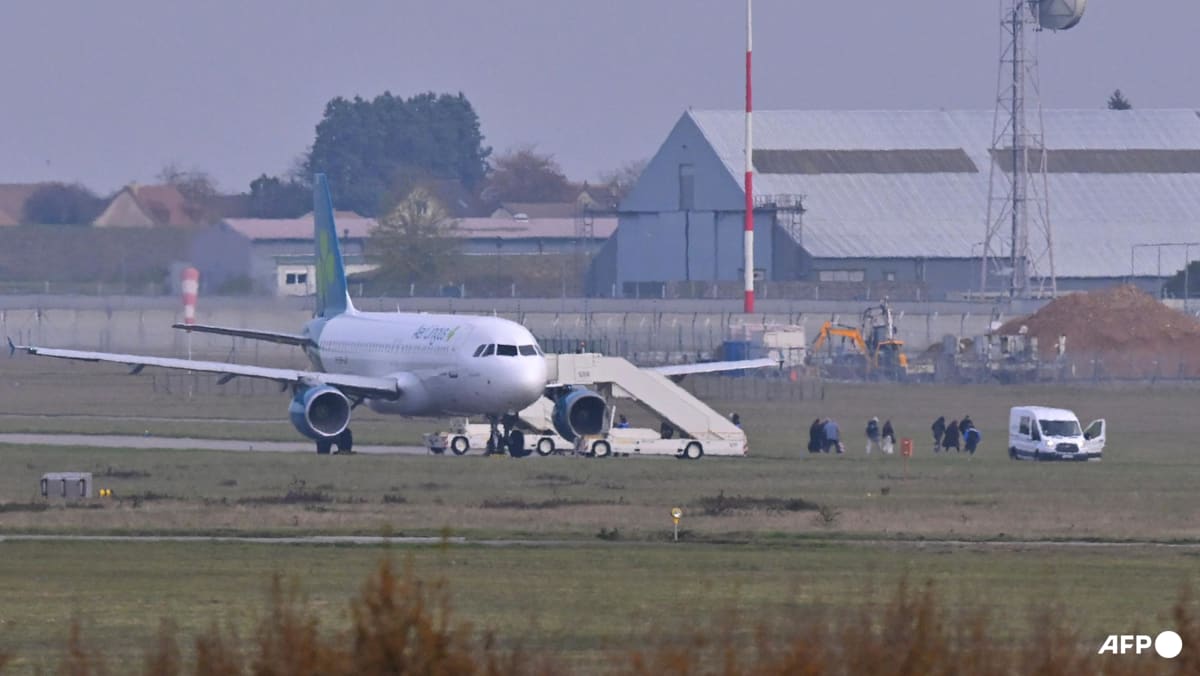
SINGAPORE: More than 30 flights across Europe have been disrupted by a wave of hoax bomb threats this week, forcing diversions, emergency landings and fighter jet escorts. At least 27 flights were affected on Thursday (Nov 5), including services across Italy, Bulgaria and the Czech Republic. Earlier on Tuesday, at least seven flights, including two departing from the United Kingdom, and a cruise ship were targeted. All affected aircraft landed safely, with security checks finding no explosives. Authorities have yet to identify those responsible or establish whether the incidents are linked. While bomb threats are not uncommon in aviation, security experts say the coordination and scale of this week’s incidents are unusual. CNA looks at what we know so far. A person stands in front of the table of departures at the Terminal 1 of Rome Fiumicino airport, on Nov 5, 2026. The hoaxes particularly targeted low-cost carriers and flights to or from Bulgaria, Czech Republic and Italy. (Photo: AFP/Andreas Solaro) WHAT HAPPENED AND WHICH FLIGHTS WERE AFFECTED? Thursday’s threats affected flights across several European countries including France, Italy, Spain, Poland and the United Kingdom.Among those targeted was a Finnair plane travelling from Helsinki to Rome that was escorted by fighter jets, and an Aer Lingus plane flying from Dublin to Rome that was diverted to a military airbase in France after being intercepted by French fighter jets. Three Ryanair flights bound for Sofia from Copenhagen, Madrid and London were also escorted by Bulgarian fighter jets.Two landed in the Bulgarian capital of Sofia, while the flight from London was diverted to Plovdiv, the country’s second-largest city, according to Bulgaria’s interior minister. Four flights heading to Prague were also targeted on Thursday, along with two LOT Polish Airlines flights bound for Paris and Brussels.Two Aegean Airlines flights travelling from Thessaloniki to Milan and from Athens to Vienna were similarly affected. This video grab from AFPTV footage shows a Finnair plane taking off from Fiumicino Airport after it was diverted due to a bomb threat, with Italian air force jets having escorted it from Helsinki to Rome on Nov 5, 2026. (Photo: AFP/Andrea Bernardi) Thursday’s incidents followed a series of similar incidents earlier this week.On Monday, a Wizz Air flight from London Luton Airport to Sofia was diverted to Budapest after receiving a bomb threat. Hungarian fighter jets escorted the aircraft, which landed safely.The following day, at least seven flights across Europe received threats, including a LOT Polish Airlines flight from London Heathrow to Warsaw that was diverted to the Warsaw Modlin Airport, prompting its brief closure. A Ryanair flight from Manchester to Murcia in Spain was also affected while another Ryanair flight from Dublin to Rome was escorted by Italian fighter jets. All incidents have been confirmed to be false alarms, with nothing suspicious found by the relevant security authorities. WHICH AIRLINES WERE THE MOST AFFECTED? No clear pattern has emerged among the airlines and airports targeted, although a significant number of the affected flights either departed or were bound for Italy. Sofia and Milan each recorded six incidents, followed by Rome with five and Prague with four incidents, according to The Guardian. Ryanair was among the hardest-hit airlines, with eight reported cases. European Union transport commissioner Apostolos Tzitzikostas said on Thursday it was “too early to draw conclusions on whether the reported incidents are linked”. A Lufthansa airplane passes by Ryanair and Bulgarian air planes at Vassil Levski airport in Sofia on Nov 5, 2026. Three Ryanair planes headed for Sofia from Madrid, Copenhagen, and London Stansted were targeted by bomb threats, a spokesperson for the Bulgarian Ministry of Transport said. (Photo: AFP/Nikolay Doychinov) WHO IS BEHIND THE THREATS? No one has claimed responsibility for the threats and authorities have yet to identify those behind them.An airport source in Italy told Reuters that an email with the subject line "Threat report" had been sent to several addresses belonging to airlines, airport operators and airport service providers at Rome's Fiumicino and Milan's Malpensa airports.The email, which claimed it was from "fighters of the Male State", said devices had been placed on inbound flights from Helsinki and Dublin and they would explode in 60 minutes."Today your sky will be red," the message said. Reuters could not independently confirm who had sent the email and there was no immediate indication of who was behind the other threats across Europe.Vladislav Pozdnyakov, a Russian blogger who set up an anti-feminist movement called the Male State in 2016 that was later banned in Russia, said that the group no longer existed and was not involved in any way. Travellers scan their boarding pass to enter the security control area at the Terminal 1 of Rome Fiumicino airport, on Nov 5, 2026. (Photo: AFP/Andreas Solaro) The incidents also come as many European officials are accusing Russia of planning “hybrid attacks”, which are often cheap, easily deniable and not expected to trigger an armed response. Some have accused Russia of carrying out sabotage and other hybrid operations since its 2022 invasion of Ukraine. Denmark, Poland and Romania, which were among the countries affected by Thursday's disruptions, have previously accused Moscow directly of being behind hybrid attacks, while Germany blamed Russia for an August attack on Leipzig airport. Britain has separately linked Iran to a suspected plot against a US air base. Both Russia and Iran have denied those accusations.Aviation security experts say that while hoax bomb threats occur regularly, the sheer number reported this week is unusual. “What has happened this week seems to be coordinated to some extent,” Philip Baum, a visiting professor of aviation security at Coventry University told Al Jazeera global news network. The threats could have also been the work of individuals acting on personal grievances or copycats, although the incidents also bear the hallmarks of a more coordinated "hybrid attack", the experts added. "When it comes to a situation like this or even other sabotage attacks, it's really hard to prove there's a certain country behind it. But it does fit in the modus operandi," said Eric Schouten, head of aviation security group Dyami. Experts said the hoaxes could serve not only to disrupt air travel but also to test how airlines, airports and authorities respond to security emergencies. It appears to “sow chaos, uncertainty, about the reliability of air traffic across Europe,” said Jacob Funk Kirkegaard, senior fellow at the Bruegel think tank in Brussels."These aviation threats are also occurring in the same period as cyberattacks on supermarket refrigeration systems across Europe," said Eliran Almog, CEO of aviation cybersecurity firm Cyviation."Different essential services are experiencing disruption that carries economic costs and can undermine public confidence."This week, unidentified hackers for the second time shut down fridges in supermarkets in several European countries, also affecting French blood banks.But no connection has been established between the cyberattacks and the aviation threats. Passengers of Aer Lingus aircraft from Dublin to Rome, leave in a bus the Evreux-Fauville Air Base after their plane had been rerouted and escorted by military aircraft after a suspected bomb threat, on Nov 5, 2026. (Photo: AFP/Guillaume Saligot) WHAT HAPPENS WHEN AN AIRLINE RECEIVES A BOMB THREAT AND HOW MUCH COULD DIVERSIONS COST? Airlines have established procedures for assessing bomb threats, with the response depending on the threats' credibility and whether the aircraft is on the ground or already airborne. In a statement on Thursday, Joji Waites, director of flight safety at the British Airlines Pilots Association (Balpa), said any threat received by an airline would be passed to a team of assessors who would grade its credibility. Threats are graded "red" if deemed credible, "amber" if partly credible and "green" if not credible. For aircraft already in flight, only red or green classifications are used, he said. If a threat is deemed credible, the flight crew is immediately informed and the captain makes all the decisions, guided by a safety checklist, said Waites.If the aircraft is on the ground, this could mean evacuating passengers.For those already airborne, the priority is to land as soon and as safely as possible.“Pilots are highly trained and skilled professionals. Their expertise is invaluable in ensuring passenger safety and keeping aviation one of the safest forms of transport there is,” Waites said.Airlines, airport operators and law enforcement generally follow guidelines developed by the European Union Aviation Safety Agency and the International Civil Aviation Organization, which conducts audits to ensure compliance.Flight crew training includes live situational exercises covering various threats, including how to search for explosives that may have been smuggled on board.When threats are called in, airline employees are instructed to keep the caller on the line and to gather as much information as possible, Baum told AP. Many of the threats received this week were sent by email, with enough information for authorities to determine that aircraft needed inspection. Such responses can be costly for airlines, especially when flights must be diverted, passengers evacuated or aircraft searched. Baum of Coventry University said diverting a flight because of an unruly passenger or a bomb threat can cost up to US$250,000.The costs may be lower in this case because most of the disrupted flights were short-haul, where there is less likelihood of overnight delays, he said.
Fighter jet escorts, flight diversions: What we know about Europe’s wave of hoax bomb threats
Full Article
Original Source
Read the full article at Channelnewsasia →KhanList aggregates and links to publicly available news content. We do not host full articles from third-party sources. Always verify important information with original sources.