
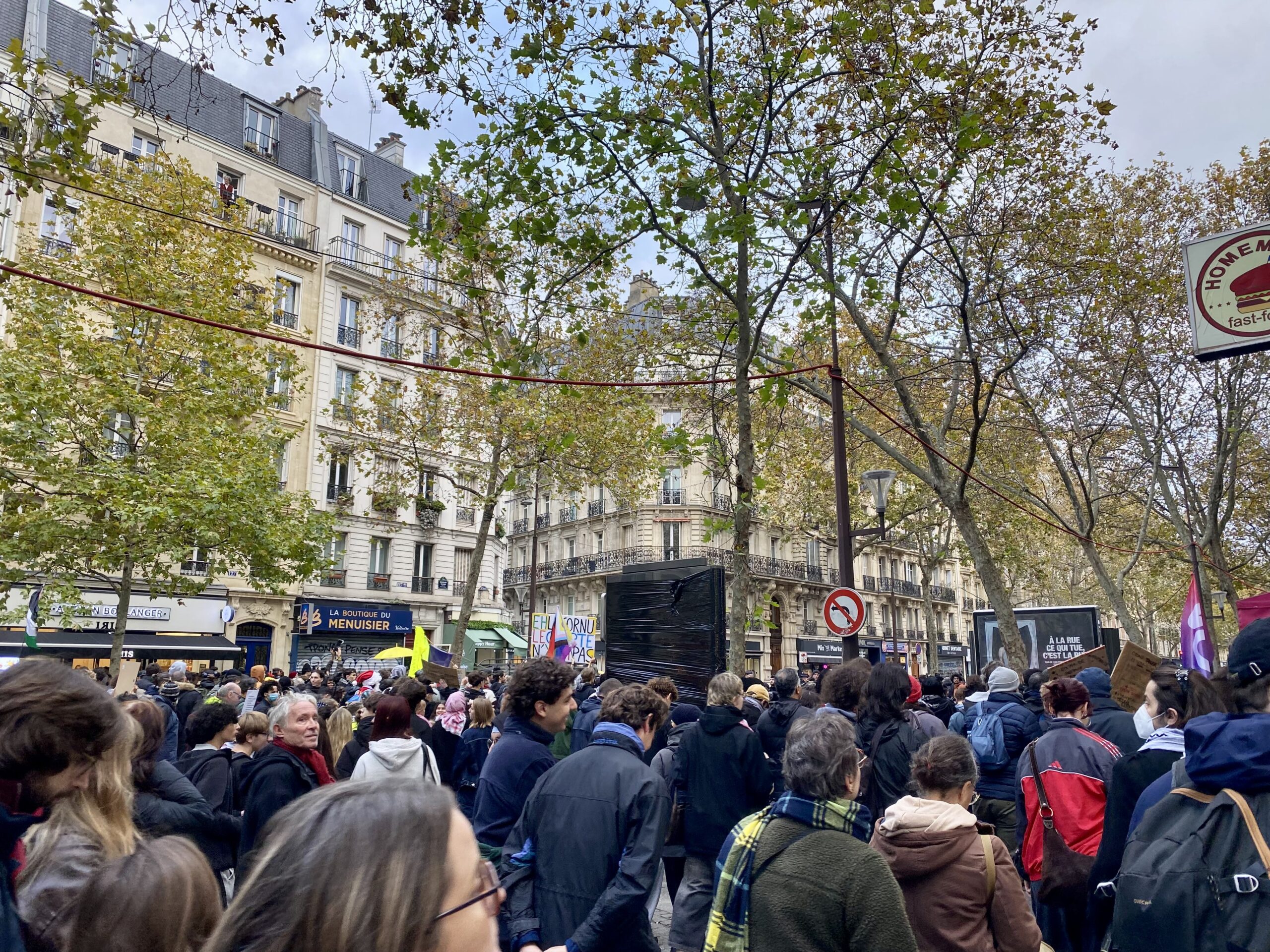
Seven countries have coordinated mass demonstrations over rising living costs and broader social frustrations, with hundreds of thousands expected to take to the streets from Friday through Sunday.PARIS (CN) — Protesters will be collectively mobilizing across Europe from Friday to Sunday, when hundreds of thousands of people are set to march for higher living standardsamid a growing sense of disappointment with political leadership.“It’s very difficult for a lot of people to live; Life is expensive and if we don’t resist, it can’t go better, so we’re obligated [to protest],” Farida, a Frenchwoman who asked to go by her first name on Saturday, said. “The rich are getting richer and the poor are getting poorer… People are tired of their material conditions for living and are scared of fascism.”In Paris, a helicopter buzzed overhead as thousands marched down Boulevard Voltaire, some carrying Heineken while others danced and sang their way through the streets.“I’m not directly concerned [by the issues at stake], but I’m here for my children and my grandchildren,” Hélène Salvat, a woman attending the Paris demonstration, said on Saturday. “Education … is for our society of tomorrow; it’s degrading more and more… I imagine these struggles are a bit everywhere [in Europe].”An inter-university union demonstrating in Paris on Nov. 21, 2026. (Lily Radziemski/Courthouse News)Protesters in France, the U.K., Spain, Italy, Belgium, Portugal and Greece coordinated demonstrations over rising rents and energy costs, military spending, police violence, underfunded schools and low wages. Many marched under the slogan, “Fight for our future, not their wars.”“This shows that we’re at a very particular historical moment, and not only in Europe,” Johanna Siméant-Germanos, a professor at the École Normale Supérieure specialized in the sociology of mobilizations and collective action, said. “Younger generations have known for years now that their futures are going to be dramatically affected by climate change, in a context where their economic futures — aside from the climate issue, which is going to impact the economy anyway — aren’t cheerful either, since the promise that each generation would do a little better than the previous one has been broken.”Recent events have spurred unions, students and workers to coordinate protests across Europe. Student-led demonstrations in France have fueled calls for education reform, while a resurgence of the yellow vest movement has renewed attention to the cost-of-living crisis.The October eviction and subsequent death of Maricarmen Abascal, 87, in Madrid sparked outrage over housing rights. Mass protests pressured Spain’s parliament to approve new legislation ahead of an early general election on Nov. 29.“We’ve been thinking a lot about how amazing this energy specifically from Spain is, and that the housing movement there has been able to trigger law changes, a snap election, a mass general strike with millions of people in the country,” Samantha James, a member of the London Renters Union, said. “We want that here, because the government is saying that they’re going to change the way [they do] business, but it’s just business as usual.”Gendarmes lined up along the Boulevard Voltaire on Nov. 21, 2026. (Lily Radziemski/Courthouse News)It’s unclear how the coordinated movement will impact politics and policy.In France, protests are widely seen as strengthening both ends of the political spectrum, with demonstrators gravitating toward hard-left leader Jean-Luc Mélenchon while far-right leader Marine Le Pen rallies supporters around restoring order and security. In Spain, left-wing Prime Minister Pedro Sánchez faces an uncertain political future ahead of the Nov. 29 election.“It’s true that in Spain, there’s a fear that it will be the far right that emerges victorious from the elections, not necessarily because of these movements, but because it can capture part of the material discontent, yet code it differently politically,” Siméant-Germanos said. “That is obviously the case in France; we can clearly see how disgruntled shopkeepers, the idea of disorder, can also benefit the far-right even though this mobilization has led to a very strong return of social issues at the same time.”Categories / InternationalSubscribe to our free newslettersOur weekly newsletter Closing Arguments offers the latest about ongoing trials, major litigation and rulings in courthouses around the U.S. and the world, while the monthly Under the Lights dishes the legal dirt from Hollywood, sports, Big Tech and the arts.Additional Reads
‘Fight for our future, not their wars’: Coordinated protests sweep through Europe
Full Article
Original Source
Read the full article at Courthousenews →KhanList aggregates and links to publicly available news content. We do not host full articles from third-party sources. Always verify important information with original sources.