
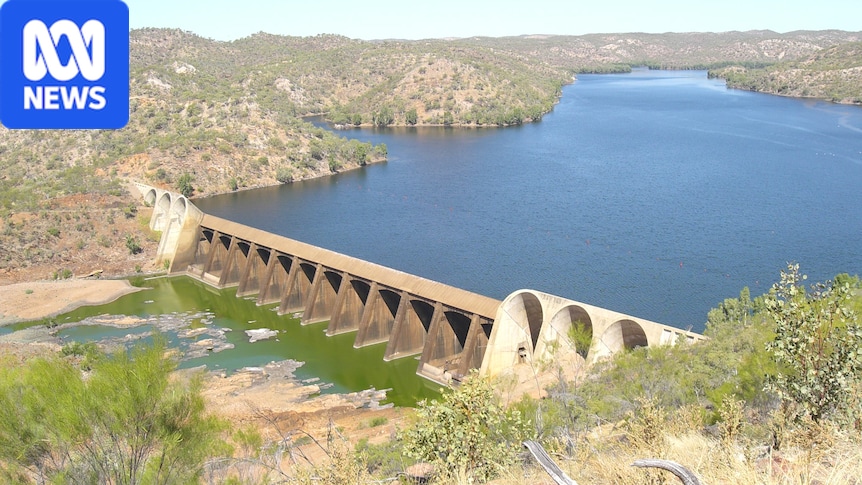
In 1971, a devastating drought exposed a serious problem in the outback mining city of Mount Isa. Despite having a major dam, the city was running short of water.Lake Moondarra, built by Mount Isa Mines in 1958 on the Leichhardt River north of town, was Australia's largest, privately-funded water scheme at the time.But as the city and its mining industry grew, the drought exposed a need for another reliable water source.The solution was unveiled five years later with the completion of Julius Dam, about 70 kilometres north-east of Mount Isa, at the junction of the Leichhardt River and Paroo Creek.The North-West Star declared "No more water worries" when Julius Dam was officially commissioned on October 8, 1976. (Supplied: North-West Star)An engineering solution built for the outbackConstructed by Thiess Brothers, Julius Dam required hundreds of workers, including people from Scotland, England and Ireland, some of whom lived on site with their families.Building a structure with a 220-metre spillway in remote Queensland had significant challenges.Hundreds of workers helped construct Julius Dam between 1973 and 1976, overcoming the challenges of building in remote North West Queensland. (Supplied: Sunwater)Engineers chose a concrete multiple-arch and buttress design that reduced the amount of material needed while maintaining the dam's strength.The design helped overcome the difficulties of building in the outback, according to current operator Sunwater."Because of its remoteness, because of the difficulty of getting materials in, that's the reason they decided to go with that structure," north region general manager of operations, William Weaver said.Julius Dam's distinctive multiple-arch and buttress design reduced the amount of concrete required for construction. (Supplied: Sunwater)Sunwater says it remains the only dam of its kind in Queensland.But another feature caught the attention of University of Queensland geotechnical engineering professor Alexander Scheuermann."The first thing I thought when I saw the dam was, 'Where's the spillway?'" he said.Professor Alexander Scheuermann says Julius Dam's unique design allows floodwater to flow directly over its structure. (Supplied: Alexander Scheuermann)Unlike dams with a separate spillway, Julius Dam's concrete, 18m wide arches allow excess water to flow directly over the structure."When the water rises higher than the dam is, it simply overtops the dam without harming the structure," Professor Scheuermann said.A reliable water source for the North WestJulius Dam can hold 107,500 megalitres of water, equivalent to about one-fifth of Sydney Harbour's volume.While originally developed to supplement Mount Isa's water supply, its role has expanded over the past five decades.The 113-kilometre North West Queensland Water Pipeline, completed in 1998, supplies mining operations including the Ernest Henry copper and gold mine near Cloncurry.Another 38km pipeline was completed in 2010 following a drought, providing Cloncurry with an additional year-round water supply.Lake Moondarra remains Mount Isa's main water source, with Julius Dam providing supplementary water when needed.Julius Dam's built-in spillway allows excess water to flow directly over its concrete arches during periods of heavy rainfall. (Supplied: Sunwater)Despite the region's long dry periods, Mr Weaver said Julius Dam had spilled every year for the past decade.He attributed its reliability to seasonal monsoonal and cyclonic rainfall regularly replenishing the Leichhardt River catchment."What Lake Julius does is it gives you that real assurance and real surety of supply," he said."And that's allowed Mount Isa and its industry to grow."William Weaver says Julius Dam remains a vital water source for North West Queensland. (Supplied: Sunwater )Built to last another 50 yearsWhile Julius Dam has operated for five decades, Professor Scheuermann said ongoing maintenance would be essential to its future.He said dams could remain operational for more than a century, but changing rainfall patterns, extreme weather and future water demand would need to be considered as infrastructure aged."So you need to have the skilled labour and also the engineers who are able to assess the safety of the dam."Julius Dam spilling before construction was completed in 1976. (Supplied: Sunwater)Mr Weaver said a seven-person team based in Cloncurry operated and maintained the dam and its associated pipelines.For a structure tucked away in a remote stretch of the Leichhardt River, its contribution reaches far beyond the water it holds."It's one of those little hidden gems that most people don't even know exists because it's tucked away in the middle of nowhere," Mr Weaver said."So it's a hidden gem, but it certainly does a great job."
Fifty years on, Julius Dam continues to sustain outback communities
Full Article
Original Source
Read the full article at Abc →KhanList aggregates and links to publicly available news content. We do not host full articles from third-party sources. Always verify important information with original sources.