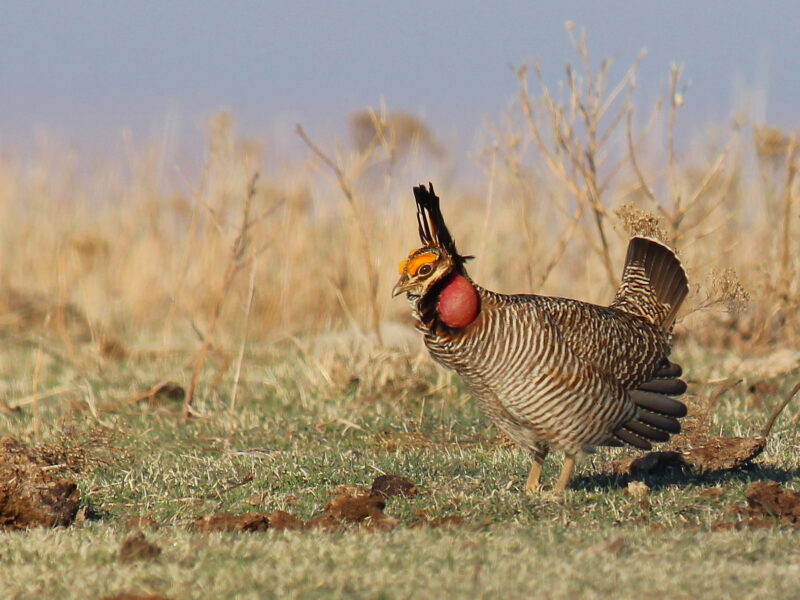
Environmental groups urged the Fifth Circuit to reverse a lower court decision that blocked them from defending Lesser Prairie Chicken protections rescinded by the U.S. Fish and Wildlife Service .(CN) — Why did the Lesser Prairie Chicken cross the road?Probably because roads and highways increasingly divide its natural habitat, according to environmentalists who told a Fifth Circuit panel Tuesday they were boxed into a “Goldilocks” dilemma in attempts to defend the bird’s listing.U.S. Fish and Wildlife Service abandoned federal protections for the species by wiping out a 2022 rule listing two distinct population segments of the bird as threatened and endangered under the Endangered Species Act.Now, after a lower court rejected the Center for Biological Diversity and Texas Campaign for the Environment’s attempts to intervene in the case, attorney Jason Rylander urged the panel to curb what he called “backroom” settlements that erase endangered species protections without meaningful scrutiny.Denied intervention early because the government was presumed to provide “adequate representation,” the center was later turned away as untimely after the Trump administration reversed course and argued its own error in the approving the rule.The 2022 rule followed years of petitions, litigation and scientific review; the service initially appeared ready to settle — then President Donald Trump’s Justice Department sought vacatur and remand.That produced a 2025 ruling from U.S. District Judge David Counts, a Trump appointee, denying the environmental groups’ intervention as untimely and vacating the listing without a full merits ruling.“I think the important thing is that there needs to be sunshine and daylight in these processes where there are administrative rules that are issued where there has been public notice and comment,” Rylander said. “When that does not happen, it invites gamesmanship and … there has to be some meaningful examination when the government confesses error.”He warned that fewer than 5,000 prairie chickens remain in New Mexico and Texas and the entire population is threatened under the new policy. Numbers of the vulnerable ground-nesting grouse have dwindled over the past century due to hunting and development in the American heartland.Although the panel pushed back on his claim that the species now has no protection, Rylander maintained that voluntary conservation was not effective, pushing the service to re-list the species.“We now have three cases where we’ve been denied the ability to intervene,” Rylander argued, noting that in each one the government returned at the last minute to claim error and vacate the rules.A trio of attorneys for industry groups, several states and the federal government urged the panel to keep the environmental groups on the sidelines.Brittany Wright, for the state appellees, said the groups waited months after it became clear the new administration might change course, she said, at a point when the two-year case was nearing an end and the parties were trying to settle.“Allowing intervention would prejudice the existing parties and their attempts to conclude the case,” she argued.U.S. Circuit Judge Cory T. Wilson, a Trump appointee, repeatedly asked why the court couldn’t simply say the environmental groups should have been allowed to intervene and send the case back.“Why can we not say they should have been allowed to intervene by right?” he asked.U.S. Circuit Judge Karl E. Stewart, a Bill Clinton appointee, questioned how a delay of just a few months could be fatal for would-be intervenors when, in similar cases, the federal government has taken even longer to decide whether to change course. He remarked that four or five months doesn’t seem untimely in that broader context.Federal attorney Emily Polachek backed both the denial of intervention and the decision to wipe away the old rule so the agency could start over.She acknowledged the groups acted within a week once it was obvious the case was about to end, but argued they had earlier awareness that policy was shifting. On the rule itself, she leaned on the government’s confession of error, arguing the math doesn’t add up.“A plus B does not equal C without including D in there, and it wasn’t in there,” she said, stressing it would be unfair to leave landowners and other regulated parties bound by a rule the agency now believes is unlawful.Industry attorney Jacob Dekeratry insisted the groups lack standing and downplayed the impact of the 2022 rule, saying the lapse in protection affects only 9% of this species for a roughly six-month period while the service revisits its analysis, expected to finish by February 2027.But Rylander maintained the lower court wrongly blocked the intervention, stressing the groups were the primary party to appeal and had standing backed by affidavits. He stressed there was no prejudice from their timing in the fast-moving litigation.“This a policy reversal masquerading as error,” he said.The panel, which also included U.S. Circuit Judge James E. Graves, a Barack Obama appointee, did not indicate when it would rule.Subscribe to our free newslettersOur weekly newsletter Closing Arguments offers the latest about ongoing trials, major litigation and rulings in courthouses around the U.S. and the world, while the monthly Under the Lights dishes the legal dirt from Hollywood, sports, Big Tech and the arts.Additional Reads
Fifth Circuit presses intervention timing in rare prairie chicken protections
Full Article
Original Source
Read the full article at Courthousenews →KhanList aggregates and links to publicly available news content. We do not host full articles from third-party sources. Always verify important information with original sources.