
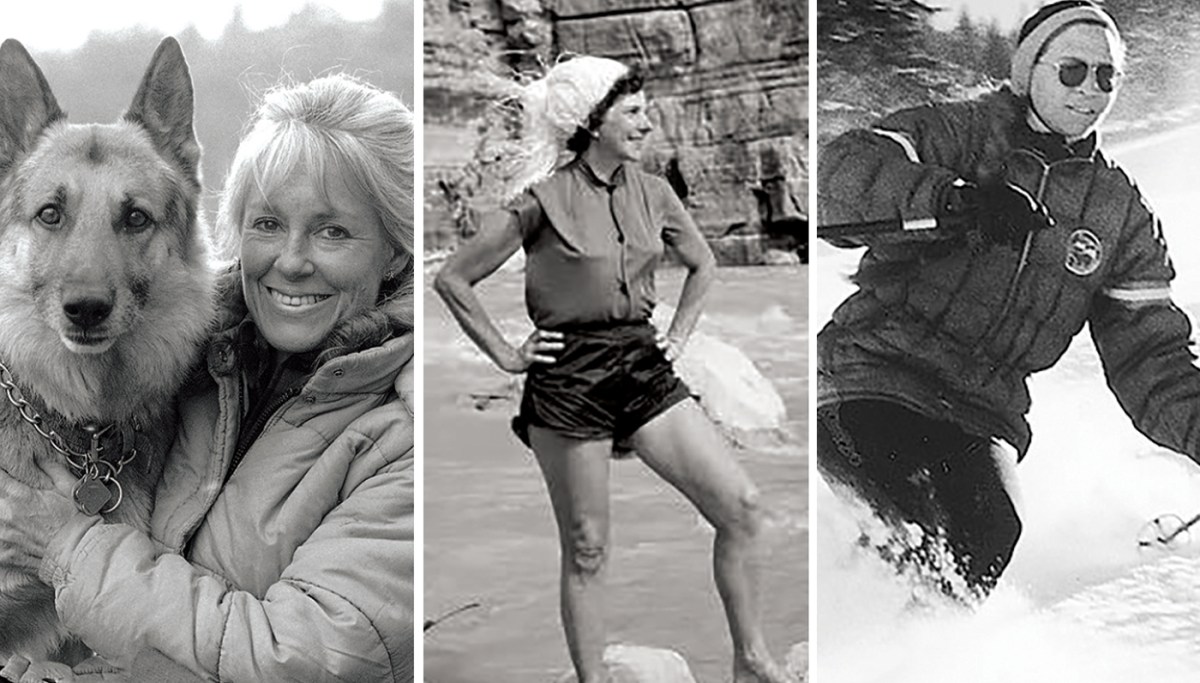
I like my heroines with a spiky side. Think Sarah Palin in camouflage and a ball cap, hunting caribou in Alaska, or Annie Oakley’s petticoat gently brushing against twigs and bushes in her native Ohio as she walked through the woods, shooting squirrels through the head. I like my heroines with a heaping portion of grit, like my grandmother in the Adirondack foothills, whose disagreeability was legendary among her townsfolk. I like reading the history of a female character alone in the forest, “skinny-dipping or slicking on pink lipstick as she ran a chainsaw.” This is how author Heather Hansman describes woodswoman Anne LaBastille in her new book, Fierce Country: The Untold Story of Three Women Who Ignited America’s Love for the Wild. Recommended Stories LaBastille, a spiritual descendant of Thoreau who lived alone in a remote, hand-built cabin in the Adirondack wilderness, is one of a triad Hansman profiles in this excellent nonfiction offering. The other two are Georgie White, the first woman to popularize bringing people through the perilous rapids of the Grand Canyon for recreational purposes, and Dolores LaChapelle, a mystical powder skier in Colorado who sought to create a neo-ritualistic framework for our relationship with the Earth. It’s clear that Hansman was in need of heroines — forerunners who could show her the path to her own deep engagement with nature, and a blueprint for the satisfaction of her physical desire to be close to the American landscape.The way she describes the daily routine of LaBastille, a writer and environmentalist, is blissful: After a morning of typing in the woods, she’d take a swim in the pristine lake, before spending “evenings on the water, where she could walk down to the dock with a pot of spaghetti, a bowl of salad, a shortwave radio, and an ice-cold beer.” Her solitary career had worldwide reverberations. A worker at the Adirondack Experience museum, where LaBastille’s home has been reconstructed, tells Hansman that female visitors sometimes “put their hands on Anne’s cabin, and cry.” Fierce Country: The Untold Story of Three Women Who Ignited America’s Love for the Wild; By Heather Hansman; Hanover Square Press; 320 pp.; $30.99 A similar feeling of pilgrimage infuses Hansman’s chapters on White and LaChapelle, and her prose is muscular. She talks about her own courageous river trip through the Grand Canyon, and what it’s like to sleep on soil where “sacred white datura flowers bloom on glossy green stalks.” The physical risk of rafting makes her feel “stretched, buzzy, springing.” The water of the Little Colorado is “fluorescent milky jade.” She describes snow that melts as “frying to lace in the sun.” Her voice has an appealing obstinacy, and her affinity for active verbs and embodied descriptions of nature’s infinite colors makes the book consistently compelling. Hansman also adeptly shifts between fact-filled, science-heavy accounts of her subjects’ interactions with the land and sharing the impressive athletic feats she’s taken on herself, from the shores of Walden Pond to the slopes of Silverton.I appreciated the physical heroism in this book. Hansman is attracted to an anti-fragility ethos despite herself because she views it and other bedrock American virtues as inherently questionable. One wishes she would let herself enjoy the glee of her own lusty, rugged individualism a little more and spend less time picking it apart or displaying shame. Perhaps these are the curtsies one must make to have a book published that, at its deepest core, celebrates the American relationship to our tricky terrain, but one gets the sense that Hansman is genuinely hampered by her moral hesitancy regarding just how much reckless self-reliance we should permit ourselves to enjoy. I say have at it: To constantly apologize for the massive physical bravery of our national heritage is an affront to our pioneering ancestors.The way Hansman talks about her body and its need to merge with the landscape echoes with me. After nearly five years in Washington, I am headed back to my native upstate New York, and recently visited an Adirondack lake, where my family made its earliest homesteads. She mentions the Welsh word hiraeth, which means “a desire for a landscape that feels like it should be yours,” or “a longing to be where your spirit lives.” This concept shows up in various cultures. The Finns have sielunmaisema, “a landscape you carry in your heart,” while the Spanish speak of querencia, the place one is drawn to that provides a deep sense of home.Left to right, Dr. Anne LaBastille is shown with dog, Condor, in the Adirondacks in 1985; Georgie White stands on rocks in the Colorado River; Dolores LaChapelle on the slopes in Alta, Utah, in the early 1960s. (AP photo; Josef Muench/Northern Arizona University/Courtesy of the National Park Service; WildSnow History Archive) When Anne LaBastille was asked why she took on her wilderness lifestyle, she replied that she wanted “to be close to the wellspring of life.” There’s a particular sickness or lingering discomfort that can afflict a person divorced from her natural landscape — a bodily knowing that something is off. I’ve felt this, too. My earliest life was characterized by long walks through farmers’ fields, alone and independent even as a small child, and nothing about living in a city street grid will ever feel natural to me. Fierce Country depicts the search for an animal sense of belonging. “I know that feeling of having your heart split by place and always feeling like something small but sharp is missing when you’re not in the right place,” its author confides.A NEGLECTED BOOK MAKES THE CASE FOR BEES Although she avows she is not a religious person, Hansman often seems to be searching for something in all these nature encounters that she can’t quite name. She describes a conversation about American spirituality with historian Adam Sowards, who tells her, “we don’t have cathedrals, but we have the Grand Canyon.” Her profile of Dolores LaChapelle, the skier and independent philosopher, is a somewhat wistful portrait of a woman who left behind the Catholicism of her youth to create a new cosmology from scraps and bits of Eastern and Indigenous thought. LaChapelle was part of a movement called deep ecology, through which thinkers and scientists attempted to find a spiritual foundation for environmental conservation. LaChapelle’s “desire for embodiment” and need to recognize “the value of every living thing,” as Hansman tells it, still seem deeply in line with Catholic social teaching and sacramental practice.At times, it seems that what Hansman’s really looking for are saints, not heroines. She critiques the moral flaws of each woman she profiles and uneasily enjoys her admiration of them. “The problem with looking for heroes is that when you go digging, you find dirt,” she concludes. But saints are allowed to be sinners. Hansman confesses to dipping her hands in Anne LaBastille’s lake and thanking her for her story. She talks about climbing with others “up a hill above town to a shrine built for Dolores.” She writes about how running the rapids in the Grand Canyon helped Georgie White feel alive again after the death of a family member left her numb. There’s a desire for religion in this book, both for its ethical framework and its validation of mystical experience. Why else would a woman throw herself into the ruddy streams of the West, or the solitary lakes of the North Country, or the glistening peaks of the San Juan Mountains, if she were not seeking God? It’s true that digging up your heroines may leave you covered in dirt. But dirt is also part of the Earth.Emma Collins is a freelance writer and the author of A New Heaven on Substack.
‘Fierce Country’ profiles three women drawn to the great outdoors
Full Article
Original Source
Read the full article at Washingtonexaminer →KhanList aggregates and links to publicly available news content. We do not host full articles from third-party sources. Always verify important information with original sources.