
Fhenix says its encrypted computation coprocessor, CoFHE, is now in production on Ethereum and Arbitrum. The October 21 announcement brings fully homomorphic encryption, or FHE, to applications that need to calculate with confidential balances, positions and trading strategies while using those networks for their contracts. The launch includes a dual-mode token design, two announced design partners and a Consensys Diligence audit, according to Fhenix. Its commercial proposition is straightforward: institutions should be able to use public blockchain infrastructure without making every financial input available to competitors.There is already a substantial market in which to test that proposition. RWA.xyz's October 20 snapshot recorded approximately $14.5 billion in distributed tokenized U.S. Treasury assets. That category includes Treasury-backed products and funds, rather than the entire tokenization market. It demonstrates that assets are reaching blockchain wallets; it does not establish how much additional capital confidentiality would attract.The more consequential question for Fhenix is whether privacy can become a feature of an asset's existing workflow. Its dual-mode approach gives a compatible token both public and confidential balances under one canonical contract address. That could reduce the need to move between separate representations of the same asset, although applications still have to integrate the confidential interfaces.Selected platform values from RWA.xyz's tokenized U.S. Treasury dashboard, accessed October 20, 2026. Values are rounded; the five platforms are a subset of the category. This is market context, not Fhenix's addressable market or a measure of assets blocked by privacy.How CoFHE separates execution from disclosure Values supplied in plaintext to ordinary public smart contracts are visible onchain. CoFHE lets developers represent selected values as ciphertext and request operations on them without first turning those values into readable numbers. The computation takes place outside Ethereum or Arbitrum. In Fhenix's documented compute pipeline, host-chain contracts submit requests, workers perform the encrypted operations, and the system records commitments associated with the resulting ciphertexts. The application uses encrypted results and its permission rules to determine what happens next. Plaintext access is a separate, authorized operation.This division matters because the host chain does not have to execute the expensive cryptography itself. Fhenix says CoFHE's dynamic throughput scales with demand. The announcement, however, supplies no sustained application throughput, latency distribution or cost benchmark. Capacity that can expand is useful, but a payments application or trading venue still needs to know how long a complete transaction takes when many users submit work together.Editorial illustration based on Fhenix's compute pipeline and access-permission documentation. It explains the division of work, rather than a measured performance result or a proof of independently verified execution.For developers, the entry point is familiar Solidity tooling and an FHE library. The implementation is more involved than importing a package. Encrypted values require their own operators, access permissions and client-side encryption. Even a conditional expression needs a different treatment: Fhenix's conditions documentation explains that an encrypted boolean cannot drive an ordinary Solidity if statement. Developers use an encrypted selection operation instead.The developer experience therefore has two tests. The first is whether a builder can create a working demonstration quickly. The second is whether that builder can manage encrypted inputs, permissions and asynchronous results reliably in an application used by other people.One token can serve two kinds of activity Fhenix's dual-mode design addresses a practical distribution problem. An asset can be useful in public markets and still require confidentiality for particular transfers or positions. Creating a separate private representation can add another integration task for its issuer, users and application partners. The dual-mode implementation keeps public and confidential balances in the same token contract. A user can shield a public balance into its confidential mode. The public side preserves the ordinary ERC-20 interface, while the confidential side exposes functions for encrypted activity.That distinction limits the compatibility claim. Existing wallets, exchanges and DeFi applications can use the public interface. Confidential balances need applications that understand the encrypted interface. An unchanged public lending market does not gain the ability to evaluate encrypted collateral simply because the token also has a private balance.The current documentation also distinguishes new dual-mode tokens from already deployed assets. It recommends the dual-mode contract for a new token and a wrapper for adding confidentiality to an existing token. The native design can avoid an external wrapper; it is not evidence that any immutable ERC-20 already in circulation can acquire privacy through a holder's transaction.Switching modes is also asymmetric. Shielding takes one transaction. Returning to a public balance requires an unshield request followed by a claim after the necessary decryption result becomes available.One implication is that Fhenix can reduce asset migration work while leaving application integration as a separate job. A token issuer could retain one asset identity across public distribution and confidential use. The value would grow as more applications support that second mode; the token contract alone cannot supply that ecosystem.Editorial illustration of the documented dual-mode design and shielding workflow. Public compatibility and confidential integration are distinct capabilities. The distinction between confidentiality and anonymity is important for the applications Fhenix wants to attract. Its dual-mode explainer says balances and transfer amounts can be confidential while sender addresses, recipient addresses and transaction timing remain public. Public-mode activity remains visible, and entering or leaving the confidential balance can disclose amounts at those boundaries.A fund may value encrypted position sizes even if counterparties can observe that it interacted with a contract. Another strategy may depend on concealing the relationship between addresses. Those are different requirements, and the second does not follow automatically from protecting a number.That ambition depends on the application design. A confidential workflow has to decide which values stay encrypted, which participants can read them and which outputs become public. An institution's operating policy becomes part of its smart-contract configuration. This suggests that permission management and disclosure controls could matter as much to adoption as the encryption primitive itself.Editorial illustration based on Fhenix's privacy explanation and mode-transition documentation. Confidentiality depends on the application and its permissions; the design does not provide blanket transaction anonymity.The first partners target information worth protecting Fhenix names Fluton and Alpha Engine as its first mainnet design partners and says both completed technical and security reviews ahead of launch. Fluton describes its product as infrastructure for confidential interactions across applications, assets and chains, using encrypted intents. Its earlier partnership announcement identifies CoFHE as part of a broader confidentiality stack. That gives Fhenix a potential distribution channel through another developer-facing product, although it does not establish how many applications or transactions will use the integration.Alpha Engine offers a more specific financial use case: evaluating strategies without revealing the logic that makes them valuable. Its public documentation describes a Strategy Arena for simulation and evaluation, with public scores and diagnostic artifacts. It also says public-v1 capital deployment endpoints are not live and that evaluation evidence creates eligibility rather than automatic capital allocation.The launch partnership therefore should not be read as proof that an established investment marketplace is already allocating substantial live capital through CoFHE. It identifies a workflow in which confidentiality has a clear purpose. The next evidence would be whether strategists submit repeatedly, evaluators can assess results, and the system progresses into capital deployment under defined controls.Audit coverage and operating trust will shape procurement Fhenix says Consensys Diligence audited the system ahead of launch. Its public confidential-contracts repository provides a more specific statement about the contract package. The accompanying remediation summary describes a September 2026 engagement and fixes released in version 1.0.0. It also identifies two subsequently added upgradeable wrapper hosts as outside that review.One acknowledged finding is especially relevant to the product's promise: an approved operator can read a holder's exact balance. The summary treats this as accepted behavior because that operator already has authority over the funds. It illustrates why “encrypted” has to be understood alongside the permissions an application grants.There are separate infrastructure questions. Fhenix's public trust roadmap, accessed before launch, describes a Fhenix-operated trusted execution environment for decryption and reconstruction of the full key inside an attested enclave. It lists multi-party threshold decryption and external computation verification as planned developments. The same page still lists an audit as planned, indicating that documentation needs to be reconciled with the launch announcement.These details do not negate the ability to compute on ciphertext. They determine the operational assumptions under which an institution would use it. Encrypted computation, correct outsourced execution and authorized disclosure are separate properties. Buyers will need the deployed contract versions, precise audit coverage and launch architecture to assess all three.Tokenization demand needs a more precise measure Confidentiality could make public-chain workflows more acceptable to asset managers and trading firms. It does not, by itself, quantify the capital waiting to enter them. McKinsey's 2024 tokenization analysis projected roughly $2 trillion in tokenized market capitalization by 2030 in its base case, with a range of about $1 trillion to $4 trillion. That forecast excludes cryptocurrencies and stablecoins. A future market estimate is different from assets presently prevented from tokenizing by one technical limitation.The BIS's work on tokenization also highlights governance, legal frameworks, credit and liquidity risk, custody and operational risk. Confidentiality addresses an important requirement within that wider implementation problem.Fhenix's roadmap offers several near-term opportunities to demonstrate demand. The company says three more applications are planned for the fourth quarter and two institutional partnerships will be announced in the coming weeks. Founder Guy Zyskind also said in the announcement that the team is working with Tandem on a confidential stablecoin. Those are development plans, rather than evidence of a launched stablecoin or institutional assets already committed.Company-reported launch scope and forward plans from Fhenix's October 21 announcement. Three additional applications, two institutional partnership announcements and a confidential stablecoin are plans. The Colosseum hackathon activity explores Solana demand; it is not a Solana production launch.For Fhenix, the useful adoption measures will be repeat application usage, the time and cost of a complete confidential workflow, and the amount of integration required to reach public liquidity. If issuers can preserve an asset's existing distribution while adding private activity that users return to, dual-mode tokens could give confidentiality a practical route into onchain finance. The mainnet launch creates the opportunity to measure that behavior.Don’t forget to like and share the story!Vested Interest Disclosure: HackerNoon has reviewed the report for quality, but the claims herein belong to the author. #DYOR.
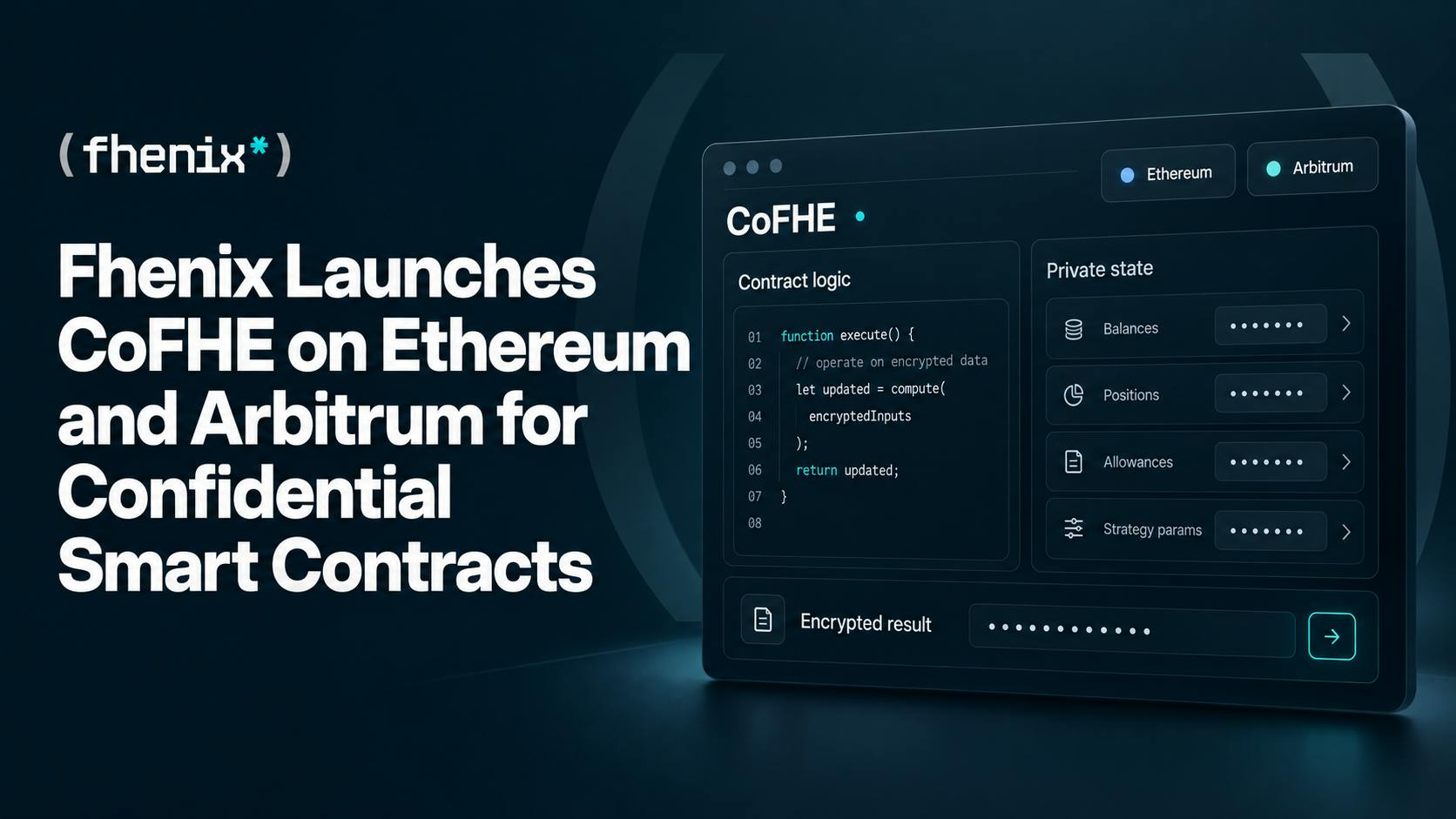
Fhenix Launches CoFHE on Ethereum and Arbitrum for Confidential Smart Contracts
Full Article
Original Source
Read the full article at Hackernoon →KhanList aggregates and links to publicly available news content. We do not host full articles from third-party sources. Always verify important information with original sources.