
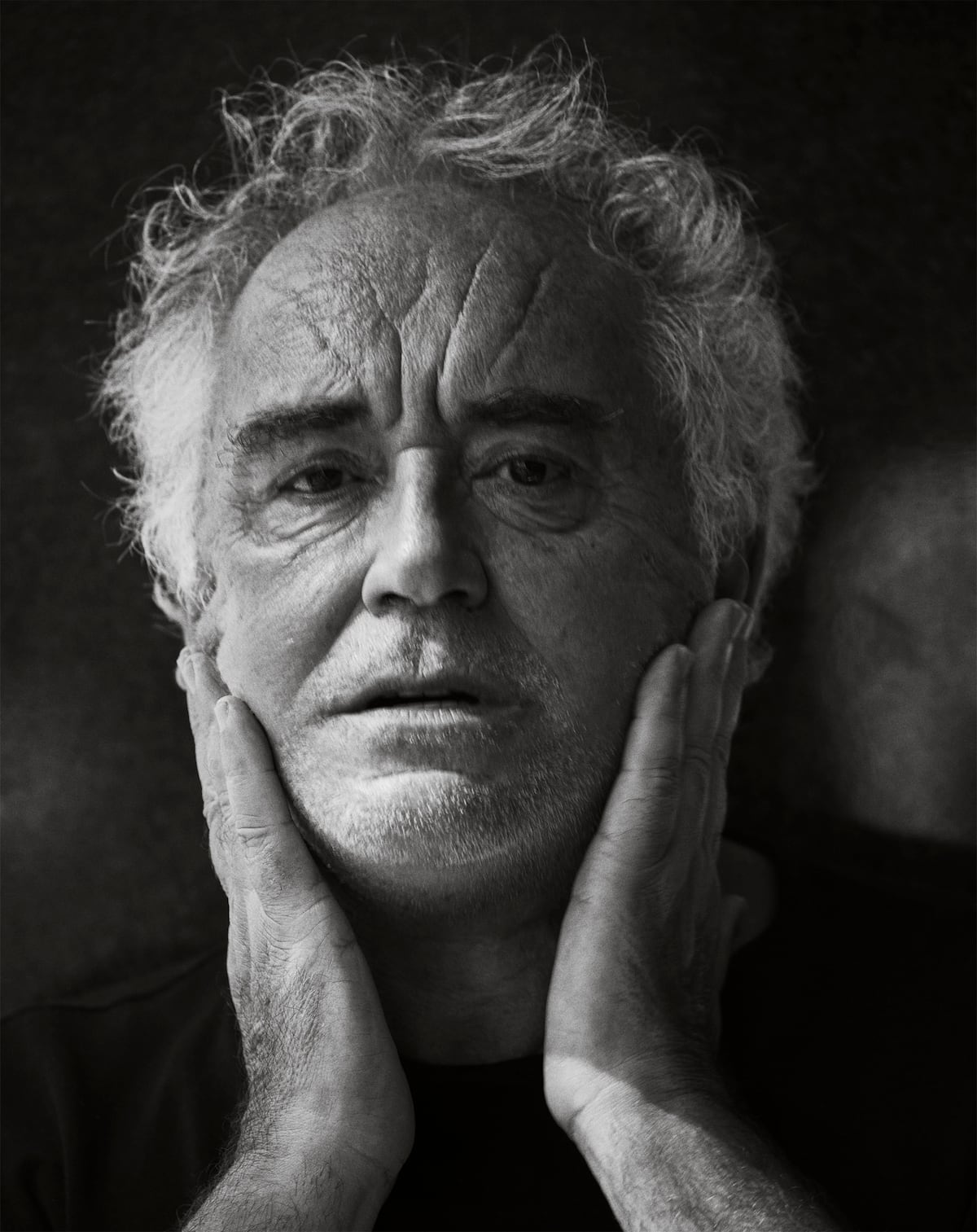
Chef Ferran Adrià.Daniel RieraHow does someone know they have achieved immortality? In the past it was obvious: a cheese, a high school, or a stretch of ring road would be named after you. It is a sign of the times that, now, lasting presence necessarily passes through screens. Sometimes it happens the Julio Iglesias way: you multiply online like a meme. Other times Netflix sets its sights on you, decides your life belongs in the canon and devotes a series to you. It happened to Elizabeth II and to Michael Jordan. It happened to Luis Miguel and Anne Boleyn. And it has just happened to Ferran Adrià, the 64-year-old chef who became a global sensation in the early 2000s with his “deconstructed cuisine.” This fall, Netflix is streaming the story of his rise to fame in Gènesi (Genesis), a co-production with the Catalan-language public streaming service 3Cat. This latest feat by Adriá can perhaps only be compared to getting a table at El Bulli in those years — 2004, 2005 — when demand was “two million people,” and there were spots for only seven thousand.Adrià, who receives EL PAÍS at his Barcelona offices, cannot complain that life has been stingy with the accolades. The laurels are piling up: Chef of the Decade. Five-time best restaurant in the world for El Bulli. Six honorary doctorates, soon to be seven. And three Michelin stars from 1997 until El Bulli closed in 2011. These days he has just been awarded — like the artist Joan Miró or the musician Pau Casals before him — the Gold Medal of the regional government of Catalonia, the Generalitat. He has racked up 550 distinctions in all, and Adrià’s team keeps track of them with the same obsessive precision with which, in earlier times, the great chef spherified an olive. It is a weighty tally for someone who says he “never worked” in order to earn those prizes, a phrase that might read like false modesty until you look at some facts. For example, Adrià held no other celebrations at El Bulli besides the restaurant’s farewell party. Or, more tellingly: when he says the Netflix series “could have a market of five billion people,” his excitement seems driven less by self-satisfied vanity than by Gènesi’s potential for “relaunching the techno-emotional movement” in cooking. The proof that Adrià is not lying is that his enthusiasm only turns into excitement when he talks about something that might seem very minor to the general public but is very important to him: this November a “two-hour and 15-minute documentary,” still untitled, about El Bulli will also premiere. Sometimes a few subtle gestures are the best measure of meaning: Vía Véneto, the old-school restaurant in Barcelona’s uptown area, has added Adriá’s dish “Gaudí red mullet” to its menu. It almost reads like a tribute in which the past pays tribute to the future.In the mid-1990s, that same red mullet dish was meant to illustrate the cover of El Bulli. El sabor del Mediterráneo (The taste of the Mediterranean), a book that has also gone from revolutionary to classic, if we judge it by the crude yardstick — €500 ($550) for starters — of its resale price. In those years the legend of El Bulli was beginning to be built. And here is an irony: Ferran Adrià, who was capable of putting philosophical concepts into motion in his kitchen — recall the concept of deconstruction? — has never posed as an intellectual chef. He has always been saved by a certain down-to-earth quality about him: even today, after so much glory, he is a man who smokes but takes care to move the smoke away, who does not check his phone even if Bill Gates is sending him a message. With that duly noted, it should be underscored that the six episodes of Gènesi recreate everything that made the Adrià era at El Bulli, to give it a pompous name, an adventure of the mind.When Adrià joined in 1984 as a station chef, he was a young man with a very short résumé: he had washed dishes in Castelldefels, worked in field kitchens and banquets during his military service, and had never set foot in a cooking school. “The better the master you have,” he would later say, “the harder it is to innovate.” In any case, the owner of the Playafels hotel had made him memorize El Practicón, a 19th-century Spanish cookbook, as one learns the ABCs. And Jean-Paul Vinay, El Bulli’s chef in the early eighties, believed he was ready to receive the then-recent — and now canonical — treatises of the nouvelle cuisine. The impact was tremendous: those Bocuse and Guérard books blew the mind of the twenty-something Ferran. From then on, not only did he plan to push nouvelle cuisine to its extremes, he also made sure to record it in print. Today the Adrià factory has published “more than sixty” volumes, including the monument titled Catálogo General de El Bulli. But he needed no more than that first book, El sabor del Mediterráneo, to get the first big push for his career. It happened like this: in 1996 Joël Robuchon left his restaurant, stepped down from the podium and declared, to the astonishment of his French compatriots, that his successor as number one was Ferran Adrià.If that boost was the most important one of his career, it was largely because it was the most scandalous. We must remember, as Adrià himself does, not only that Robuchon “was God in the kitchen,” but that France had had a “400-year monopoly” on haute cuisine. Shall we speak of the first Spanish triumph over the French since 1812? Not quite: “In the end, the French half-adopted me.” Maybe, in fact, they reacted the way Robuchon did on his first visit to El Bulli, well staged in the series: the French pharaoh showed up looking tense and skeptical, aware he was in a country on the periphery of academic gastronomy, but long before he saw the desserts he was already cheering Adrià. Everything else came in time. A feature in The New York Times magazine in August 2003 defined Spain — with a close-up of the chef — as “the new France”: the next day Adrià woke up to seven hundred interview requests. Then there was his selection as one of Time magazine’s 100 most influential people in 2004: “That was important,” he reflects, “because it meant stepping out of the kitchen.”Books like Au revoir to all that, from 2009, hint at the spiritual crisis of French culinary culture after Adrià burst onto the scene: that southern wind from Spain crossing the Pyrenees and sweeping everything away. Today, in a form of reconciliation, the Catalan chef says that France remains first. And at El Bulli, where he had begun by cooking hare civet, he would finish with another caress to the famed French chef and writer Auguste Escoffier: the restaurant’s last recipe —number 1846— in July 2011 was a version of Peach Melba. There is the respect not just for French tradition but for classical forms. At the same time, Adrià is aware that “after we got together” — him and other top Spanish chefs like Juan Mari Arzak, Pedro Subijana and later the Roca siblings — the French “began to get scared.” “We empowered ourselves first,” he emphasizes, “and then we empowered the United States, Denmark, everyone else.” The old French monopoly was shattered: world cuisine became a league in which “now there are 20 countries.” So besides France, what about the rest? “Italy and Spain are neck and neck,” Adrià says. “Then there’s Japan. That said, in ten years everything will be China.” After the assertion, the question: “Did you know they have churros in China?”Adrià seems incompatible with nostalgia, although he recalls a time when Spanish chefs “were just ten or twelve, not three hundred like now” and they would all meet on the conference circuit and stay up until four in the morning finding inspiration between gin and tonics. There was a feeling of community that is lacking in so many other fields. But Spain, he concludes, “is the country that communicates the worst in the world,” and while northern Europe came up with New Nordic Cuisine, “we didn’t even have a name” for what they were doing. He now sees some hope in the national government’s International Plan for Spanish Gastronomy. He notes with satisfaction that when a foreign head of state visits, a top chef is called in to give them a good meal. And he points to where the future should go, in his view: promote the casa de comidas, which is “the Spanish bistro.”The chef does not deceive himself: you have to sell — selling is what it’s all about. “The series was paid for by the Generalitat [Catalan regional government],” he says, “to sell Catalonia and, consequently, to sell Spain.” Viewers will have few doubts: Gènesi is not, and does not want to be, about the hidden side of Ferran Adrià, nor the truth about Ferran Adrià, nor a critical reassessment of his legacy. The series is upfront about its goals: by minute two we already see Robert De Niro kneeling before the chef in the kitchen of El Bulli, while a figure explains that the actor is paying tribute to the “best chef in the world.” The striking thing is that, once the incense clears, the whole thing still works. “I have watched the series, I’m not exaggerating, forty times. What I had to make sure of was that the cooking was a ten, and the cooking is a ten. I don’t believe any culinary series or film that I’ve watched. But I believe this one.” Pending critics’ verdicts, one truth is obvious: with a touch of mature modernity, each dish is identical to its corresponding page in the Catálogo General de El Bulli. Still, if identity is the issue, the surprise should be sought less in the cooking than in the cook: Miquel Fernández delivers such an exact portrayal of Ferran Adrià that from now on it will be hard to think of Ferran Adrià without picturing Miquel Fernández. The actor shines above all in those passages when the young Adrià is still called Nando and speaks that mix of Castilian Spanish and Catalan that has accompanied him to this day. Isabel, Adrià’s wife, has sometimes believed her husband was speaking to her when in fact it was Miquel on the TV.It is very possible that Ferran Adrià has had more glasses of Dom Pérignon than most humans get in a lifetime. But he has also had to eat his share of bitter bread. There is no series without its drama and Gènesi could not ignore that. We are of course talking about Adrià’s relationship with Santi Santamaría, who was “my best friend in the kitchen” and whom time turned into his nemesis. The reasons seem clear: Santamaría, a terroir-oriented cook, was skeptical of Adrià’s high-lab, molecular cuisine. But perhaps things are not so clear, since Santamaría was also one of El Bulli’s habitués and defended Adrià when it wasn’t cost-free to do so. The series avoids black-and-white portrayals and avoids kicking a chef who can no longer defend himself (Santamaría died in 2011). The matter, as Adrià recounts, is treated “with the utmost affection” in the series. And, as happened between 2008 and 2009, when the hostilities splashed tabasco across Spain’s gastronomic conversation — even José Luis Rodriguez Zapatero, the Spanish prime minister at the time, intervened — Adrià is seen suffering: suffering to keep his vow of silence, to stay true to the many years that he has applied the motto “you will not hear me speak ill of anyone” in the profession. Least of all, someone he once loved and admired. Adrià still regrets not reconciling in life. Perhaps for that reason, just a few months ago, he took part in a tribute to Santamaría to ask “that a wound that does not exist not be reopened.” The series also moves viewers to tears with another emotional point: those brutal years when Juli Soler, co-owner of el Bulli, struggled with Alzheimer’s before dying in 2015. Rita and Panxo, his children, continue working with Adrià, following a clear rule: if there is a Bulli, there has to be a Soler. “Ferran, do you still remember Juli?” “I remember Juli every day.”Perhaps from having heard it so often, Adrià has something of an aversion to the word genius: “I only knew I was good,” he replies, “when others told me so.” After so many years dressing in white as a chef, Ferran Adrià closed the restaurant and began to wear black. It is tempting to follow a code shared with other disruptors of their worlds: Steve Jobs, Giorgio Armani. He, simply, says he is not vain. He has “twenty projects” on the go: his could be the desk of a consultant or an architect. An encyclopedia of wine, “the best in the world.” The Madrid Culinary Campus (MACC), which will continue his Sapiens method and preserve the lion’s share of his legacy. And, of course, elBulli1846, his museum in Cala Montjoi.He does not miss “the pressure of immediacy” of the kitchen, which his brother Albert Adrià still feels at the helm of the Barcelona restaurant Enigma and many other ventures. Nor are there excessive regrets: yes, he could have delayed the closure of El Bulli by three or four years; yes, he could have charged €5,000 ($5,500) per cover in later years, but by 2011 he had already fulfilled his program of taking cooking to what he then believed to be his “physical and mental limit.” Today he continues to defend the legacy of his life’s work. He does so emphatically: “The relationship with Japan, the long narrow menu, opening a single service… we even changed the physical dimension of kitchens. All that comes from El Bulli. In twenty years we did 80% of the world’s innovation!” There are metrics, he says, to prove it. In the end, he is glad he maintained a certain obsession — “obsession” is a recurring word in the series — by which he would rather close than change. There were moments in the 1990s, he recalls, when El Bulli may have already been famous but no one went to El Bulli. On those nights of empty tables, he was put to the test. Later, he didn’t even need to open abroad: “PepsiCo paid me what 10 restaurants in Singapore would.”Adrià continues to travel to browse and to eat, helped by five or six secret Instagram accounts to spy on what’s cooking. Of haute cuisine, he says, “I no longer enjoy it so much: it has to give you something new.” At home he makes carbonade flamande, boeuf bourguignon and oxtail Córdoba style. He believes that, as with paella, fewer broths, fewer extracts, fewer juices should be used: “If a young person wanted to help purify that traditional recipe book, I would support them.” He continues experimenting because, as the saying goes, a leopard can’t change its spots. And, inevitably, he keeps surprising people: “Château d’Yquem [a wine that retails in the hundreds of euros] should be drunk with anchovies.” He had saved the bombshell for last.Sign up for our weekly newsletter to get more English-language news coverage from EL PAÍS USA Edition
Ferran Adrià: ‘Spain is the country that communicates the worst in the world. Our cuisine didn’t even have a name’
Full Article
Original Source
Read the full article at English →KhanList aggregates and links to publicly available news content. We do not host full articles from third-party sources. Always verify important information with original sources.