
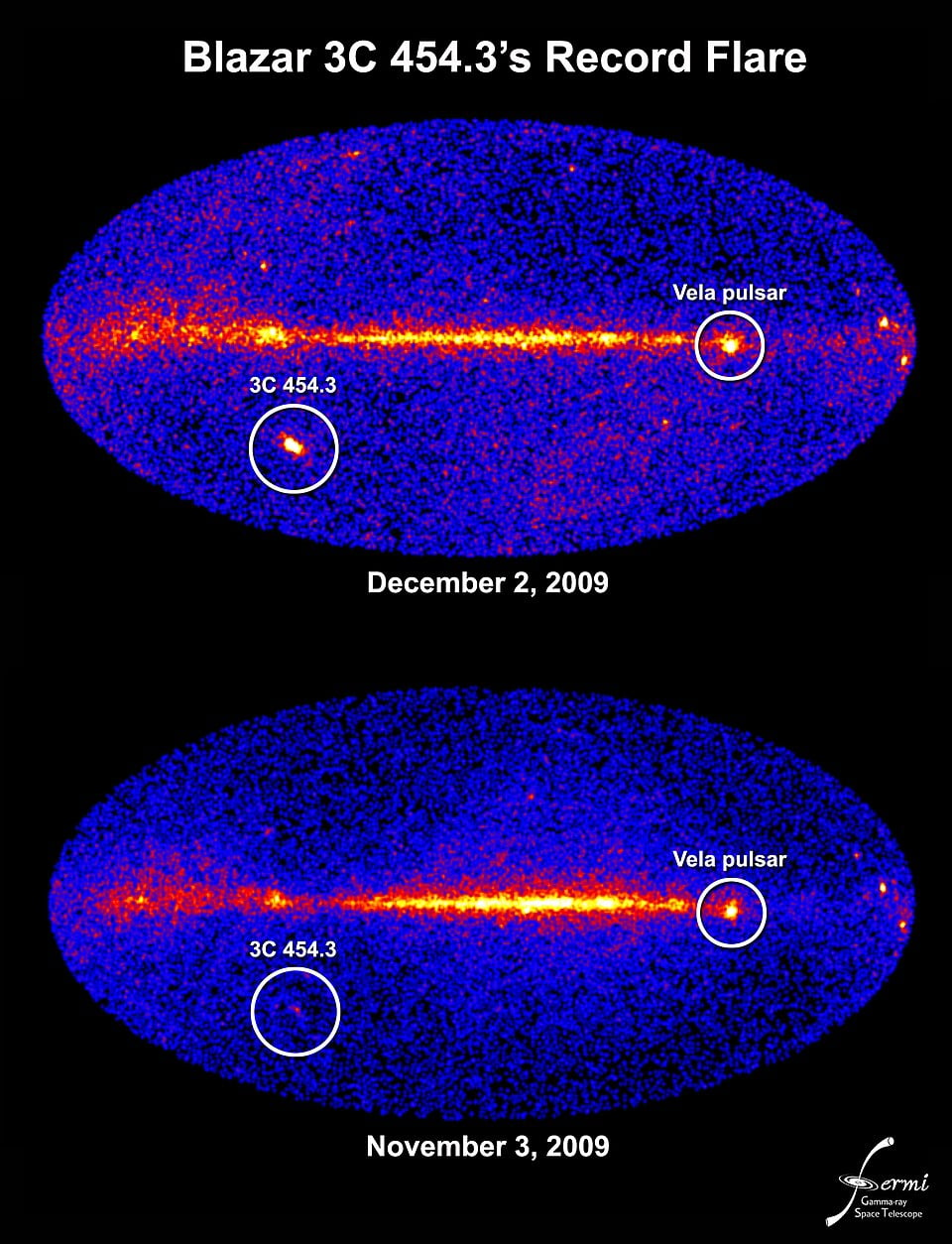
Gamma rays, the most high-energy type of electromagnetic radiation in the universe, have always had a blind spot. We’ve always had trouble measuring them in the “mega-electron volt” (MeV) energy range, which astronomers have taken to calling the “MeV gap”. But a new paper from an international group of scientists working with the Fermi Large Area Telescope (LAT) Collaboration recently published a paper in The Astrophysical Journal Supplement Series that takes a stab at closing that gap by identifying 450 cosmic sources in the 20-200 MeV range, providing the clearest view of low-energy gamma rays ever. The “gap” comes from a technological blind spot. Scientists have plenty of tools in the lower energy spectra, such as the Chandra X-ray observatory, that can capture radiation at the x-ray end of the electromagnetic spectrum. They also have a great number of tools at the high end of gamma ray spectroscopy, including the Fermi Gamma-ray Space Telescope, which is capable of finding higher end ones. But why are low energy gamma rays so hard to catch? Gamma rays notoriously pass right through mirrors and every other attempt to reflect them. Telescopes like Fermi-LAT can be thought of more as particle detectors in orbit rather than traditional telescopes. They track what happens when a gamma-ray photon hits layers of tungsten and silicon inside their chassis. Fraser explains what a Quasar is. At high energies - around 1 giga-electron volt (GeV), the damage done to those layers is catastrophic enough to be able to trace a line back to a source. However, at the lower 20-200 MeV range, the photons scatter much more randomly, making it difficult to track where precisely they came from. Fermi-LAT is only capable of tracking a single 20 MeV photon to a patch of the sky about 20 degrees wide - more than forty times the size of the full moon. Combine that with a massive amount of background radiation caused by everything from the Sun to distant galaxies, and it can be a real pain to pick out the direction of any one particular source. However, Fermi-LAT has been operating now for almost two decades, and with that much data there’s some math that can help. The researchers combined 14 years worth of collected data with some advanced statistical modeling techniques to pinpoint 450 distinct gamma-ray sources, what they are calling the Second Catalog of Low-Energy Fermi-LAT Sources, or 2FLE. Cross-checking them with other radio, optical, and X-ray data showed known counterparts for 377 of those objects. The vast majority of those objects - 325 of them - are far outside the Milky Way. Almost half of the entire group of objects consist of flat-spectrum radio quasars (FSRQs), a very extreme type of active galactic nuclei. FSRQs represent a type of “blazar” - a supermassive black hole that is pointing one of its twin jets of plasma directly at Earth. The 2FLE catalog confirms that FSRQ blazars pump out the majority of their energy at this 20-200 MeV spectral window. Fraser and Pamela discuss the differnet "colors" of gamma rays. Closer to home, the catalogue includes 52 sources from inside the Milky Way. Most of them are pulsars - the spinning leftovers left behind when a supermassive star explodes into a supernova. But one intriguing outlier was gamma rays that appear to be coming from M2, a globular cluster, which would mark the first time it’s ever been observed at gamma-ray energies. Perhaps the most intriguing part of the paper, though, are the 73 sources that don’t have a clear counterpart at other energies. 60 of those appear to be brand new gamma-ray discoveries. And while some of those signals might turn out to be overlapping signals from neighboring objects, it's likely there are at least some truly new exotic cosmic accelerators in the dataset awaiting follow-up observations. One particular mystery source seems to align with an object called 2FLE J0340.8+5258, which seems to also have been detected by an observatory in China, and appears to be capable of generating light across nine orders of magnitude in energy. Fermi-LAT itself seems to have reached its limit with this new data set. The researchers have likely squeezed everything they could out of the decades of data of this satellite, which was originally launched in 2008. However, there are other gamma-ray missions coming online, including NASA’s Compton Spectrometer and Imager (COSI), which is designed specifically to look for gamma rays in the 0.2-5 MeV range using a special type of germanium detector that has only become available in the last few years. Combining that new data with the decades worth of Fermi might finally shed some light on one of the longest-standing blind spots in the extreme physics of the universe. Learn More: DESY - A new view of the gamma-ray gap A. Adelfio - The Second Catalog of Low-energy Fermi-LAT Sources UT - A Giant Burst of Energy In Need Of An Explanation UT - Unexplained Gamma-Rays from the Galactic Center Could be from Self-Annihilating Dark Matter
Fermi’s 14-Year All-Sky Map Bridges Astronomy’s Elusive "MeV Gap"
Full Article
Original Source
Read the full article at Universetoday →KhanList aggregates and links to publicly available news content. We do not host full articles from third-party sources. Always verify important information with original sources.