
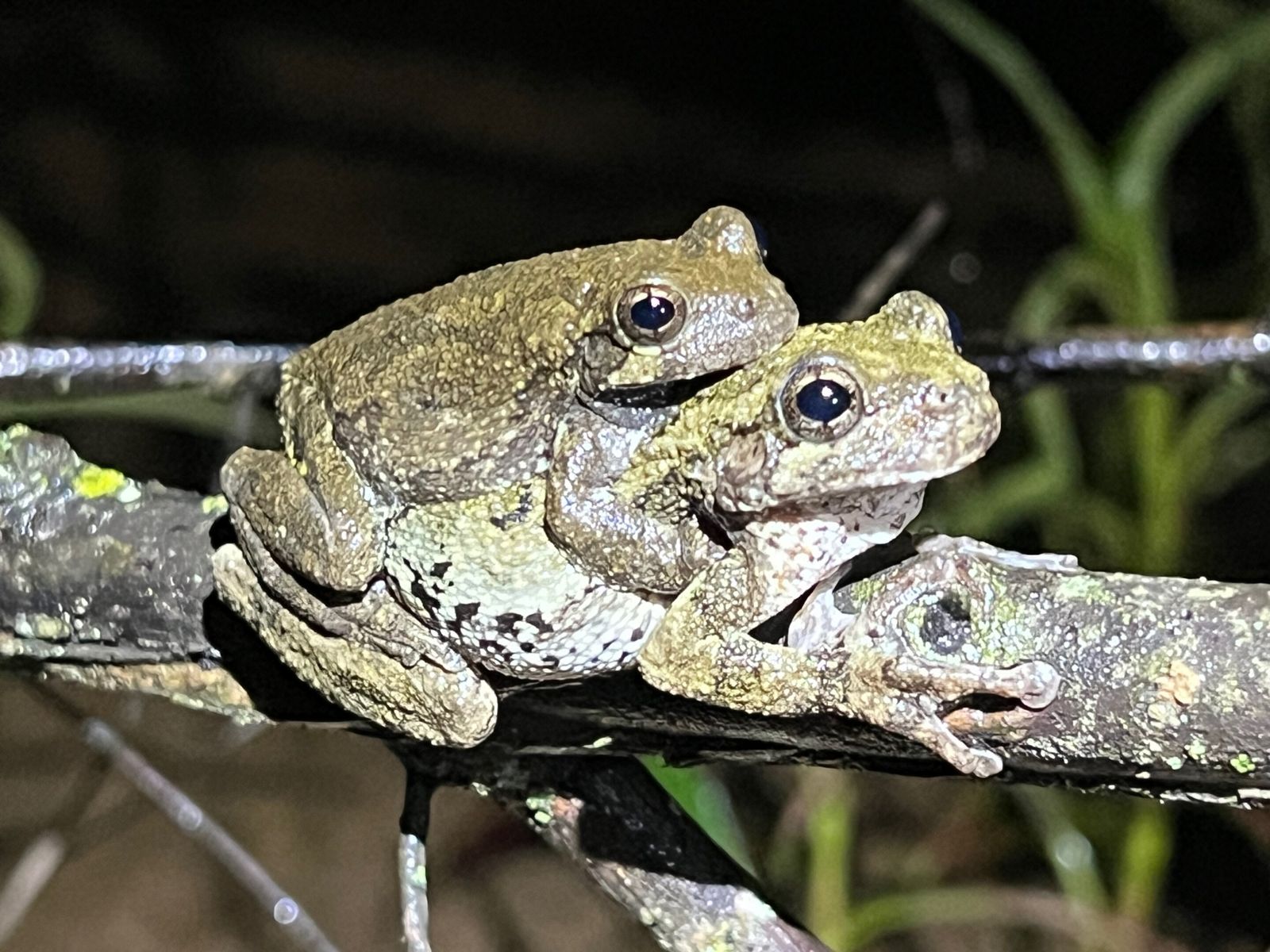
Faced with a chorus of potential mates, female Cope’s gray treefrogs may be overwhelmed by the number of options and struggle to make a careful decision, a study suggests September 1, 2026 9:42 a.m. A male Cope's gray treefrog is smaller than a female and attaches to her back as she looks for a spot to lay eggs. Jessie Tanner To win over a female, a male Cope’s gray treefrog will puff out its throat and release a musical trill of high-pitched vibrations. The competing males crowd together around ponds during the mating season, producing a noisy chorus of calls. Under such conditions, the female frogs can have a hard time choosing their mates. But researchers weren’t sure whether the background noise or the sheer number of suitors was giving them trouble. “In human terms, is it like entering a crowded bar and not being able to hear anyone talk, or is it like using a dating app and not being able to choose among the many options?” Claire Hemingway, a research associate at the Smithsonian Tropical Research Institute and a cognitive ecologist at the University of Tennessee, Knoxville, says in a statement. To find out, Hemingway and her team brought 60 female frogs, collected from ponds in eastern Tennessee, into the lab and played them various mating calls in a sound chamber. Their results, published in the journal iScience in August, revealed the frogs struggle with the number of options—a conundrum called choice overload—regardless of the presence of background sound. The work “offers new insight into the cognitive capacity of Cope’s gray treefrogs,” Julianne Pekny, director of conservation and science at the Amphibian and Reptile Conservancy who was not involved with the study, tells Smithsonian magazine. Cope's gray treefrogs Jessie Tanner From previous research, the team understood that female Cope’s gray treefrogs prefer males with longer calls. So, they played a long, “target” call alongside some shorter calls meant to distract the females. When presented with just two choices—one target and one less appealing alternative—the female frogs hopped toward the target call 77 percent of the time. But adding more options gave the females more trouble: With four calls, only about half of the frogs selected the target, and just a quarter of them selected the target when the team played eight calls. The females also took longer to choose a mate when faced with more calls. Some neglected to pick at all—with two calls playing, 3 percent of the females did not select any mate, and with eight calls, 18 percent did not make a decision. The researchers repeated these trials with background noise played out of an overhead speaker to mimic a chorus of other competing frogs. But they didn’t see an impact on the females’ choices. “With or without noise, when we presented more calls to the females at once, their performance declined in several ways, making the effect of choice overload clear,” Jessie Tanner, a study co-author and animal behaviorist at the University of Tennessee, Knoxville, says in the statement. The team conducted a “well thought-out experiment,” Luke Larter, a behavioral ecologist at Brown University who was not involved with this paper, tells Smithsonian magazine. The roles of background noise and choice overload “are often not explicitly differentiated,” in discussions about frog mate choice, Larter adds, and “few studies empirically tease these alternatives apart.” He notes, however, that no laboratory study can perfectly capture all the details of mate choice in the wild. Quick fact: Cope’s gray treefrog Found in parts of the United States and Canada, the Cope’s gray treefrog grows to be roughly two inches long and has bumpy gray or green skin that helps it blend in with tree bark. Choice overload could be influencing the frogs’ evolution. Females’ preference for mates with long calls would be expected to weed out males with short calls from the population over time. But short-calling males are still here—and this work suggests that it could be because females don’t get to make the most effective choice if they’re overwhelmed. Female frogs “can’t always get what they want,” Tanner tells Science News’ Freda Kreier. Choice overload, then, might improve the odds that a less-desirable male will find a mate. “Because female mate choice can drive evolution, our results suggest that evolution might happen more slowly than we thought before,” Tanner said in a statement last year, regarding a similar study she worked on that also suggested choice overload can distract female Cope’s gray treefrogs from the ideal mating calls. Many animals encounter several potential mates at once—especially in species that gather in leks, choruses or swarms during the breeding season. The team suggests in the paper that choice overload might be a common feature of these mating systems. And it might even affect creatures’ decision-making in other situations, such as when bees look for foraging sites and mosquitoes choose where to lay eggs. The study indicates that cognitive limitations prevent the female frogs from making a careful selection when given too many options. It “contributes to the growing literature showing that more complex choice environments … make accurate decisions more difficult,” Larter says. The decisions of the female frogs “are really biologically important,” Tanner adds in another statement. “But maybe they’re not able to exercise that choice effectively all the time.” You Might Also Like Get the latest stories in your inbox every weekday. More about: Amphibians Animals Biology Frogs Nature New Research Reproduction Smithsonian Smithsonian Institution Smithsonian Tropical Research Institute Wildlife
Female Treefrogs Experience 'Choice Overload' Amid Too Many Mating Calls From Males
Full Article
Original Source
Read the full article at Smithsonianmag →KhanList aggregates and links to publicly available news content. We do not host full articles from third-party sources. Always verify important information with original sources.