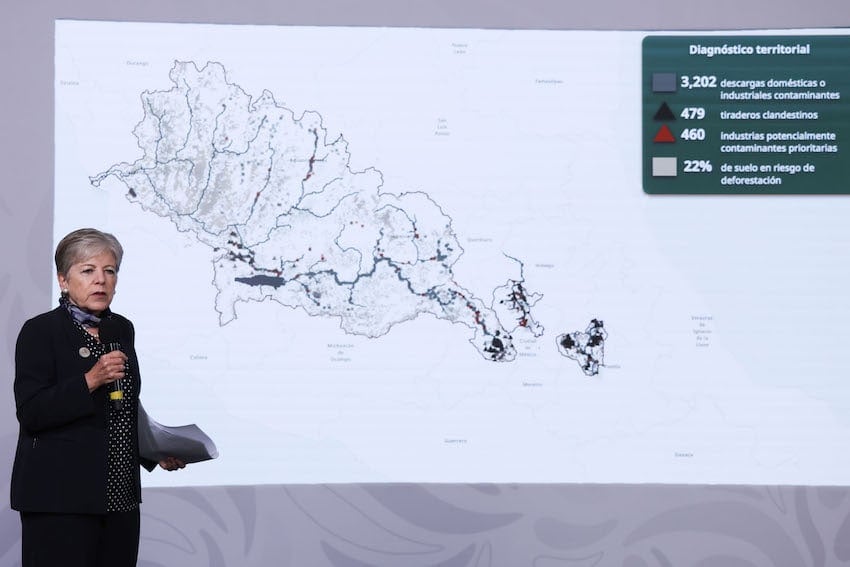
The federal and Jalisco state governments are embarking on a joint effort to clean up the region’s rivers, improve wastewater treatment and fix the water distribution system in a long-awaited effort to end the water pollution crisis affecting millions of residents in the Guadalajara metropolitan area. With federal technical support, the project will rehabilitate the antiquated Chapala aqueduct in Guadalajara, clean up the Lerma-Santiago river basin, increase enforcement against industrial polluters and increase investment under the National Water Plan. Efraín Morales López, director general of the National Water Commission, confirmed the federal government’s role in the cleanup of Guadalajara’s water supply: “We are doing our part from the Federation to provide technical support so that the project is a real solution to the problems experienced in the city of Guadalajara as well as its metropolitan area.” (Andrea Murcia/Cuartocuro) At President Sheinbaum’s morning press conference Thursday, head of the National Water Commission (Conagua) Efraín Morales confirmed federal collaboration with Jalisco’s government to address the water quality crisis. “We are doing our part from the Federation to provide technical support so that the project is a real solution to the problems experienced in the city of Guadalajara as well as its metropolitan area,” Morales said. Morales attributed Jalisco’s water issues to the deterioration of the original Chapala aqueduct, which has long lacked adequate maintenance. The Chapala-Guadalajara aqueduct carries water from Lake Chapala — the main source of supply for the Guadalajara metropolitan zone (ZMG) — to the city. The original pipeline is in a critical state, with leaks, internal corrosion and loss of capacity, which increases the risk of failures and leads to sediments and contaminants in the water that reaches the network. Simultaneous with the pipeline rehabilitation will be an increased cleanup effort for the region’s rivers. Mexico’s Environment Ministry (Semarnat) said that the ZMG’s water issues are also linked to industrial contamination, with discharges from industries polluting the Lerma River. “Industrial discharge is crucial as that’s where heavy metals and truly toxic products come from, and Lerma is one of the rivers presenting such a problem,” Semarnat Minister Alicia Bárcena said. She added that companies thought to be responsible for discharging industrial waste have been identified and that inspections are underway that could lead to penalizing any proven to have violated environmental regulations. She also explained that the federal government is implementing the 2024–2030 National Water Plan, a 20-billion-peso (US $1.15 billion) initiative that includes river cleanup programs and new wastewater treatment plants in the Atoyac, Lerma–Santiago and Tula river basins, Mexico’s most polluted rivers. Although the federal government pledged technical support for the river cleanup efforts, experts argue that addressing Guadalajara’s water crisis will also require a stronger local strategy. With reports from Zona Franca
Feds and Jalisco state are joining forces to tackle water contamination in greater Guadalajara
Full Article
Original Source
Read the full article at Mexiconewsdaily →KhanList aggregates and links to publicly available news content. We do not host full articles from third-party sources. Always verify important information with original sources.