
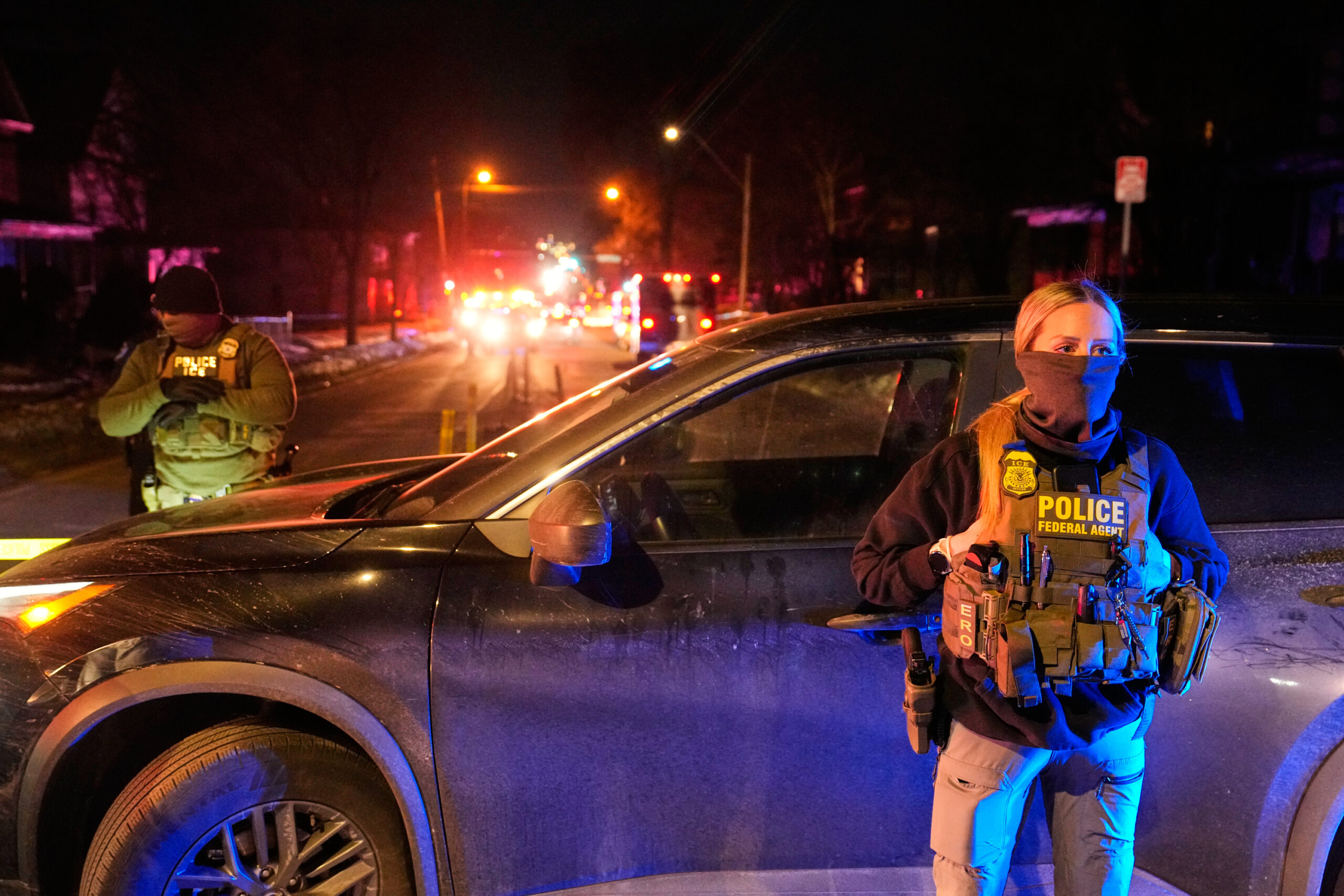
Minnesota claims the incident was little more than “road rage” unrelated to federal immigration enforcement.MINNEAPOLIS (CN) — A federal judge heard hours of testimony Friday regarding whether Minnesota’s prosecution of an Immigration and Customs Enforcement agent for pointing a gun at motorists should take place in state or federal court.ICE agent Gregory Morgan Jr. argues his assault case belongs in federal court because he was acting within his duties enforcing federal law, while state prosecutors say the underlying highway encounter was more akin to a “road rage” incident unrelated to immigration enforcement.U.S. District Judge Nancy Brasel presided over the evidentiary hearing, which lasted more than three hours and will continue Oct. 13, when Morgan is expected to testify.Morgan’s second-degree assault charges stem from a Feb. 5 incident during the peak of Operation Metro Surge, when state prosecutors say he illegally drove an unmarked SUV on a Minneapolis freeway shoulder to bypass rush-hour traffic.When a car repeatedly swerved onto the shoulder to slow him, Morgan pulled alongside it and pointed his service weapon at the occupants, according to prosecutors, who say they did not know he was a federal agent.The vehicle’s occupants were scheduled to testify Friday, but Brasel, a Donald Trump appointee, dismissed them from the hearing after their attorney said they intended to invoke their Fifth Amendment right against self-incrimination.State prosecutors previously sought federal immunity for the pair to encourage them to testify, but those efforts were unsuccessful.Brasel ordered all parties to refer to the civilians by their initials to protect them from public harassment, drawing pushback from Morgan’s attorney, Ryan Pacyga.“The idea in American courtrooms is transparency,” he said. “If they’re going to be witnesses in this case, their names are public. They ought not be able to proceed under initials; that’s just not how we do it in America.”While Morgan’s defense revolves around a proper federal agent’s response to a “targeted vehicular attack,” state officials questioned how brandishing a gun while driving illegally has any connection to official federal enforcement duties.Myles Codner, an ICE agent partnered with Morgan during the surge, testified Friday that they were ordered back to their “base” near the airport after spending the day surveilling immigration enforcement targets and assisting other ICE officers, including one “boxed in” by protesters.Codner said that on the return trip, a white Cadillac occupied by the two motorists repeatedly swerved onto the shoulder where Morgan was driving and brake-checked their SUV, coming within five feet of its bumper.Accompanied by Minnesota Department of Transportation traffic footage, Codner testified that he “feared for his safety” and that of Morgan and other motorists.According to the officer, Morgan pulled alongside the Cadillac, held his service weapon in a visible, “low-ready” position and shouted, “Police, back off!” to take control of the potentially dangerous situation, as they are trained to do.As Pacyga pressed Codner about the perceived danger and intended impact of Morgan drawing his firearm, Brasel scolded the attorney for asking leading questions, warning it could affect her ability to assess the agent’s credibility.“I can’t take any of this into account,” she said. “This is leading.”During cross-examination of his partner, Minnesota’s attorney James Pearce sought to undermine Morgan’s claim of federal authority by pressing Codner on the limits of ICE’s jurisdiction on state highways, where, as the state noted in court filings, immigration agents lack authority to enforce traffic laws.Pearce also questioned Codner about orders to return to base “quickly and safely,” which Codner acknowledged did not permit them to break traffic laws by driving on the shoulder or speeding.Pearce further pressed Codner on whether their illegal shoulder driving during rush hour provoked the incident rather than retaliation against immigration officers. Codner also acknowledged neither agent had reason to believe the Cadillac’s occupants were unlawfully present in the country.An ICE training officer, John Parodi, also testified Friday briefly on use of force and threat assessment — most notably stating that, under ICE policy, displaying or pointing a weapon is not, by itself, a use of force.While not a party in the case, the federal government issued a statement of interest in July claiming Morgan made an adequate showing he is being prosecuted for actions taken within the scope of his federal duties.Morgan’s case will serve as a key test for how courts determine jurisdiction in state prosecutions of federal agents — a largely unprecedented action Minnesota is spearheading.The state has similarly charged ICE agent Christian Castro with second-degree assault and with falsely reporting a crime over the shooting of Julio Sosa-Celis in January.Subscribe to our free newslettersOur weekly newsletter Closing Arguments offers the latest about ongoing trials, major litigation and rulings in courthouses around the U.S. and the world, while the monthly Under the Lights dishes the legal dirt from Hollywood, sports, Big Tech and the arts.Additional Reads
Federal judge weighs jurisdiction for ICE agent assault case in Minnesota
Full Article
Original Source
Read the full article at Courthousenews →KhanList aggregates and links to publicly available news content. We do not host full articles from third-party sources. Always verify important information with original sources.