
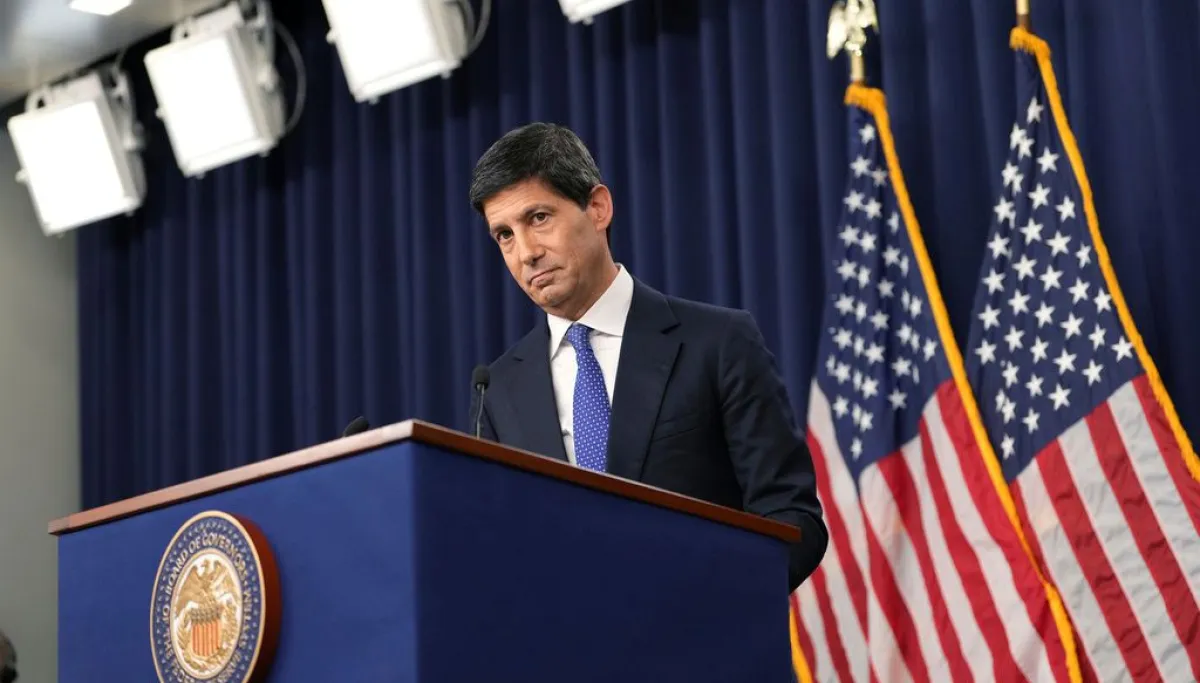
Warsh, speaking at the Productivity and Jobs Task Force Conference in San Francisco, said the central bank is examining an array of potential outcomes from the boom in AI, which the Trump administration has branded as “super intelligence,” or SI, rather than AI. “It’s worth considering the range of economic outcomes we could see over the next several years, depending on how SI progresses,” Warsh said in prepared remarks. “The board’s staff has begun to evaluate various contingencies, applying stylized, model-based frameworks to generate scenarios.”There have been major questions about exactly how AI will shape not only the stock market, but also the broader economy and labor markets. Some think that AI could be a very big net positive, driving growth while unemployment stays low, while other economists highlight the notion that the boom could end up costing jobs.Warsh said that, at one end of the modeling, AI could lead to increased productivity and economic gains “that are shared broadly across labor and the owners of capital.” In that scenario, he said real GDP would rise above its long-run average while unemployment remains low.But he said other outcomes are less ideal for the labor market.“An SI-driven expansion could bring substantial labor market disruption as some jobs are displaced, rather than complemented, by technology,” Warsh said. “GDP growth would still rise above its long-term average. But widespread automation, combined with labor market frictions, could push the jobless rate above levels consistent with full employment.”The chairman also said that AI could disappoint and that, after the recent investment boom, stock gains could move in the other direction, leading to an economic slowdown as well as an increase in unemployment.“In time, the economy would recover, but without the productivity gains,” Warsh said.AI has been a hot topic in recent years as the technology has grown in usage and integration throughout the economy. Many economists point to AI as driving recent gains in the stock market.The benchmark S&P 500 has risen more than 8.7% in 2026 alone and even more over the past calendar year.Meanwhile, the tech-heavy Nasdaq has also grown since the start of the year and over the past 12 months.Notably, the speech from Warsh comes just days after two hot inflation reports raised the odds of the Fed increasing interest rates at its next meeting. Warsh didn’t address interest rate policy in the Monday speech.The country’s most closely watched inflation report, the consumer price index, showed prices rose sharply by 0.4% in October.Because of the government shutdown in October 2025, the Bureau of Labor Statistics did not publish how much inflation increased on a 12-month basis, although economists estimate that the annual number is somewhere in the high 3% to low 4% range — well above the central bank’s 2% target. That reading was higher than forecasters had expected.Inflation, as measured by the producer price index, rose two-tenths of a percentage point to 6.5% for the year ending in October, the BLS then reported on Friday.And while the PPI reading was slightly better than expected, that 6.5% climb marked the biggest annual gain since November 2022 under then-President Joe Biden and then-Fed Chairman Jerome Powell.POST-ELECTION ECONOMIC REPORTS MAKE FED INTEREST RATE HIKE ALL BUT CERTAINIt is also worth noting that the country’s labor market has been more resilient than expected.The economy added 165,000 new payroll jobs in October, the Bureau of Labor Statistics recently reported — many more than expected. Also, the unemployment rate fell one-tenth of a percentage point to 4.1%.
Fed is modeling how the AI boom could change the economy
Full Article
Original Source
Read the full article at Washingtonexaminer →KhanList aggregates and links to publicly available news content. We do not host full articles from third-party sources. Always verify important information with original sources.