
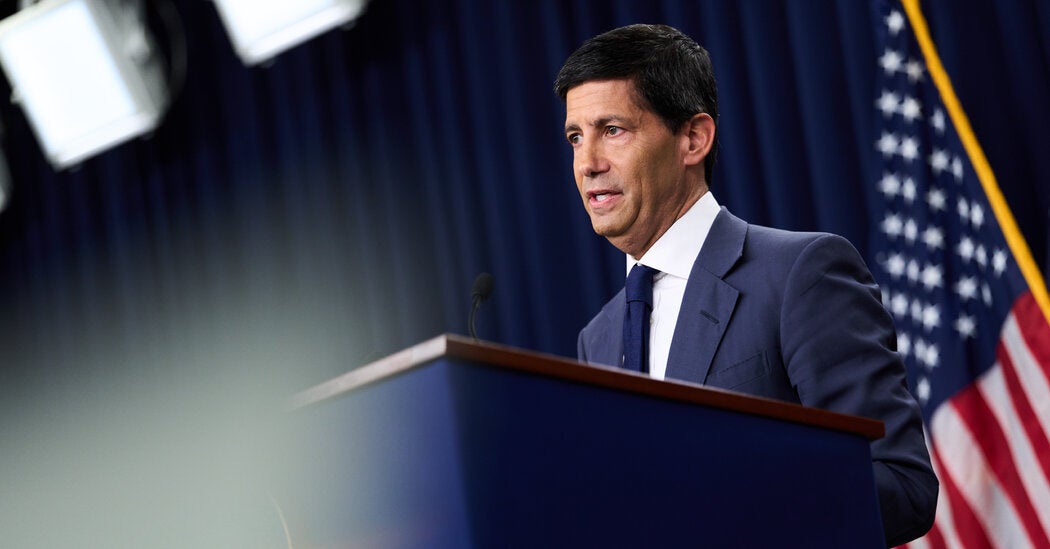
AdvertisementSKIP ADVERTISEMENTKevin M. Warsh, chairman of the Federal Reserve, has assigned a task force to explore how productivity gains tied to new technologies could impact the labor market.Kevin M. Warsh, the Fed chairman, said there was vast uncertainty surrounding the economic impact of the artificial intelligence boom.Credit...Julia Demaree Nikhinson/Associated PressNov. 16, 2026, 1:35 p.m. ETKevin M. Warsh on Monday underscored how uncertain the artificial intelligence boom could be for the economy, highlighting the potential for increased productivity and growth as well as job losses and disappointing stock market returns.Mr. Warsh’s remarks kicked off a conference at the Federal Reserve Bank of San Francisco that homed in on the work of a task force he established to examine how productivity gains might affect the labor market. It is one of five groups that Mr. Warsh created to look into issues that he has said are central to monetary policy.Mr. Warsh said that the Fed was modeling scenarios related to how A.I. might impact the economy. Productivity growth had in recent months been “reasonably strong,” he noted, but it “hasn’t yet broken out definitively and structurally to the upside.”Under the most positive circumstances, the technology could lead “to an increase in productivity and economic gains that are shared broadly across labor and the owners of capital,” Mr. Warsh said. In that case, economic growth would rise “persistently above its long-run average” and the unemployment rate would remain steady.In a gloomier case, Mr. Warsh warned of “substantial labor market disruption” in which jobs are “displaced, rather than complemented” by A.I. In that scenario, the likely outcome would be higher growth but rising unemployment.Lastly, Mr. Warsh raised the prospect that A.I. returns could disappoint relative to the enormous investment that has flooded into the technology, which has pushed up stock valuations and helped to power consumer spending. At risk in that scenario is an economic slowdown as the broader market falls. Productivity gains are unlikely to accrue against that backdrop, he said.Mr. Warsh said that the Fed’s role was “neither advocacy nor opposition,” although he conceded that he was “not exactly impartial about American leadership in a time so filled with both challenge and possibility.”“Our job is to prepare for whatever comes next,” Mr. Warsh said. “That means contingency planning, which becomes only more important when the world is changing this fast."In the Fed’s semiannual financial stability report, released on Friday, nearly 90 percent of survey respondents across Wall Street cited risks related to A.I. as their top concern. They appeared primarily worried about the prospects of disappointing returns leading to a stock market correction as well as cyberattacks.Mr. Warsh is scheduled to moderate three panels at the conference on Monday, including a fireside chat with Gina Raimondo, who served as secretary of commerce under President Joseph R. Biden Jr., and Marc Andreessen, a venture capitalist.Mr. Andreessen is one of three external advisers that Mr. Warsh selected to lead the productivity and jobs task force. The others are focused on the Fed’s balance sheet, its communications, how inflation is modeled and the data sources the central bank monitors.Colby Smith covers the Federal Reserve and the U.S. economy for The Times.Related ContentAdvertisementSKIP ADVERTISEMENT
Fed Chairman Highlights Economic Uncertainty of A.I. Boom
Full Article
Original Source
Read the full article at Nytimes →KhanList aggregates and links to publicly available news content. We do not host full articles from third-party sources. Always verify important information with original sources.