
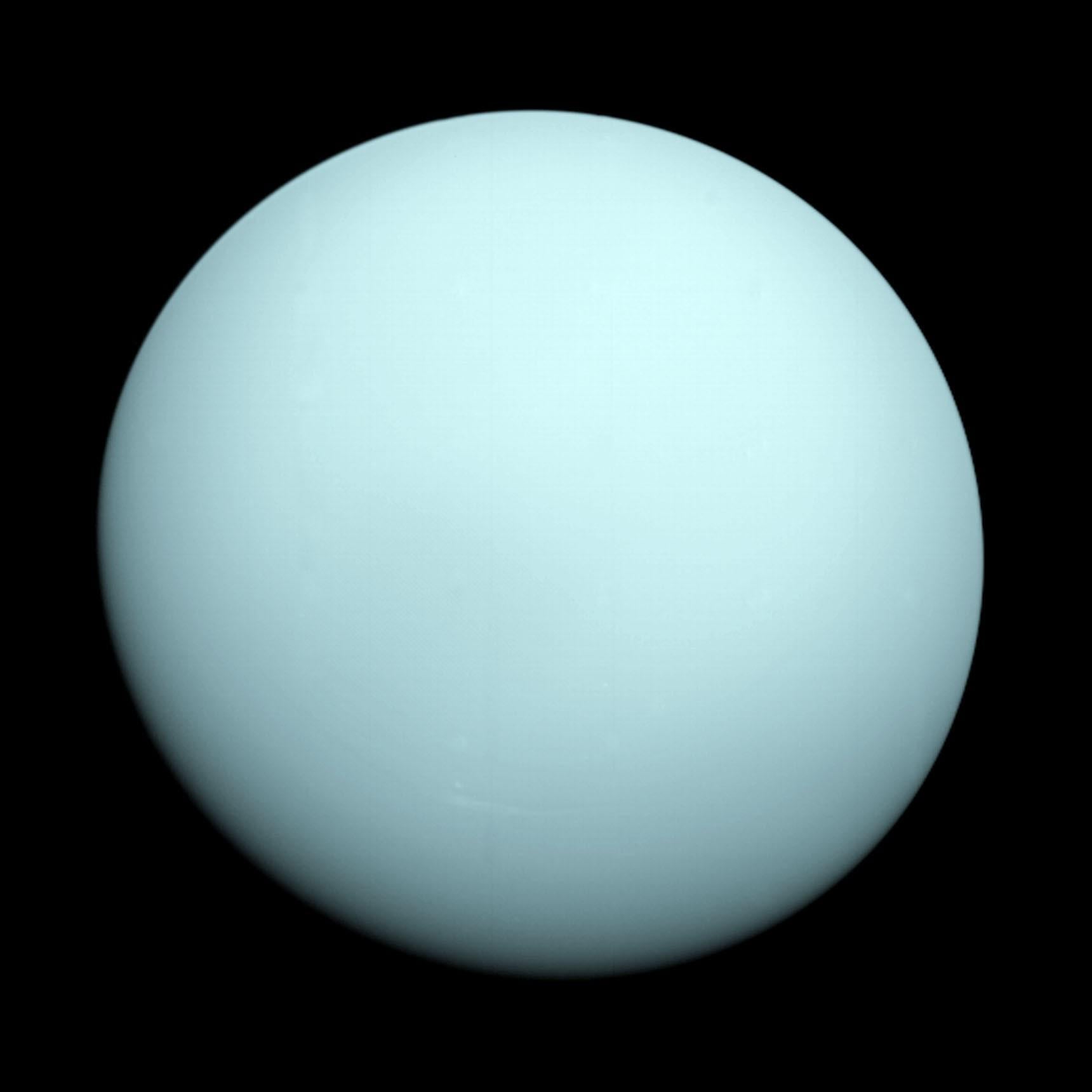
Why late November 2026 is prime Uranus observing season. The outer planets are ever so slowly starting to sneak back into the evening sky this month. First, Saturn crossed this mark last month on October 4th, then Neptune followed suit on September 26th. Now, the planet Uranus makes the transition, crossing opposition next week. Uranus in 2026 Opposition occurs on November 25th. On ‘U.S. Thanksgiving-eve.’ We say ‘opposition’ for an outer planet, as a point at which it seems to rise ‘opposite’ to the setting Sun as seen from our Earthly vantage point. Orbiting the Sun at a leisurely pace once every 84 years, Uranus has a synodic period of 370 days, meaning oppositions for the planet only slide forward about five days each year. This year sees Uranus reach opposition in the astronomical constellation of Taurus, between the Hyades and the Pleiades open star clusters. Uranus at opposition for 2026. Credit: Stellarium. Shout out to the Full November Beaver Moon nearby on the same date as opposition 2026, fresh off of occulting the Pleiades for the Arctic on November 24th. Uranus reached aphelion 20 Astronomical Units (AU) from the Sun in 2009, and is now inbound toward perihelion 18.3 AU distant in 2050. In 2033, Uranus will pass the point in Taurus where it was discovered by Sir William Herschel on March 13th, 1781, between the horns of the Bull very near the constellation's border with Gemini. Uranus made spurious appearances on star charts of the era at least 20 times prior to discovery. The discovery position of Uranus. Credit: Dave Dickinson/Starry Night Uranus reached its southernmost point in the sky in 2007, and crossed the celestial equator multiple times from 2011-2012. Uranus crosses the ecliptic plane northward in 2029. Uranus reaches its northernmost in 2032, and then begins the long trek southward. The Moon won’t resume occulting the planet Uranus again until a cycle starting on September 29th, 2029. The Moon occults the Pleiades on November 24th. Credit: Occult 4.2. Observing +5.5 magnitude Uranus is as easy as sweeping the suspect field at low power, and looking for a blue-green ‘star’ that obstinately refuses to snap into focus. To my eye, Uranus looks like a tiny planetary nebula or perhaps a distant fuzzy comet. In fact, that’s exactly what Herschel thought he’d first discovered, back on that fortuitous night in 1781. He later correctly realized after following the new object for several nights that it was a distant, and therefore intrinsically large object far out in the solar system beyond Saturn, then thought to mark its outer boundary. All of this happened in his backyard garden in Bath, England. We can, however, be thankful that the name ‘George’ that Herschel proposed to honor his benefactor King George the III didn’t stick (!) One of Herschel's speculum metal mirrors and telescopes at the London Science Museum. Credit: Dave Dickinson Can you see Uranus with the naked eye? Topping +6th magnitude near opposition, it’s knocking on naked eye visibility from a good dark sky site. At the eyepiece, Uranus only shows a 4” disk at around opposition, barely resolvable with a telescope and tough to tease out detail. A fine capture of Uranus from 2017. Credit: Szabolcs Nagy. Uranus is tipped over 98 degrees (prograde) on its side, the result of some ancient encounter with another large body early in the solar system’s history. Currently, we’re staring nearly directly at the rotational (north?) pole/hemisphere of the planet, which will be pointed nearly directly towards us in late 2029. Challenge: Catching the Uranian Moons Though Uranus has 29 known moons, only five are within potential reach of amateur telescopes, with +13.9 magnitude Titania being the brightest. Orbiting Uranus once every 8.7 days, Titania reaches a greatest elongation of 28” from Uranus. We once saw a sharp view of the moons observing through the Steward Observatory’s Kuiper Telescope in the Santa Catalina Mountains outside of Tucson, Arizona. They were a surprisingly easy catch through the enormous 61” telescope. A fine capture of Uranus and its moons. Credit: Ralph Smyth. A planetarium program such as Stellarium and Starry Night will show you the current orientation of the moons of Uranus, to help parse them out from any nearby background stars. The orbits an orientations of the major Uranian moons. Credit: Starry Night. The orbits of the moons are currently nearly perpendicular to our view in 2026, though they’re edge-on and can transit Uranus as seen from our view once every 42 years. This last occurred on 2006-2009, and will happen again starting around 2048. Hubble captures a shadow transit of Ariel in 2006. Credit: NASA/ESA/L. Sromovsky/University of Wisconsin. Will we return to Uranus in the coming years? To date, only one mission has seen the planet close up: NASA’s Voyager 2, which flew past Uranus and its moons in 1986. Cassini-style orbiters have been proposed, though such a mission would be a lengthy affair, needing to first make the trip to the distant ice giant then slow down to enter orbit. As it stands, such a mission would be feasible for around the 2040s time frame. JWST's view of Uranus and its rings. Credit: NASA/JWST. Certainly, Uranus calls out for a dedicated mission. But you can explore the planet yourself tonight as it nears opposition for 2026.
Feast Your Eyes on Uranus at Opposition This Thanksgiving 2026
Full Article
Original Source
Read the full article at Universetoday →KhanList aggregates and links to publicly available news content. We do not host full articles from third-party sources. Always verify important information with original sources.