
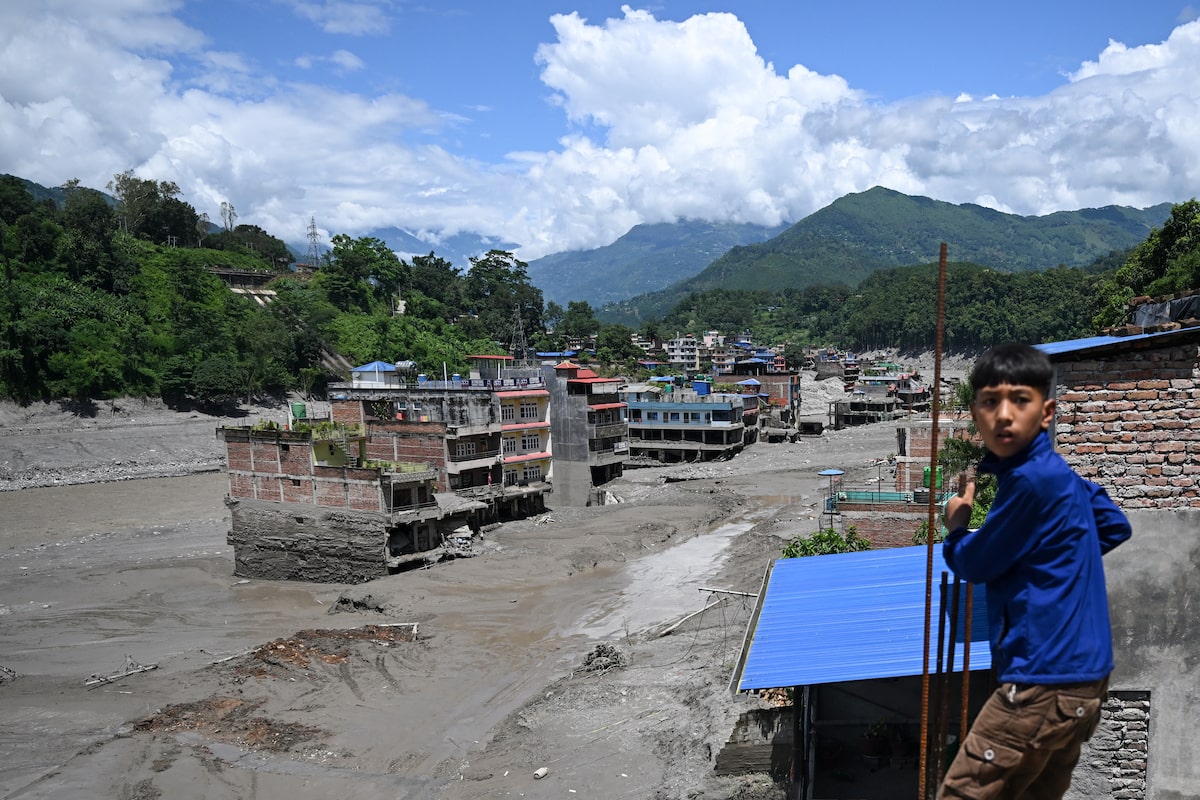
Open this photo in gallery:Houses lie deluged in sludge after flash floods at Trishuli in Nepal's Nuwakot district on Aug. 27.ARUN SANKAR/AFP/Getty ImagesA lake formed by a flash flood which swept through a border region of Nepal and Tibet earlier this week began to overflow Friday, halting rescue work and threatening a second catastrophe in the remote Himalayas. Authorities in both China and Nepal had been closely monitoring water levels in the lake, which had continued to rise after Wednesday’s initial disaster, when a glacier collapse sent a huge torrent of rock, ice, mud and debris cascading down river, killing almost 500 people and leaving some 1,000 missing. China’s Ministry of Water Resources said Thursday the lake held around two million cubic metres (70 million cubic feet) of water and was expected to receive another three million cubic metres (106 million cubic feet) over the next three days.Open this photo in gallery:This aerial image released on the Chinese social media platform Weibo account of the Lhasa Mobile Fire and Rescue Service on Aug. 27 shows a barrier lake which formed after a landslide near where Nepal's Chhochen Khola River flows into the Purepu Tsangpo River, in Gyirong county, in China's Tibet region.-/AFP PHOTO / Lhasa Mobile Fire and Rescue DetachmentResidents fled uphill Friday afternoon amid fears the lake would burst its banks, potentially prompting further landslides and flooding, while rescuers on both sides of the border also halted work. Work resumed hours later, however, with China’s state broadcaster reporting flood risk from the lake was deemed “manageable.”“There is a risk of further flooding,” said Shanti Mahat, spokesperson for Nepal’s disaster management authority. She urged all those in the area, including relief workers, “to exercise high alertness and immediately move to a safe place if they see any risk.” Earlier, Nepalese rescue teams used helicopters to search for survivors and drop emergency supplies to thousands cut off in towns and valleys, while emergency services – some using sniffer dogs – recovered dozens of bodies swept down into the plains.Dibga Tamang was among the last people rescued from Rasuwa on Thursday, airlifted along with three others to an army camp in Nuwakot.“All of our people have gone. They are dead,” Ms. Tamang said. “I have no one left waiting for me. Everything and everyone is gone. The end.”Religious pilgrims from Canada at building swept away in Tibet-Nepal border floodsWhile offers of assistance are pouring in, Nepal has said it does not need help from other nations in search and rescue missions.“The offer for help is natural. Our security agencies are doing the search and rescue operation. For now we don’t require such help,” foreign ministry spokesperson Lok Bahadur Chhetri said Friday.Chinese rescuers had yet to reach the worst-hit area on the Chinese side of the border, the Gyirong border crossing, by Thursday evening, state media reported, as crews worked to clear debris from the key access road leading to the area.China’s Premier Li Qiang arrived to inspect relief efforts Thursday, while in Beijing, President Xi Jinping convened a meeting of the Communist Party central committee to discuss the ongoing “extremely difficult” rescue operation. According to a readout in state media, the meeting stressed the need to strengthen early warning and monitoring systems and improve emergency response, as scientists have warned global warming increases the likelihood of glacial collapse in the Himalayas, threatening future disasters. Open this photo in gallery:A member of the security forces and his sniffer dog search for survivors on Thursday.PRAKASH MATHEMA/AFP/Getty ImagesLevan Tielidze, a research fellow in glacial geomorphology at Melbourne’s Monash University, said while footage of Wednesday’s flood was shocking, it was “not surprising.” “As climate change intensifies, glaciers worldwide are melting – even in high regions such as the Himalayas,” Dr. Tielidze wrote Thursday. “The Himalayas are especially vulnerable, because the steep slopes of many of these very tall mountains are made of permafrost – rock and soil frozen for centuries. As temperatures rise, these slopes are beginning to melt or destabilize. If an earthquake or slope failure occurs, it can trigger a sudden and devastating debris flow.”While increasing temperatures as a result of the ongoing climate disaster will inevitably cause more glaciers to collapse, Dr. Tielidze said mitigation can help save lives. When 20 million tonnes of rock and ice buried the Swiss village of Blatten in May, 2025, hundreds of homes were destroyed, but there were no fatalities, as residents had plenty of time to evacuate thanks to early-warning systems in place. The UN Green Climate Fund last year approved US$36.1-million to install such protections in Nepal, with chief investment officer Henry Gonzalez warning “the rapid retreat of Himalayan ice leaves no room for delay.” The prescience of that remark was proven this week as hundreds of pilgrims, tourists and local residents in Nepal and Tibet were caught entirely off guard by the catastrophic glacier collapse. Open this photo in gallery:Relatives gather to enquire about missing people outside a hospital in Kathmandu on Friday.PRAKASH MATHEMA/AFP/Getty ImagesAccording to Global Affairs Canada, some 30 Canadians and permanent residents are still missing in Nepal and Tibet, though officials warned that “given the extremely difficult circumstances on the ground, this number will fluctuate as new information comes in.” Around 22 of the missing Canadians were members of two groups of pilgrims returning from Tibet to Nepal around the time the disaster struck, friends and tour group operators told The Globe and Mail. The adventure-travel company Himalayan Glacier said their missing clients included 10 from Canada. They were staying at the Hotel Kailash near the Rasuwagadhi crossing, on the Nepali side of the border.Meanwhile, 12 religious pilgrims from Canada were among a group of 80 travellers who arrived at an immigration-control building on the Tibet-Nepal border when the flooding washed away the facility, according to the India-based Isha Foundation, which organized the trip. With reports from Tu Thanh Ha, Reuters and the Associated Press
Fears of second catastrophe in Nepal and Tibet as lake formed by flood overflows
Full Article
Original Source
Read the full article at Theglobeandmail →KhanList aggregates and links to publicly available news content. We do not host full articles from third-party sources. Always verify important information with original sources.