
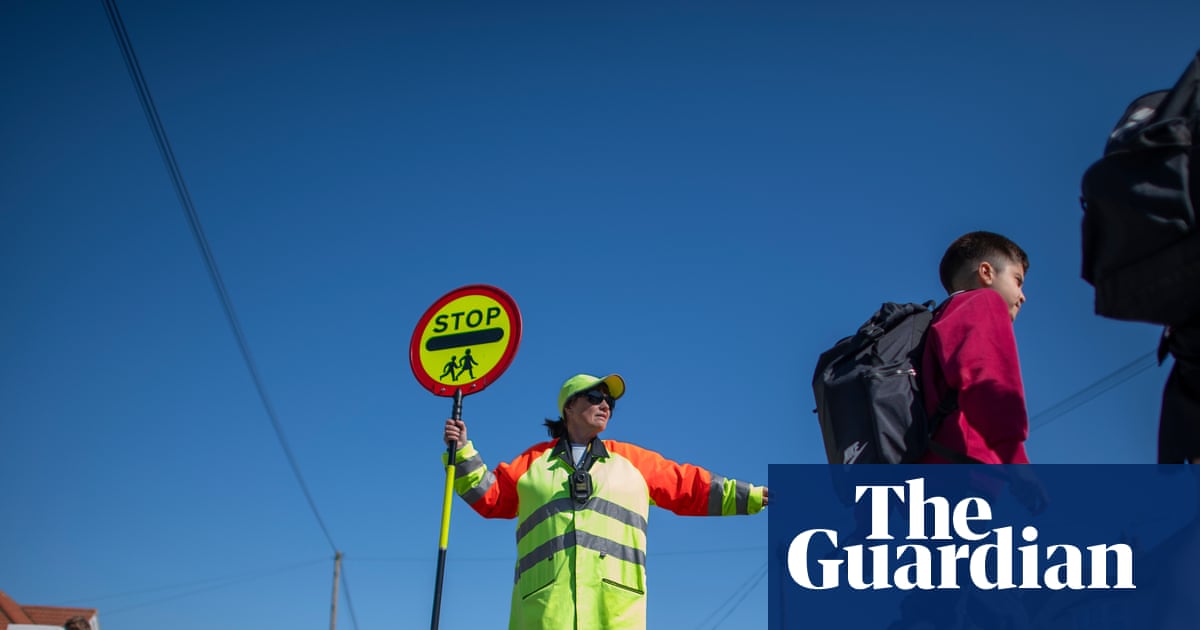
They have been a feature of British schooldays for decades, instantly recognisable by their round signs and yellow hi-vis uniforms. But a struggle to recruit against a backdrop of staff cuts at cash-strapped local authorities is threatening to make lollipop people a thing of the past.The Recruitment and Employment Confederation (REC) said school crossing patrols were among jobs showing the biggest increase in vacancies in recent weeks, alongside sales roles and exam invigilators.There is no legal obligation on councils to fill the roles. Last week, East Riding of Yorkshire council said a quarter of school crossing patrol sites were unstaffed, adding that applicant numbers were dwindling. It said it was exploring long-term alternatives at some sites, including infrastructure changes, such as creating zebra crossings.Parents and carers in Hessle told the BBC that unstaffed crossings were “not really safe for the children”, but the council said some had been vacant for some time “with no applicants”, while others had become vacant after previous lollipop people retired.A council spokesperson said: “The role of a school crossing patrol may not be as attractive in this day and age, as it requires work for limited hours each school day, offers relatively low pay for the short morning and afternoon shifts they are needed to work, and they are outside in all weathers.“The short period of time they are needed to work may not suit everyone and limits what people can do during the rest of the day. But we continue to encourage local residents to apply for these jobs and help make a difference to children, parents and the school community.”Earlier this year, after a council meeting in Redcar and Cleveland where elected representatives expressed concerns about gaps in school crossing patrols, the council leader, Alec Brown, said it was not easy to maintain a full roster.“It’s difficult, you just can’t have a pool of ready-made lollipop people to step up,” he said after the meeting in March.A Redcar and Cleveland borough council spokesperson said it advertised vacancies through the council’s recruitment channels and, where appropriate, directly through schools.“We receive a reasonable number of applications, but one of the main challenges is that these roles are part-time positions with relatively low weekly hours,” the spokesperson added. “We currently have three applicants going through the recruitment process, and once appointed, the service will only have one vacancy remaining.”The Bournemouth East MP, Tom Hayes, who has been campaigning to save local school crossing patrols, said: “I absolutely think we could be seeing the loss of lollipop people everywhere in the country. It just feels to me like we’re breaking down as a society so many of these touch points, which can hold communities together, the kind of the little things that create the glue.”The factors of limited hours and low pay have probably been compounded in recent years by an increase in lollipop people facing dangerous and aggressive drivers, leading some councils to provide their crossing patrols with body cameras.Ally Mitchell in his school crossing patrol uniform.Ally Mitchell took a job as a lollipop person in Edinburgh after being made redundant from a role in the video games industry. It was initially meant to be a stopgap while he looked for a full-time position, but he enjoyed the job so much he stayed on even after securing a role in the charity sector.“While the additional income is certainly important, what keeps me doing the job is the sense that I’ve become a trusted and respected member of my local community,” he said. “I genuinely enjoy helping people, wishing them a good morning and making a positive contribution to their day.”Mitchell said school crossing patrols go “beyond road safety”, having a wider impact on communities. “I think we’re living in a world where people can increasingly feel isolated and disconnected from one another,” he said.“School crossing patrol officers are one of those little everyday points of human contact that help bring communities together.skip past newsletter promotionafter newsletter promotion“You can replace a crossing with road markings or traffic lights, but you can’t necessarily replace the person standing there, remembering the children’s names, greeting their families and becoming part of their lives,” he added. “And I think that would be a real loss.”Meanwhile, in some areas, those who want to become a lollipop person may struggle to find work, with councils scrapping the positions to save money.Last year, Durham council – controlled by Reform UK – decided to scrap vacant roles for crossing guards as part of a savings drive, saying: “These posts have been vacant for a prolonged period of time without incident.”The latest data available, obtained by the GMB trade union under freedom of information laws, found that school crossing patrol officer numbers in England, Scotland and Wales fell by 2,081 in a decade, from 7,128 in 2009-10 to 5,047 in 2017-18.Earlier this year, Bournemouth, Christchurch and Poole council postponed its proposed cuts to patrols after a campaign was launched to save the roles.The council took the decision to “upgrade” school crossing patrol sites with permanent crossings in 2024.A council spokesperson said: “While we appreciate there is the loss of a familiar face in the community, permanent crossings provide a safe and reliable facility that is available 24 hours a day, seven days a week, benefiting schoolchildren and the wider community all year round.”Hayes said the issue was part of a broader pattern. “Whether it’s the librarian behind the counter, who’s going to help you to do your homework, whether it’s the person who works at a Sure Start centre who’s going to help you to raise your kid because they give you the skills that you need, whether it’s the playground that’s broken down, where mums would otherwise have just sat on a bench for ages and got to know each other, there are these just little contact points in the society.“If you chip away at them, and you do it in the interest of saving money, or you’re doing it in the interest of something more efficient, which are the arguments I have heard, it just undermines who we are as a society, and it makes it harder for people to feel like they can create connection.”
Fears for school crossing patrols as councils struggle to recruit lollipop people
Full Article
Original Source
Read the full article at Theguardian →KhanList aggregates and links to publicly available news content. We do not host full articles from third-party sources. Always verify important information with original sources.