
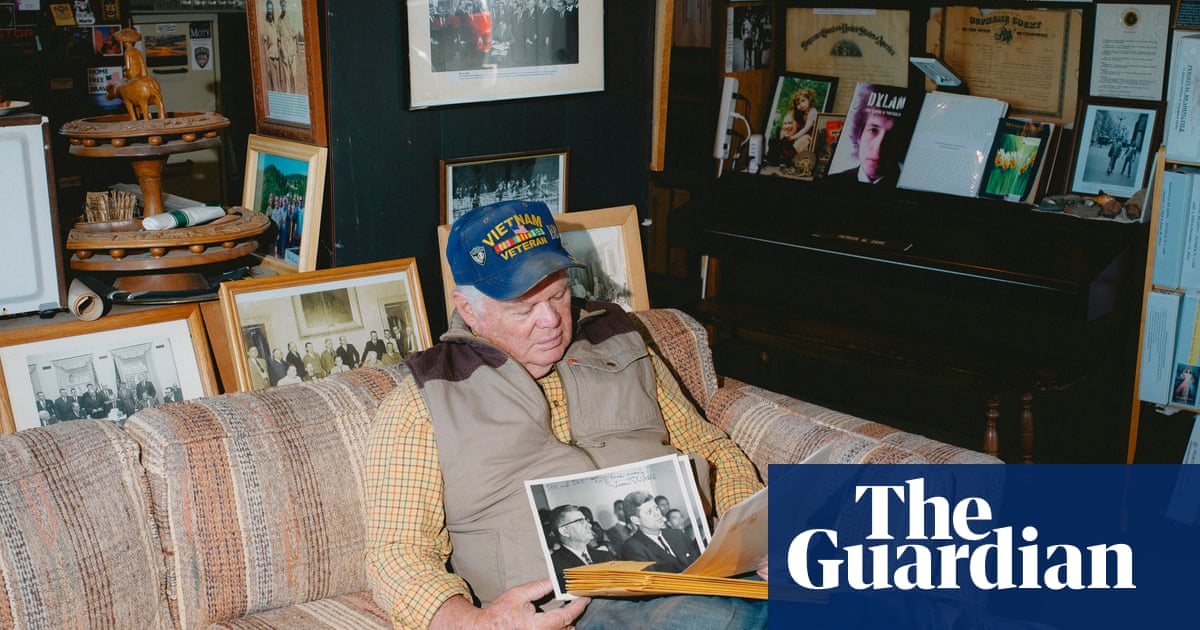
Pat Carr looks through photographs at his home in Cottonwood, California. Photograph: Mason Trinca/Mason Trinca for The GuardianA crucial election was approaching and the country was desperate. Despite promises that economic conditions were improving, nearly a quarter of the US was out of work as voters headed to the polls in 1932.It was the darkest time since the civil war, a period so dire that in California’s capital people fought each other for work. In early 1931, a crowd of 200 men scuffled over a handful of temporary jobs moving back-breaking loads of granite, the Sacramento Bee reported.That same newspaper urged its readers to find odd jobs to save fellow citizens from hunger and homelessness. Those who had already lost shelter set up along the banks of the Sacramento River, as unhoused people would do decades later, and were, in some cases, near starvation, according to the Bee.The situation was often even worse in the remote and rural communities further up north, where opportunities were fewer and relief was slower. In Shasta county, which stretches from the northernmost reaches of the Central Valley to the state’s dense forests, residents were struggling.Loggers move timber using horses and ‘big wheel’ wagons near Mount Shasta in this 1930 photograph. A ‘donkey’ steam engine can be seen in the background. Photograph: Historical/Corbis/Getty ImagesShasta had been founded in 1850, as hundreds of thousands flocked to California in search of gold. The region became a productive center for gold mining, with newcomers scouring creeks and boring through mountains in search of the precious metal. It was a place of opportunity, a soon to be railroad hub that offered jobs in copper mining, agriculture and the timber industries.Then came the depression.In one mountain town, a group of jobless men were accused of setting a blaze with the aim of being hired to extinguish it.Desperate people returned to the green hills that once yielded fortunes, hoping to find a bit of gold again. “Not getting rich, but I dug out $18.90 last month,” one young man told a reporter in 1931. “I eat, and that beats being jobless and hungry.”Franklin Delano Roosevelt promised hope and help. He traveled to 41 states during his campaign, making a point to visit small towns and rural areas. When he stopped in Redding, the Shasta county seat, in September 1932, businesses closed and classes ended early so that everyone could see the New York governor’s remarks.“I am not making this trip a political one. I am making it to learn the conditions and needs of every section of the United States,” he told a crowd of several thousand from the back of a train. “We are not making this fight against the Republican party but against Republican leadership which has brought the country to its present condition.”Franklin D Roosevelt speaks from the rear of a train alongside his daughter Anna in Redding in 1932. Photograph: National Archives and Records AdministrationHis message resonated. Despite Republican insistence that the party would carry California, the state went, as one newspaper declared, “Democratic and progressive with a vengeance”. That was especially true in Shasta, where just over 72% of voters backed Roosevelt.Nearly a century later, it’s an election result that is difficult to imagine. Shasta is the de facto Maga capital of California, and a center of the US election denial movement. Roughly two-thirds of voters supported Donald Trump in 2016, 2020 and 2024. They took his political philosophy and ran with it, electing officials who promoted falsehoods about stolen elections and frequently clashed with the state.During the pandemic, the area drew national attention for its hostility to Covid restrictions. The years that followed brought more turmoil that touched all corners of public life, documented in headline after headline – a journalist assaulted while covering a meeting of local conservative groups, a protester who faced jail time for holding a sign calling for the resignation of an elected official during a public meeting.Map of 2024 presidential political results in northern California. Shasta county, with a republican majority, is highlighted.For more than a year, the Guardian has explored the political transformation that unfolded here over the 20th century. The story that emerged through conversations with longtime residents, historians, and political experts is one of a community that dramatically veered right amid the collapse of its major industries and became a hotbed for radical conservative politics.And it’s a chapter in the story of the Democratic party. Shasta can be seen as a case study for how the Democrats have struggled to regain a crucial pillar of the base they once relied upon – rural America – even as they appear on track to win back crucial seats this midterm election.The small settlement of Cottonwood is perhaps best known for its rugged western beauty, nearby fish hatchery and rightwing militia. It is a place of wide open spaces with sprawling cattle ranches and pristine views of the junction of the Sierra Nevada and Cascades.Even in a deeply Republican county, the community stands apart for its conservatism. Along the roads, underneath majestic oaks, are old signs for measure B, a controversial ballot initiative voters approved in June that would end nearly all voting by mail while requiring voter ID and a hand count. The effort put the county in yet another legal battle with the state – a judge blocked the measure from taking effect as the litigation moves ahead.Cattle graze in a pasture near Cottonwood, with Lassen Peak in the distance. Photograph: Mason Trinca/The GuardianA few miles away, inside a packed home office not far from the Sacramento River, Pat Carr has assembled a sort of museum showcasing a mostly forgotten history. Old photos of local luminaries with Democratic presidents line the walls, along with letters from White House officials and even a supreme court justice.The documents paint a portrait of a deep blue region built by Democratic policies.“When I try to explain that to people here now, they’re going, ‘You’ve got to be kidding me. It couldn’t have been like that’,” Carr, 82, said sitting in front of a table crowded with memorabilia. “Those of us that remember a heyday, we’re almost all dead.”In the 20th century, Shasta residents played crucial roles in state and federal politics. They chaired California’s Democratic party, helped bring major infrastructure projects to the region, and they served in John F Kennedy’s administration.Carr knows the history well – it was his family’s. In a photo of Roosevelt’s Redding visit, FDR stands alongside Carr’s grandfather, Francis. Carr’s father and cousin managed Kennedy’s Northern California campaign, and his uncle was the undersecretary of the interior department under Kennedy.Pat Carr at home in Cottonwood. Photograph: Mason Trinca/Mason Trinca for The Guardian“The money was flowing out of Washington into the north state, and the guys that were getting it done were all Democrats,” Carr recalls.The Shasta Dam is a 600ft tall monument to that era. Constructed with 15m tons of concrete, with a reservoir capable of holding back some 4.5m acre-feet of dark green water, the dam has helped make California an agricultural powerhouse as the keystone of the Central Valley Project.It sends vast quantities of water from the state’s far north to more arid sections of the Central Valley for farming, and generates enough electricity to power as many as 710,000 homes. The federal government, which manages it, considers the dam critical infrastructure at a level just below the White House and the Pentagon, a tour guide said on a September morning.During its construction amid the Great Depression and through the second world war, it provided thousands of badly needed jobs.Roosevelt came to the White House with broad support and implemented an ambitious agenda that over his first term helped build a powerful coalition of labor unions, African Americans, the working class, liberal professionals and white southerners that became the backbone of his party.Mere months after he took office, there were work camps established in Shasta county through the Civilian Conservation Corps (CCC).The Shasta Dam. Photograph: Mike Kai Chen/The GuardianThe president’s administration put millions of Americans to work through programs such as the CCC, which enlisted jobless young men to build campgrounds, cut firelines and construct fire lookouts.The agencies he created worked in virtually every county in the US, helped bring power to vast swaths of the country, and established much of the local infrastructure we now know. Redding, the largest city in the area, received federal dollars to build a fire station, post office, bridge and veterans memorial building.“That won over the hearts of millions of ordinary people,” said Richard Walker, a professor emeritus at UC Berkeley and the director of the Living New Deal research project. “They felt that the government cared. Critically, they felt they participated. They were helping their own community, whether it was fixing streets and sidewalks or planting trees or building schools.”The county had scored the most significant investment in the form of the dam, one of the largest public works projects of the era and one of the most important hydroelectric facilities in the world at the time, Walker said.Construction workers of the site of the Shasta Dam, circa 1940. Photograph: Frederic Lewis/Getty ImagesMost of California’s water is located in the north, while 80% of the demand lies in the central and southern regions of the state. For decades, California had sought a solution to the imbalance and the winter flooding of valley communities. The state couldn’t afford to finance the project during the depression, but after lobbying from prominent Californians including Francis Carr, Roosevelt’s administration funded it.“Things are more optimistic than ever before in [the] Central Valley. We are delighted with prospects of immediate work,” state senator John B McColl said in 1937 before construction began.It employed almost 5,000 people at one time – bringing new residents. Construction was under way 24 hours a day, seven days a week, and was considered so vital that some workers received draft deferments during the second world war. The dam translated into enduring Democratic loyalty, said Bob Mulholland, a veteran Democratic strategist and longtime resident of northern California.“I think there was a certain amount of that commitment or thanks for years, from the workers themselves and the kids, to FDR and the Democrats,” Mulholland said in an interview with the Guardian in 2025 shortly before his death.The war brought significant growth in the timber industry, as did surging demand for housing in the years that followed. It was an era of opportunity and expansion in this part of the state, with ample jobs in the mills and unions for wide swaths of workers from loggers to retail clerks to bartenders. It echoed what was happening across the US.“After the war, the United States experienced the greatest economic boom in human history and moreover, even as inequality was declining, the rich were still getting richer,” said historian Harvey Kaye, a professor emeritus of democracy and justice at the University of Wisconsin-Green Bay. “Everyone was doing better.”The agencies Roosevelt created established much of the local infrastructure we now know. Redding, the largest city in the area, received federal dollars to build a veterans memorial building, a fire station, and a post office. Photograph: Mike Kai Chen/The GuardianBy 1948, when Diane Kinyon was born, Shasta was one of California’s bluest counties and an important part of its Democratic base. Kinyon’s family had migrated to the area in the 1860s and for generations worked in the industries that helped build and feed California, from the railroad to ranching and logging.Her parents were “diehard Democrats”, she said. Her father, a union man, was employed by the county road department, working his way up after starting as a mechanic, and also owned a pizza shop with her mother. Her father emphasized the importance of unions to Kinyon who later who spent decades as a union organizer.“We knew we were union. We knew we were Democrats, and we knew what that meant was that you help people,” she recalled. “But I think on the other side, [those were Republican] values too. They just financially had a different way to get there.”In the 1960s, the construction of Interstate 5, the nearly 1,400-mile (about 2,253km) highway that runs from Mexico to Canada, opened up the county, and brought more tourists, Kinyon recalled. Road work, along with reservoir projects, offered even more jobs.The region’s extractive industries created challenges over the years – pollution from the mining industry damaged crops, seeped into waterways and poisoned fish.Still, a sense of hope hung over the region, along with near constant smoke from wood waste burners at the mills, recalled Pat Carr and his brother Jeff, a farmer and retired teacher. It was a sweet wood smell rather than the acrid wildfire smoke California frequently endures today.The industry was in full swing in 1960, when Kennedy ran for president, and Shasta was still a Democratic powerhouse.Kennedy visited the area twice, following the same trail as Harry Truman in 1948, he said on one visit. He spoke in Redding in 1960, praising the Shasta Dam and telling the crowd “water is key to the American future” and that “this valley shows what can be done”.Shasta went on to have some of the highest support for Kennedy of any county in the state. And James Kennedy Carr, the Carr brothers’ uncle, became the undersecretary of the department of the interior.President Kennedy with James K Carr, then undersecretary of the interior, in this 1962 photograph. The photograph is inscribed ‘JFK and JKC — Two fine ones!’ and signed by then interior secretary Stewart Udall. Photograph: Courtesy of Pat CarrWhile the US benefited from the legacy of the New Deal, major changes would soon alter the Democratic party and fracture the coalition Roosevelt built. The successes of the civil rights movement and the Democrats’ support of landmark legislation resulted in many white southerners beginning to abandon the party. Lyndon Johnson was the last Democratic presidential candidate to attract support from a majority of white Americans.Meanwhile, conservatives and the corporate elite began what historian Kaye describes as a class war and crusade against the achievements of the “long age of Roosevelt”.Business groups touted “free enterprise” in an effort to disempower unions and reduce government regulation, while corporations moved operations to the US south and abroad to cut costs and skirt regulations, Kaye has argued. Jimmy Carter embraced deregulation and austerity measures, Kaye said, and his policies ultimately weakened unions.“The Democratic party basically turned its back on the working class,” Kaye said. “Republicans benefited from the Democrats abandoning the FDR tradition and the age of Roosevelt that had made them the majority party of the people from the early 1930s right through the early 70s.”Shasta remained reliably blue for a little longer, but trouble was on the horizon. Mills had begun closing. For decades, wood products had been one of the top manufactured goods in the country, and far northern California was a key hub. The industry argued it was being hamstrung by increased regulation and environmental laws. But, Walker countered, by the late 70s the region had cut much of its prime timber and was being out-competed by new technology and production in Canada and the southern US.Jeff Carr, 66, was a teenager at the time, and remembers the closures, and the hardship that followed. Instead of heading to the mills after graduating, people his age went into the military and some left town to attend college. Shasta was founded on extractive industries, he said, and it appeared it had largely used them up.In November 1980, after nearly 50 years of almost uninterrupted support for Democrats, Shasta county, like the rest of California, backed Ronald Reagan for president. Voters also ousted the area’s long serving congressman Bizz Johnson in favor of a Republican.It was a seismic shift, Jeff Carr recalled. And it echoed a change taking place across California.Jeff Carr, left, and his brother Pat pose for a portrait. Photograph: Mason Trinca/The Guardian“There’s one story here: California has gone to hell for Democrats,” Michael Berman, a Democratic consultant, told the Los Angeles Times in 1986. “Young people are registering Republican. And from what they’ve had to choose – between Jimmy Carter and Walter Mondale or Ronald Reagan – it’s not been a tough choice.”The trend would ultimately reverse in much of the state, but in parts of California’s interior, including Shasta county, it proved a lasting change. Some locals began voting Republican and stayed aligned with the party. Meanwhile, a surge of new residents arrived from southern California, eager to escape to the more affordable north, and they leaned conservative. At the same time, there was an expansion in churches, including ultra conservative worship houses. Simpson University, an evangelical college, arrived in Redding in 1989.Shasta was becoming more solidly conservative while the influx increased property values and drove up costs at a time when mills that had been critical to the economy were declining. The shift was shocking.“None of us really saw that coming. I chalk it up to being complacent, being overly self-assured,” said Frank Treadway, a lifelong Shasta resident and Democratic organizer.It manifested in countless ways. Treadway, 84, saw it in his coffee and tea shop where newly arrived conservatives would make a point to loudly discuss religion and politics, knowing he was active in the party. Jeff Carr heard it on ranches and job sites that suddenly rang with the endless soundtrack of conservative talk radio.“With that fusion of religious fervor, it made politics extremely personal and a part of people’s fabric,” Carr said. “That’s when we began to see it: a real divide and the inability to meet on common-ground issues.”A battle over wildlife highlighted the disintegration of this common ground. Even decades on, some Shasta residents shudder at mention of the spotted owl. Kinyon does not mince words: “The spotted owl screwed us.”The timber industry had been in steep decline locally, but the federal government’s decision to list the northern spotted owl, which relies on old growth and mature forests for nesting, as a threatened species dealt another blow as the protection significantly restricted logging. The industry pushed a self-serving narrative, Walker argued, pinning the blame for its downturn on environmentalists who wanted to protect the small percentage of old-growth trees that remained.While it was Republican George HW Bush’s administration that added the raptor to the list, following lawsuits, the Democratic party largely supported the proposal. It would become the source of years of resentment and further diminish the party’s popularity in the area.“Not everybody is with me on the spotted owl situation,” Kinyon said. “As a Democrat I thought: we’re making a mistake.”By the end of the century, California had turned into a blue bastion, while Shasta hardly resembled the community Roosevelt, Truman and Kennedy had visited decades before. The population had exploded, but the Democratic base had collapsed.The transformation is emblematic of what happened throughout rural America as the loss of key industries drove economic decline, Walker said. These communities needed something akin to the New Deal, government intervention and investment to keep them viable and improved schools to allow students to better compete in changing labor markets. It never came – not from Democratic or Republican administrations.“The government stopped caring. You’ve got very little government aid to workers whose factories were closing, whose lumber mills were closing, whose mines were closing. The basic foundation of their lives were shrinking,” he said.On a sweltering afternoon in June 2016, Donald Trump stood before a crowd of thousands of supporters in Redding and promised a transformation.“We are going to bring jobs back to this country. We need our jobs. We’re going to make it very expensive for companies to fire everybody and leave,” he said in front of a plane adorned with his name at the Redding airport. “You know, your area has lost one in three manufacturing jobs over a fairly short period of time. That’s a lot of manufacturing jobs.”Trump, then a Republican candidate, speaks at a campaign rally in Redding in June 2016. Photograph: Stephen Lam/ReutersFor Shasta, home to 180,000 people and now one of California’s most conservative counties, Trump’s words brought hope. He received more than 64% of the county’s votes that year and 65% in 2020. And Trump did deliver change here, but not the kind he had promised.His refusal to admit he lost the 2020 presidential contest, coupled with the pandemic, ushered in an era of political extremism that reshaped public life in this region.The latest shift began even before the election, amid a swell of outrage over California’s covid restrictions. There was growing discontent across the US during the pandemic, as seen in unruly school board meetings and city council sessions, but in Shasta it was particularly severe.Some viewed the state’s strict rules as missteps and overreach, and further evidence that California’s Democratic leaders were out of touch with rural communities. The restrictions reinforced a feeling that had been building in past decades – that the region had been forgotten by Sacramento.Many residents were aggrieved at what they saw as a sudden and lengthy intrusion into their daily lives. Photos of the state’s governor at a dinner party at the upscale French Laundry while the state was urging people to avoid such gatherings fueled further outrage.The frustration over the pandemic and the state’s Democratic supermajority in the capitol intensified anger at the government and deepened allegiance to Trump. In Shasta, it also brought together disaffected residents and broad political groups including militia members, anti-vaxxers and secessionists. Reverge Anselmo, a Connecticut heir with a years-long grudge against the county, poured money into the growing anti-establishment movement. He also backed an effort to recall moderate Republican supervisors accused of not doing enough to push back against state pandemic rules.Woody Clendenen, barbershop owner and founder of the Cottonwood Militia, shaves customer Ben Duncan. Clendenen displays Trump 2020 and Maga hats alongside shotgun, rodeo posters and references to the US constitution. Photograph: Frederic J Brown/AFP/Getty ImagesLeonard Moty, a former police chief who had served on the board for years, suddenly found himself not conservative enough for the political moment. Trent Copland, a retired teacher whose family settled in the county in the 1860s, was friends with Moty and considered him a reasonable Republican. They had clashing political beliefs, Copland recalled, but when Moty faced a recall election, he rushed to help.In the end, Moty lost his seat, and the recall handed control of the county’s governing body to a deeply conservative majority aligned with the anti-establishment movement. It set off years of dysfunction.In the following five years, local politics would be defined by animosity, with Democrats and moderate Republicans pitted against ultra conservatives. Public meetings have seen little meaningful conversation and instead verbal sparring and even arrests.Jenny O’Connell Nowain, a former pre-school teacher with no criminal history, was detained and charged for silently protesting against an official who had alleged without evidence that elections in the community were being manipulated.Visiting Shasta county in recent years, one might come away with the impression that fraudulent elections are the most pressing local issue.“Now the big deal is election fraud, and there’s not a shred of proof that election fraud has ever taken place,’ said Copland. “But that doesn’t seem to matter. The facts don’t matter.”Still, a small but visible group of local residents has insisted local races are compromised. Some elected officials have supported those claims, arguing without evidence there has been widespread interference in local contests. They’ve unsuccessfully sought to implement a hand-count system, a method considered too costly and error-prone for complex US elections but embraced by those who mistrust the integrity of the country’s voting.A sign supporting Prop 39, a statewide ballot measure that would require voters to show ID, in a front yard in Shasta county. Californians will vote on the measure on 3 November. Photograph: Mason Trinca for The GuardianLast year, Shasta appointed Clint Curtis, a self-described election integrity advocate with no experience, to oversee its voting. Curtis accused his predecessors of interfering with elections – even though Republicans consistently win the county – and recently announced plans to hire a disgraced election clerk from Colorado for a job.Longtime residents like Kinyon are frustrated by the significant time and resources officials have invested in trying to solve a problem that doesn’t exist while the area faces significant challenges.Shasta county has one of the highest suicide rates in the state and high overdose rates. There is a severe lack of economic opportunity, residents say. Bethel, a conservative megachurch with about 11,000 members, plays a significant role in the local economy. The church’s school of supernatural ministry, which has been called a “Christian Hogwarts”, has attracted thousands of students and visitors, some of whom have stayed and started businesses.The area relies heavily on federal funding – not in the form of massive infrastructure projects that once employed thousands – but through grants and social services.Rural California is expected to take a significant hit with the Trump administration’s cuts to those grants and services, including about $1tn from Medicaid over 10 years. Last year, the head of Shasta’s largest healthcare provider warned the changes to Medicaid would have “crippling” impacts in a county where the local Medicaid provider serves nearly a third of the population.It will take time for the full effect of the budget reductions to be seen, but they will have repercussions in the region for years to come. Experts have warned a new fund allocating $50bn for rural health is too small to offset the adverse effects.Democrats have said they will reverse the cuts if they are victorious in the midterms.Times may be dark for Democrats in Shasta, but there is also some hope.Because of a redistricting effort undertaken in response to Trump’s push for gerrymandering in Texas, the region is poised to have its first Democratic representative in Congress in nearly 50 years.Among conservatives, the redistricting measure, called Prop 50, has only fueled resentment against the California governor, Gavin Newsom, and intensified feelings that rural areas are not getting fair representation. Just over 70% of Shasta voters opposed it. But others celebrated the development, and are excited to have an experienced new congressman.“I believe one of the best advocates that the North State will have gained is Jared Huffman,” Jeff Carr said, referring to the lawmaker slated to represent the region in January. He pointed to Huffman’s role as the top Democrat on the House natural resources committee and advocacy for farmers.Local Democrats hope the party will be moved to invest more into organizing in the county. “We as Democrats [have looked] at Shasta county as a place where we gotta reduce our losses, not as a place we can win,” Mulholland said last year.The California Democratic party concentrates resources in close races, meaning conservative rural areas receive relatively little support. Kinyon has long believed that if the state party invested more into local races, Democrats here could rally more voters.“Our votes are important. Our people are. Give us some help.”In the meantime, local Democrats are focused on the same sentiment Kinyon recalled from her childhood; community building and advocacy with food and clothing drives and support groups for immigrants.“I think we’re making meaningful progress in Shasta county in the ways that we find people need help,” she said. “Those are the things that we work on here.”Jeff Carr serves on the local Democratic central committee, alongside Kinyon, and says the local party is trying to aid people at risk of losing food, health and housing benefits under recent federal cuts.More support from the state party wouldn’t necessarily change the outcome of races right away, but it would help improve the conversation, argued Francie Sullivan, one of the few Democrats to ever serve on Shasta’s governing board.But what the region needs, like similar areas across America, is massive investment, Walker said, to create thriving communities. Joe Biden’s administration backed some significant rural projects, but Democrats have largely been poor communicators and failed to articulate what they were doing, he added.“People in the rural areas like Shasta county have no idea what Biden was trying to do for them … They don’t think the government helps them,” he said. “There’s a lot of money that flows into Shasta county from the richer areas, but nobody trumpets it. They need more, and they don’t get it. And I understand their despair.”Name badges, newspaper clippings and political stickers cover a filing cabinet at Pat Carr’s home. Photograph: Mason Trinca/Mason Trinca for The Guardian“If we don’t get a new New Deal of some kind it’ll continue,” he said. “The rural areas will continue to wallow in the mire of Magaism, and we’re going to be stuck with this horrible government. It’s a tragedy. It’s just a long, slow tragedy.”Back in Pat Carr’s office, he and his brother pondered what it might take to turn things around in Shasta. Residents have previously lobbied the state to open a new university campus here, which would have a tremendous impact, Jeff Carr said. The region needs a change of perspective and a vision for its future economically, he said.But whatever comes, they’re not going anywhere.“There are other places that I could be that would be easier and the like. It’s well beyond family loyalty,” Pat Carr said from his property in Cottonwood, as the sun shone brightly over Lassen Peak framed in the window behind him. “I feel a duty almost to be here.”
FDR made it a blue bastion – now it’s Trump’s stronghold in California. Is it forever lost?
Full Article
Original Source
Read the full article at Theguardian →KhanList aggregates and links to publicly available news content. We do not host full articles from third-party sources. Always verify important information with original sources.