
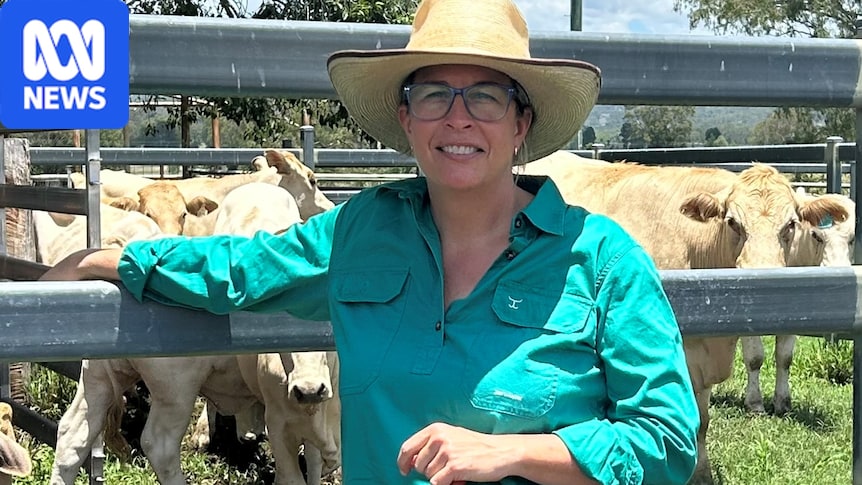
Julianne McLean knows the worst is still to come, which is why she hopes to take part in a promising clinical trial developed from 25 years of scientific research.The 49-year-old cattle farmer from Kilkivan, about 230 kilometres north of Brisbane, was diagnosed with motor neurone disease (MND) in August.What started as discomfort in her left leg developed into difficulty walking and foot drop, followed by spinal and voice degeneration.Sunshine Coast University Hospital (SCUH) director of neurology Antony Winkel said MND, also known as amyotrophic lateral sclerosis (ALS), was a progressive neurological condition affecting the nerve cells in the brain and spinal cord responsible for movement.Antony Winkel has worked in neurology for more than eight years. (Supplied: NuNerve)As these motor neurons deteriorate and die, the brain can no longer send signals to the muscles, leading to muscle weakness, wasting and loss of function over time."Currently, we don't have a great understanding of what causes it," Dr Winkel said."The life expectancy is only two or three years after a diagnosis and, because we know the diagnosis can be quite delayed, the average survival in MND is about three to five years."'Really nasty disease'Dr Winkel treats many Queenslanders living with the disease, including Ms McLean."It's one of those really nasty diseases where it doesn't matter what you do, you know the next day is going to be harder in some way," he said."The impact the disease has sticks with families for the rest of their days. It's horrendous to watch."Ms McLean and her husband, Angus, are bracing for what is to come.Julianne and Angus McLean have been together for 30 years. (Supplied: McLean family)"I know, as my body deteriorates, things will get harder and harder," she said."I'm just trying to stay focused on enjoying each day as much as possible."Losing hopeThe McLeans have been farming cattle and crops to make hay for more than 20 years."The majority of the work is physical and now that I have compromised stability and balance as well as deteriorating strength, I really can't do much of anything on the farm," Ms McLean said.Antony Winkel treats MND patients at SCUH including Julianne McLean. (Supplied: NuNerve)She said it was hard to accept her life had been cut short."Anytime you're given a terminal diagnosis and that there's officially no cure, the first thing that you lose is hope," she said.National clinical trialA new therapy aimed at halting MND progression and restoring function will advance to a phase 2 clinical trial next year.The 75-person trial was the result of 25 years of University of Queensland (UQ) research into how nerve cells communicate and repair themselves.UQ's Queensland Brain Institute (QBI) is hoping to commercialise its research through the formation of biotechnology company NuNerve.The trial is still in the recruitment phase but will roll out at SCUH, Brisbane, Perth, Sydney, and Newcastle.Stacey Thorpe says it is a devastating, progressive disease and people living with it face enormous uncertainty about their future. (Supplied: MND Queensland)MND Queensland chief executive Stacey Thorpe said the announcement of the trial was an "encouraging development" because treatment options were limited and there was no cure."Developments like this provide genuine reasons for hope," she said."The possibility of treatments that could preserve or even restore function is incredibly significant."How it worksThe new therapy hopes to protect movement-controlling nerve cells and help repair damaged connections between the brain, spinal cord and muscles.Emeritus professor Perry Bartlett, QBI founder and chief scientific officer of NuNerve, said a protein-based therapy, called NUN-004, was designed to inhibit a receptor, EphA4.He said EphA4 had been linked to motor neurone degeneration and impaired recovery of nerve connections.Perry Bartlett has been researching MND for more than 20 years. (Supplied: NuNerve)In the trial's first phase, which took place over six months, some of the eight participants showed signs that their condition had stabilised and they reported improvements with walking, balance, grip and strength."We hope it's fundamentally a game changer in the field," Dr Bartlett said."I think we've got some reason to hope that this molecule, which we're going to be giving continuously during this 12-month period, will change the course of this disease, both in terms of preventing progression, but also hopefully improving some of the functions."Julianne McLean has been farming cattle at Kilkivan for more than 20 years. (Supplied: McLean family)While the early findings were promising, further clinical trials would be essential to establish whether the treatment was safe and effective, Ms Thorpe said."Whether it ultimately leads to a new treatment, improves our understanding of the disease or informs future research, each carefully conducted study brings us closer to better outcomes," she said.Time is a giftAfter dedicating more than two decades to researching MND with his colleague, Andrew Boyd, Dr Bartlett hopes this new drug can make a difference."It's like watching yourself fall apart … it's the most unimaginably terrible disease to have," he said.Julianne McLean says she wants to make the most of every day by spending quality time with Angus and their teenage daughters. (Supplied: McLean family)While she did not believe there would be a cure in her time, Ms McLean said this trial could mean more time with her husband and their teenage daughters."Once you know you have limited time, yes, there's a gift in that you do choose to spend it a lot more wisely on things that truly do matter," she said."It's more time with the people I love and it's more time for them to spend with me."
Farmer hopes MND trial could give her more time with family
Full Article
Original Source
Read the full article at Abc →KhanList aggregates and links to publicly available news content. We do not host full articles from third-party sources. Always verify important information with original sources.