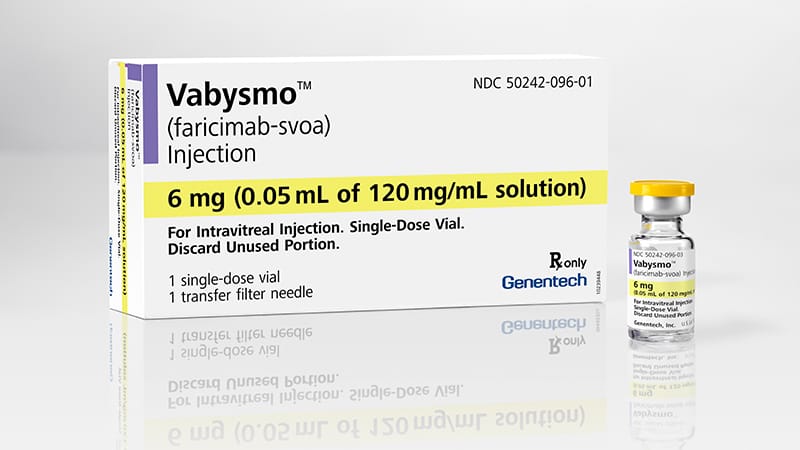
People with retinal disease who switched from a first-generation agent to the dual-action antibody faricimab (Vabysmo) needed fewer injections and experienced vision improvements up to 2 years later, according to two real-world studies presented at the American Society of Retina Specialists (ASRS) 2026 Annual Meeting in Montreal, Québec, Canada.Researchers investigated the drug’s effect on patients with neovascular age-related macular degeneration (AMD) and diabetic macular edema (DME) using large datasets. The results showed a strong response in people who both had been on previous therapies or were treatment naive with faricimab, which targets VEGF and angiopoietin 2, known culprits in exudative retinal disease. First-generation branded agents for AMD and DME target only VEGF.Promising AMD ResultsThe first study included 8714 patients (10,450 eyes) who had AMD part of a single electronic medical records system shared across 34 participating clinics in the UK.In AMD, faricimab is approved for injection intervals of up to 16 weeks after an initial 4 monthly introductory injections, whereas intervals for first-generation anti-VEGF agents aflibercept 2 mg (Eylea) and ranibizumab (Lucentis) top out at 12 weeks depending on patient response after four introductory doses.In 3682 eyes that did not have previous treatment with first-generation agents, the average gain in visual acuity was four Early Treatment Diabetic Retinopathy Study letters, at 2 years, from 61 to 65, said Ian Pearce, MB ChB, a vitreoretinal surgeon at Royal Liverpool University and director of Northwest Eyecare Consultancy.At enrollment, 30% of eyes in the treatment naive group had visual acuity of 70 letters or better; 2 years later, 41% did, Pearce said. At 24 months, 28% of eyes had gained 10 letters or more of visual acuity.Of patients who had received anti-VEGF therapy previously, 81.2% had been on aflibercept 2 mg (Eylea). Investigators were able to space out their treatment intervals across the board after switching patients to faricimab, Pearce said.“If you were a 4-weeker at switch, you were extended out on average to a 9.4-week interval, but even the 10-week group got to a 12-week interval,” at the 2-year mark, he said.Visual acuity in previous anti-VEGF patients remained stable for 2 years after switching, at 67 letters, just slightly down from 68 letters at enrollment, Pearce said. However, 12% of these eyes gained 10 letters or more letters in visual acuity over the study course.The study also compared the number of injections administered in 6-month intervals. In the previously untreated eyes, injections went from 4.7 over the first 6 months to 1.8 over the last 6 months. In previously treated eyes, treatment burden went from 4.5 to 2.5 injections between the first and last 6 months of study, Pearce said.“By the end of the second year you can see the significant reduction in the mean number of injections given over a 6-month period,” he said. “This equates to 3.8 injections over the second year of treatment for treatment-naive and 5.1 injections in the second year of treatment for previously treated eyes.”Rates of intraocular inflammation and endophthalmitis related to injection mirrored previous clinical trial findings, Pearce said. The rate for intraocular inflammation was 0.2% and 0.17% in newly treated eyes and switched eyes, respectively. For endophthalmitis, rates were 0.02% and 0.03%, respectively, Pearce said.More ResultsThe second trial was of 11,751 patients (16,136 eyes) with DME from the American Academy of Ophthalmology’s Intelligence Research in Sight registry.Patients starting out on faricimab or switching from an anti-VEGF medication achieved and maintained improvement in visual acuity and retinal anatomy after 24 months.Overall, the study population maintained visual acuity of 76 letters over 24 months, but subgroups demonstrated more robust improvement. Patients with visual acuity between 20/40 and 20/80 improved from 61 to 65 letters, whether they were new to treatment or had switched.Murtaza Adam, MDThe positive results of those who switched from anti-VEGF agents or aflibercept 2 mg and had a baseline of 20/40 visual acuity may be most significant, maintaining or improving acuity over a 2-year period, said Murtaza Adam, MD, partner a chair of clinical research at Retina Specialists of Colorado in Denver.“Furthermore, we see that correlate to a reduction in central subfield thickness,” in those who switched, he said.Central subfield thickness went from 356.5 microns at enrollment to 284.9 at 24 months in the treatment naive group. The previous treatment groups showed less robust improvement: from 342.5 to 293.8 microns in prior anti-VEGF-treated eyes and 343.3 to 290.3 microns in the aflibercept 2 mg subgroup, Adam said.“Knowing that central subfield thickness reduces over time even in nontreatment naive patients tells us that faricimab, perhaps with its dual-function activity, is more potent and durable than first-generation drugs,” he said.Injection frequency also improved over 24 months, dropping from 3.6 in the first 6 months to 1.5 in the last 6 months in the naive group and from 3.8 to 1.9 in all previously treated eyes, and from 4.6 to 3.1 in the previous aflibercept 2 mg group, Adam said.Aflibercept 2 mg has until recently “been the gold-standard anti-VEGF for treating DME,” Adam said.Carving out the aflibercept group helped target the most difficult-to-treat patients that required frequent injections, he said.“We found that the trends for naive patients and for patients who received all anti-VEGFs were still there,” Adam said. “We saw that the reduction in injection frequency was equivalent for faricimab patients and all switchers.”In a pooled analysis, rates of intraocular inflammation and endophthalmitis, which included eyes in the AMD group, were similar to those reported in clinical trials, Adam said.CommentaryKnowing the reasons for transitioning patients from earlier-generation anti-VEGF drugs to faricimab would have added valuable context to the findings, said Talisa de Carlo Forest, MD, an assistant professor and co-director of the AMD registry at the Sue Anschutz-Rodgers Eye Center at the University of Colorado Anschutz School of Medicine in Aurora, Colorado.“We still have these patients that are really frustrating to treat because they’re just not getting a full anatomic and visual response,” she said. “If we could target that group and try to understand biomarkers for who’s going to do poorly, that would be very helpful.”The disparity between extended injection intervals between the first and second study for patients switched from anti-VEGF drugs also raised questions, Forest said.“In a lot of these real-world studies for AMD, I’ve seen about a 2-week extension using” faricimab, she said. Comparing faricimab and aflibercept is “really hard” without a head-to-head study, Forest said.Pearce reported being a consultant to Allergan, Bayer, and Roche. Adam disclosed having financial relationships with Genentech and Regeneron Pharmaceuticals. Forest reported being a Genentech advisory board member.Richard Mark Kirkner is a medical journalist based in the Philadelphia area.
Faricimab Reduces Shots, Improves Vision for Retinal Disease
Full Article
Original Source
Read the full article at Medscape →KhanList aggregates and links to publicly available news content. We do not host full articles from third-party sources. Always verify important information with original sources.