
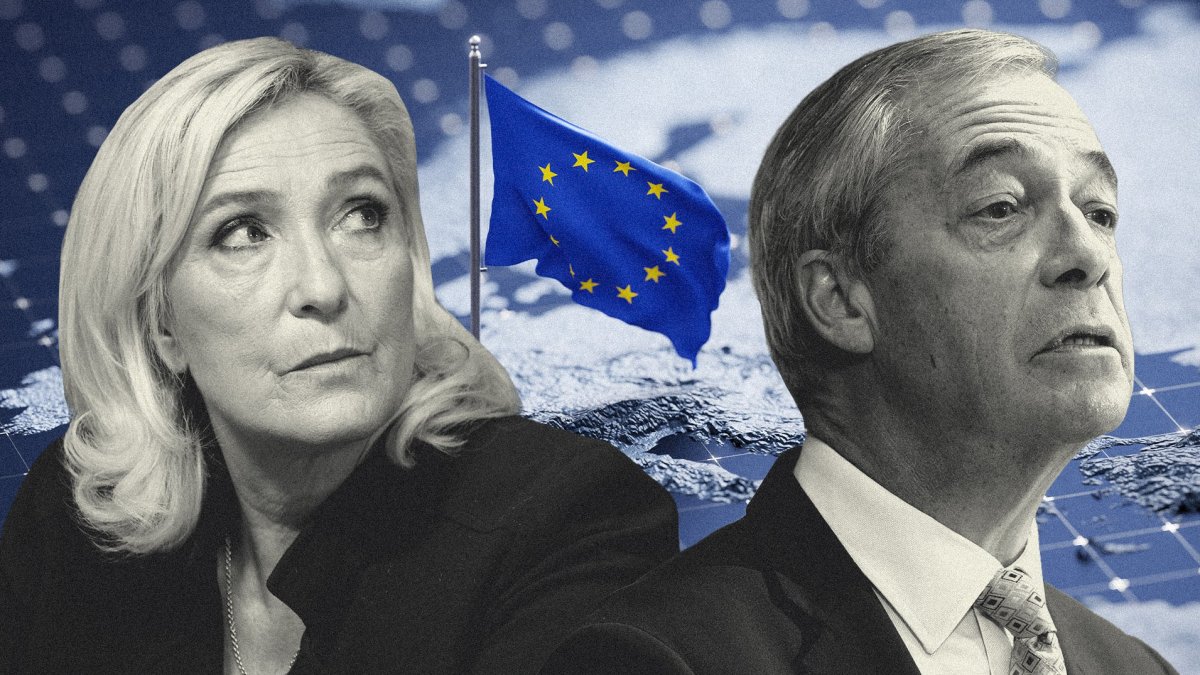
Nigel Farage thinks he has found a secret weapon to keep Britain out of the European Union: Marine Le Pen. Launching the Keep Britain Out campaign on Wednesday, the Reform UK leader said that if far-right Le Pen were to become president of France, it would be “difficult” for Britain to rejoin the European Union. Asked by The i Paper whether her election would help or hinder the Stay Out campaign, he replied: “It will help.” A day earlier, asked whether he would try to persuade a future French government to oppose British membership, Farage joked: “Are you suggesting that I’d interfere in overseas politics? Quite possibly, yes.” Le Pen is currently the favourite to win France’s presidential election next year. Polls put her ahead of hard-left rival Jean-Luc Mélenchon, with the first round due on 18 April and a run-off on 2 May. France could block Britain’s return to the EU because accession requires unanimous approval from member states. Under French law, an accession treaty would normally go to a referendum. However, France’sparliament can approve it instead if both chambers pass an identical motion by a three-fifths majority. That gives Le Pen a potential veto if she were President. But Farage’s plan depends on a much less certain proposition – that she would want to help him. Flattery and public insults The relationship between the pair has swung between flattery, public insults and political calculation for more than a decade. Farage, leader of Reform UK, has made clear that he wants closer ties with Le Pen’s National Rally, but whether her party would back his ambitions is another matter.A Whitehall source told The i Paper that Le Pen would not share a platform with Farage. That fits with recent reporting suggesting that, despite the public talk of closer ties, a meeting between the two is not imminent. At Reform’s conference in September, Farage’s party said he would visit Le Pen in France in October. Farage joked: “The only downside is I think they’re going to invite me to go to Paris and I’ll have to speak in French.” Farage at the launch of the ‘Keep Britain Out’ campaign in London this week. With him are Arron Banks, co-founder of Leave.EU, and Catherine McBride of the Great British Business Council (Photo: Ben Stansall/AFP) The invitation has not materialised. Four National Rally officials told Politico this month that no meeting with Le Pen was scheduled before Christmas. Party figures said there was “no urgency in refocusing media attention on relations with Reform”. Another source close to Farage told The i Paper they did not “want to get in the way” of the French election campaign. That is a long way from the political partnership his plan appears to require. Admiration and divisions The relationship began with mutual admiration, but quickly ran into the question of whether their parties could work together. In 2014, Le Pen called Farage “undoubtedly a charismatic leader” and argued that their shared opposition to the EU should make co-operation possible. As an MEP, Farage refused to join her in a European Parliament alliance, citing “prejudice and antisemitism” in her party, then called the Front National. Le Pen accused him of making “defamatory” and “extremely disagreeable” statements. The two moved closer during Le Pen’s 2017 presidential campaign, when Farage endorsed her and argued that the party had changed under her leadership. He contrasted her with her father, Jean-Marie Le Pen, and interviewed her on his LBC show. Divisions, however, resurfaced during France’s snap election in 2024. Farage told UnHerd that a National Rally government would be a “disaster” and “even worse for the economy than the current lot”. He held up Italy’s Giorgia Meloni as a model Le Pen should follow. Farage’s more concrete links with the National Rally run through its president, Jordan Bardella, whom Le Pen has chosen as her prime minister if she wins. The two met at a London club last December and again in July. Bardella was the headline guest at Reform’s Birmingham conference in September, where he and Farage signed a memorandum on returning small-boat migrants to France. At the conference, Farage said he had been “nervous” about Le Pen’s father, but praised her for changing the party. He called Le Pen and Bardella “odds-on favourites” for 2027 and urged “a genuine new entente cordiale between our parties and our countries”. A Farage ally described Bardella as the “acceptable face” of the National Rally, saying that he was helping to set a more moderate tone for the party. The source denied any risk from an association between Reform and Le Pen, whom they insisted would win the French presidency. Jordan Bardella, president of National Rally, and Farage hold up a memorandum of understanding signed at the Reform conference in Birmingham (Photo: Rasid Necati Aslim/Anadolu) “This is not her father’s party,” the source said. “Lots of people will lend her party their votes as they seek to find a circuit-breaker. They see things going wrong in France, where they are finding it harder and harder to earn a decent living wage and are seeing immigrants coming into their country and being given everything for free. “They see Le Pen’s party as the only way things can change in the same way as they see Reform.” Le Pen woos centrist voters Some sources believe Le Pen wants to present herself as mainstream and politically respectable -and would rather share a platform with Andy Burnham than with Farage. The National Rally leader has spent more than a decade trying to detoxify the party her father founded, and has dropped the “Frexit” referendum she promised in 2017. In France, Farage is still “Monsieur Brexit”. Commentators argue that a photograph with him could revive stories about Frexit and unsettle the centrist voters she now needs. Britain back in EU could help France That does not mean she would oppose British membership of the EU. It means Farage cannot take her support for granted, particularly when there may also be a financial argument for France to welcome Britain back rather than block it. Before Brexit, the UK was the EU’s second-largest net contributor after Germany. A returning Britain would pay into the budget again. Farage himself warns that membership could cost more than £40bn a year. That could ease the burden on France. Since launching her bid, Le Pen has attacked France’s contribution to the bloc, which reached almost €29bn this year. Speaking to business leaders in late August, she said she saw “no reason” for it. Sources believe she could view British re-entry as a way to reduce the French bill. Le Pen’s candidacy is not yet secure. In July, a Paris appeal court upheld her conviction for misusing EU funds but shortened her ban from office, leaving her free to stand. She has appealed to the Court of Cassation, and some legal experts argue that this legal bid could revive the question of her ineligibility. Polls consistently put her first and Jean-Luc Mélenchon second. Farage has no doubt of her success, telling The i Paper: “I really do think Le Pen will win.” He added that if she were to face “the revolutionary who supports violence on the streets” – an apparent reference to hard-left Mélenchon – “she will win”. Farage argued that the wider political shift across Europe would weaken the case for rejoining. “Europe is moving massively to the right, to the right of anything I’ve ever stood for in this country,” he said. He questioned whether Burnham, whom he called “Tick Tock Andy”, would be willing to sit down with Germany’s hard-right AfD party. “I mean, I struggle to do that,” he said, arguing that the rightward shift would make it “incredibly difficult” to persuade pro-Europeans in the UK that Britain should enter “political union with these people”.
Farage hopes Le Pen is his secret weapon against the EU. She may need convincing
Full Article
Original Source
Read the full article at Inews →KhanList aggregates and links to publicly available news content. We do not host full articles from third-party sources. Always verify important information with original sources.