
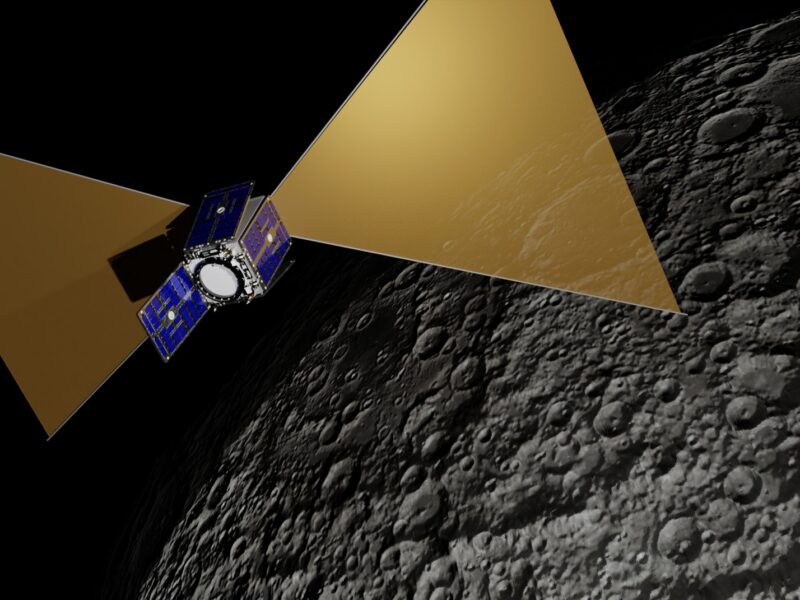
A proposed mission might offer clues about dark matter and how hydrogen came together to form the first stars and galaxies.(CN) — A satellite about the size of a small carry-on suitcase could use the far side of the moon to listen for a faint signal from one of the least understood periods in the universe’s history.The proposed CosmoCube mission would search for radio signals emitted by hydrogen atoms more than 13.5 billion years ago, during the roughly 150 million years between the afterglow of the Big Bang and the appearance of the first stars.Details of the mission, which has received funding from the UK Space Agency and could launch within the next five years, were published Friday in Nature Astronomy.Scientists have never directly observed this period, known as the cosmic dark ages. The signal is difficult to detect from Earth because the planet’s ionosphere blocks the necessary radio frequencies, while FM radio, satellites and telecommunications add interference.CosmoCube would get around those problems by orbiting the moon. For about 40 minutes of each two-hour orbit, the moon would block radio interference from Earth, giving the satellite a chance to search for the faint signal.Over a planned two-year mission, researchers hope to collect about 1,000 hours of observations.“There’s no other place where you can get the sort of shielding you need to detect such a faint signal, while at the same time looking at the whole of space,” said lead author Eloy de Lera Acedo of the University of Cambridge, in a news release. “The far side of the moon is really the only option: It solves multiple problems at once, opening a clear window to the very early universe.”CosmoCube would search for what scientists call the H-line or 21-centimeter line, a radio signal produced by hydrogen. Detecting it could give scientists their first direct look at the universe before the first stars formed and offer clues about how matter eventually came together to form stars and galaxies.The observations could also shed light on dark matter and the role it played in that process.“This emission from hydrogen after the Big Bang, but before the first stars, will hopefully allow us to understand the role of dark matter in the early universe, how it worked to pull together hydrogen into the first stars and galaxies,” de Lera Acedo said.Once in lunar orbit, CosmoCube would unfold a lightweight radio antenna and operate at extremely low frequencies between 10-50 MHz. The satellite would repeatedly calibrate its instruments to help distinguish genuine cosmic signals from noise generated by its own electronics.Once the data reaches Earth, researchers plan to use statistical methods to remove other interference, mainly radio emissions from the Milky Way. Computer simulations and measurements taken during the mission would also help them account for distortions caused by the antenna itself.The small satellite is designed to tackle the same fundamental questions that often require much larger missions.“Aside from the science, what makes our mission unique is its size: we’re probing the earliest, deepest parts of the dark ages that others don’t reach, but with a compact, relatively low-cost platform,” de Lera Acedo said.There may also be a limited window to take advantage of the Moon’s radio silence. Other missions from the United States, India and elsewhere are being planned for the far side, which could eventually introduce more human-made radio interference.CosmoCube is still under development. Working laboratory prototypes are being tested, and researchers hope to continue developing the payload in preparation for a full mission.“This could be a real U.K. success story: The hardware, the software, the implementation and the technology is all being developed here, and it could help us answer one of the most profound questions in the universe,” de Lera Acedo said.Subscribe to our free newslettersOur weekly newsletter Closing Arguments offers the latest about ongoing trials, major litigation and rulings in courthouses around the U.S. and the world, while the monthly Under the Lights dishes the legal dirt from Hollywood, sports, Big Tech and the arts.Additional Reads
Far side of moon could unlock a hidden chapter of the universe
Full Article
Original Source
Read the full article at Courthousenews →KhanList aggregates and links to publicly available news content. We do not host full articles from third-party sources. Always verify important information with original sources.