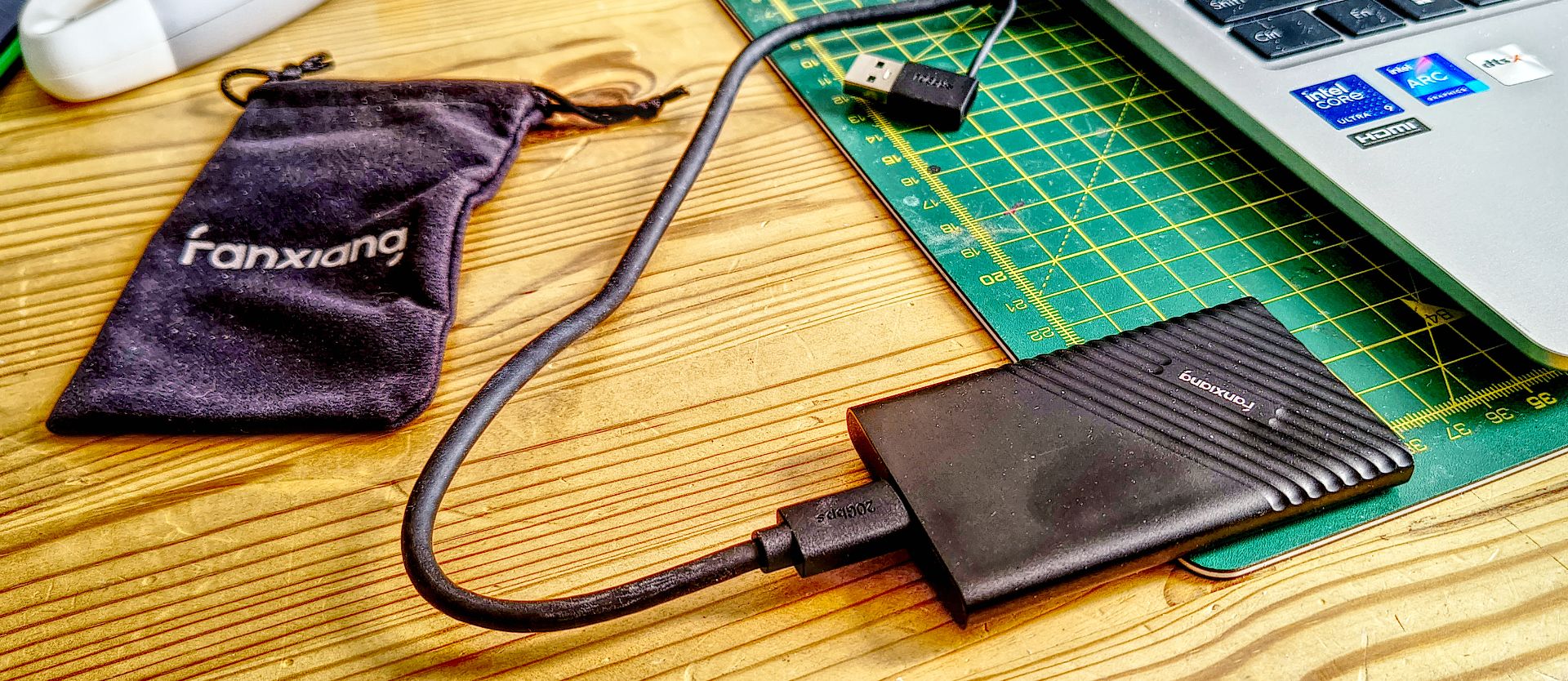
TechRadar Verdict The Fanxiang PS2000W portable SSD ticks most of the boxes with the possible exception of hardware encryption. However, the price of flash-based external SSDs isn’t sustainable at current levels, including this drive. Pros +Lightweight +Durable +Cable for USB-A and USB-C Cons -Recent 100% price increase -Needs USB 3.2 Gen 2x2 for full performance -Lacks hardware encryption Why you can trust TechRadar We spend hours testing every product or service we review, so you can be sure you're buying the best. Find out more about how we test. Jump To: 30-second review Pricing and availability Specs Design Performance Final verdict Should I buy? Fanxiang PS2000W: 30-second reviewFanxiang is a Chinese storage brand, most commonly known as Shenzhen Fanxiang Information Technology. The company grew out of a team with a decade of prior experience in storage design, firmware, and product sales, and they've built their range around four main product lines: solid-state drives, mobile storage, memory modules, and storage cards.It’s been making external SSD storage for about five years, with a wide range of devices and specifications.The PS2000W appeared in 2025, and delivers capacities from 500Mb to 4TB in a slim aluminium case. It comes with a soft carry pouch and a cable that has an integrated adapter for both USB-A and USB-C connections.The quoted performance is 2000MB/s reads, and 1800MB/s writes, but that assumes you have a USB 3.2 Gen 2x2 port, and that’s not a common standard.More realistically, a USB 3.2 Gen 2 port will achieve a little over 1000 MB/s reads, and 950 MB/s writes with either a USB-C or USB-A connection.For those wanting faster transfers, you either need a system with the rare USB 3.2 Gen 2x2 port, or choose a different drive that supports the USB4 standard, like the Fanxiang PS3000 portable SSD.However, that option costs $350 for the 1TB model, which is substantially more than the $150 the PS2000W is typically priced at for that capacity.Are you a pro? Subscribe to our newsletterSign up to the TechRadar Pro newsletter to get all the top news, opinion, features and guidance your business needs to succeed!The problem the PS2000W doesn’t address is that this drive is double the price it was only eight months ago, and unless you have a system that can make the most of its enhanced performance, there are cheaper alternatives. In fact, if you have a spare NVMe drive, then buying an external enclosure for USB4 is probably a better choice.Not the best portable SSD, or the worst, but sadly impacted by the outrageous cost of flash memory in 2026. (Image credit: Mark Pickavance)Fanxiang PS2000W: Pricing and availabilityHow much does it cost? Starts from $90When is it out? Available nowWhere can you get it? Sold through online retailers and also directly from Fanxiang.The Fanxiang PS2000W portable SSD comes in capacities starting at 500 GB, doubling each step to include 1TB, 2TB, and 4TB drives.Directly from the maker, these are priced at $112.99, $203.99, $379.99 and $495.99 for the largest capacity. That pricing makes the 4TB the best value, and the 500MB the worst.But the maker prices aren’t especially good, and I was able to find it much cheaper on Amazon. On Amazon.com in the US, the 500MB model is only $89.99, the 1TB model is $149.99, and the 4TB model is $419.99. There wasn’t a price for the 2TB version.UK pricing via Amazon.co.uk is £64.60, £119.99, £169.99, and £319.99, and Amazon EU sites are €94.99, €139.99, €229.99, and €379.99, respectively.For those curious, the UK is the cheapest place to buy this hardware, followed by the EU, and the most expensive is the USA.While officially Crucial has exited the retail market, its equivalent product, the X10, is still available from many retailers. At $207 for the 1TB option, and $299.99 for the 2TB option, the X10 is slightly more expensive. But it is rated as water-resistant, and while there isn’t a 500GB model, there are 6TB and 8TB options.A cheaper option with the same spec is the PNY RP60, but the 1TB model is still $10 more than the PS2000W.But many of the familiar brands are more expensive, such as the SanDisk Extreme Pro V2, Samsung T9, Kingston XS2000 and LaCie Rugged Mini. Western Digital has its My Passport SSD, but it’s the same price as the PS2000W, but only offers half the performance.Those looking for a cheaper option should consider the $82 Orico S20 with 512GB storage.It’s tempting to look at the pricing of the PS2000W and see it as a good deal, when it’s far from that.Price tracking the 1TB model: it was $149.99 at the time of writing; it was $75.99 in November of 2025. That’s nearly a 100% markup.Now, I should say that Fanxiang doesn’t control the price of Flash memory, which has spiked since AI companies and speculators decided to buy all of it. But in good conscience, I can’t recommend people spend this sort of money on devices that cost half as much a year ago.Value: 3 / 5 (Image credit: Mark Pickavance)Fanxiang PS2000W: Specs Swipe to scroll horizontally Model Fanxiang PS2000W Interface USB 3.2 Gen 2x2 (20Gbps) Sequential read Up to 2050MB/s Sequential write Up to 1800MB/s Flash type TLC 3D NAND Capacities 500GB, 1TB, 2TB Dimensions 8.5cm x 5cm x 0.8cm Weight Approximately 45g Build Aluminium alloy unibody Cables included USB Type C to C, plus Type C to A adapter Compatibility Windows, Mac, Android, PS5/PS4, iPhone 15 and later via USB-C Warranty 5 years Fanxiang PS2000W: DesignAluminium enclosureDual USB standards cable Some brands, and you know the names, will try to make their external SSDs and HDDs as cheaply as possible, typically by using mostly plastic construction.Thankfully, Fanxiang didn’t go down that path with the PS2000W, and this device appears to be entirely made of metal. And, based on its relatively low weight, it uses aluminium.The package is a simple lozenge shape with curved sides and flattened ends, measuring 85mm long by 50mm wide and less than a centimetre thick.Out of the box, it comes with a 30cm USB-C to USB-C cable that has a USB-A adapter permanently attached. The drive and cable fit neatly into a soft drawstring bag, also provided, making for a neat and easily pocketable solution.The review model was a 2TB capacity drive, which translated into 1863GiB of usable space, and it connects to the host device using USAP (Serial ATA).To achieve the best performance, it requires a USB 3.2 Gen 2x2 port, but the drive is backwards compatible with USB 3.2 Gen 2, Gen 1, and even USB 2.0. However, as you move down the USB interface pecking order, the expected speed decreases.As for features, this drive is basic. It supports S.M.A.R.T. NCQ, TRIM and GPL, but it doesn’t offer hardware encryption like on the Kingston XS2000 or the Crucial X10 Pro. (Image credit: Mark Pickavance)There are also no software tools included, though you can download a utility for SSD management from the Fanxiang website. I didn’t notice any means to update the installed firmware, or any firmware releases.To be blunt, this is a basic USB SSD with a Gen 2x2 interface, but otherwise it’s unremarkable. And therefore, if you don’t have that interface, there appears to be no compelling reason why you would choose this one over another brand. (Image credit: Mark Pickavance)Design: 3.5 / 5Fanxiang PS2000W: PerformanceNeeds USB 3.2 Gen 2x2Performs within quoted specification Swipe to scroll horizontally Fanxiang PS2000W Benchmark Bench Test USB 3.2 Gen 2x2 USB 3.2 Gen 2 CrystalDiskMark 9.03 Default Read 2002MB/s 1041MB/s Row 2 - Cell 0 Default Write 1853MB/s 948MB/S Row 3 - Cell 0 Real World Read 1336MB/s 993MB/s Row 4 - Cell 0 Real World Write 1219MB/s 912MB/s AJA System Test 64GB Read 1804MB/s 971MB/s Row 6 - Cell 0 Write 1645MB/s 891MB/s AS SSD Read 1771MB/s 971MB/s Row 8 - Cell 0 Write 1496MB/s 879MB/s ATTO Read 1.89GB/s 994MB/s Row 10 - Cell 0 Write 1.73GB/s 906MB/s PCMark Data Drive Bench Score 2028 1250 Let’s be brutally honest: USB 3.2 Gen 2x2 was a dead standard walking from its inception, and USB4 didn’t really include it in its repertoire of supported prior standards. There are a few exceptions, but in general, if you don’t actually have a port to the 2x2 standard, then you won’t see the true performance that this drive can muster.For that reason, I’ve presented the performance via a Gen 2x2 port and a much more common Gen 2 variety. How does it compare with the best Gen 2x2 drives?Well, read speed is below the Crucial X10 Pro, ADATA Elite SE880 and LaCie Rugged Mini SSD, but write speed is close to what all those achieve.Given the different controllers and implementations of Gen 2x2 interfaces, the Fanxiang PS2000W portable SSD doesn’t have a compelling reason to be chosen over any other drive in Gen 2x2 mode, but it can get close to the maximum realistic speed for this interface.But if speed is the prerequisite, then a USB4 or Thunderbolt external drive, like the Corsair EX400U or the SanDisk Extreme PRO with USB4, would be a better choice if you have a USB4 port. These drives can hit read speeds of 3800MB/s or higher, and 3650MB/s writes.And, if I were rushing to catch a plane or train, and needed to transfer files, I know which I’d prefer.Performance: 4 / 5Fanxiang PS2000W: Final verdictIf the Fanxiang PS2000W portable SSD had appeared during the golden age of Gen 2x2, when the Kingston XS2000 appeared back in early 2022, and at a reasonable price, then it might have been something I’d recommend.And the fine irony of that comparison is that the price of the PS2000W is almost exactly the same as the XS2000's MSRP was nearly four years ago. And the Kingston device supported hardware encryption, where the Fanxiang does not.To be clear, the construction quality and performance of the PS2000W are absolutely fine, but what isn’t is the amount of money being asked for.If money isn’t an issue for you, I’d buy the Crucial X10 Pro before they’re extinct, as it has hardware encryption. Or I’d consider a USB4-capable drive, like the Corsair EX400U, if you have a port that supports that specification.Should I buy the Fanxiang PS2000W? Swipe to scroll horizontally Value 100% more expensive than it was 8 months ago 3 / 5 Design Metal construction, comes with a carry pouch and a dual standard cable 3.5 / 5 Performance Works well at Gen 2x2 speeds, if you have that port 4 / 5 Overall A nice drive, but hardly great value 3.5 / 5 (Image credit: Mark Pickavance)Buy it if...You have USB 3.2 Gen 2x2If you have a USB port that is Gen 2x2 (not just Gen 2), then this might be the drive you want to exploit the extra speed that it offers. However, unless all the ports you are likely to plug it into are this spec, the advantage will be limited. Money isn’t a concernBuying RAM, storage or GPUs is currently only for those people not paying with their own money. Since, depending on what you are buying, the price hikes range from 100% up to 400% and higher, if you can wait for the AI bubble to burst, you could save yourself, or your business, lots of money.Don't buy it if...You have USB 4.0If you have USB4 or Thunderbolt 4, then this isn’t the drive for you, at whatever price. There are USB4-specified drives that are twice the speed of this one, and most of them only cost a little more.You need bigger than 4TBThe largest drive available in this range is 4TB. And those wanting 8TB or more need to look for a different product entirely.Also considerNextorage NX-PS1PRO SeriesOne of the first USB 4.0 capable external SSDs available, the Nextorage NX-PS1PRO Series comes in 1TB, 2TB or 4TB capacities.Read our full Nextorage NX-PS1PRO Series reviewOWC Envoy Pro FXIf you have Thunderbolt 3 ports or intend to add this functionality soon, then the Envoy Pro FX might well be worth your time. A beautifully engineered external storage option that can provide exceptional performance in the right circumstances, the OWC Envoy Pro FX is effective if expensive.Read our full OWC Envoy Pro FX reviewWe've also tested out the fastest external SSDs around. Mark is an expert on 3D printers, drones and phones. He also covers storage, including SSDs, NAS drives and portable hard drives. He started writing in 1986 and has contributed to MicroMart, PC Format, 3D World, among others. You must confirm your public display name before commenting Please logout and then login again, you will then be prompted to enter your display name.
Fanxiang PS2000W review: A solid portable SSD that's another victim of the rising memory prices
Full Article
Original Source
Read the full article at Techradar →KhanList aggregates and links to publicly available news content. We do not host full articles from third-party sources. Always verify important information with original sources.