
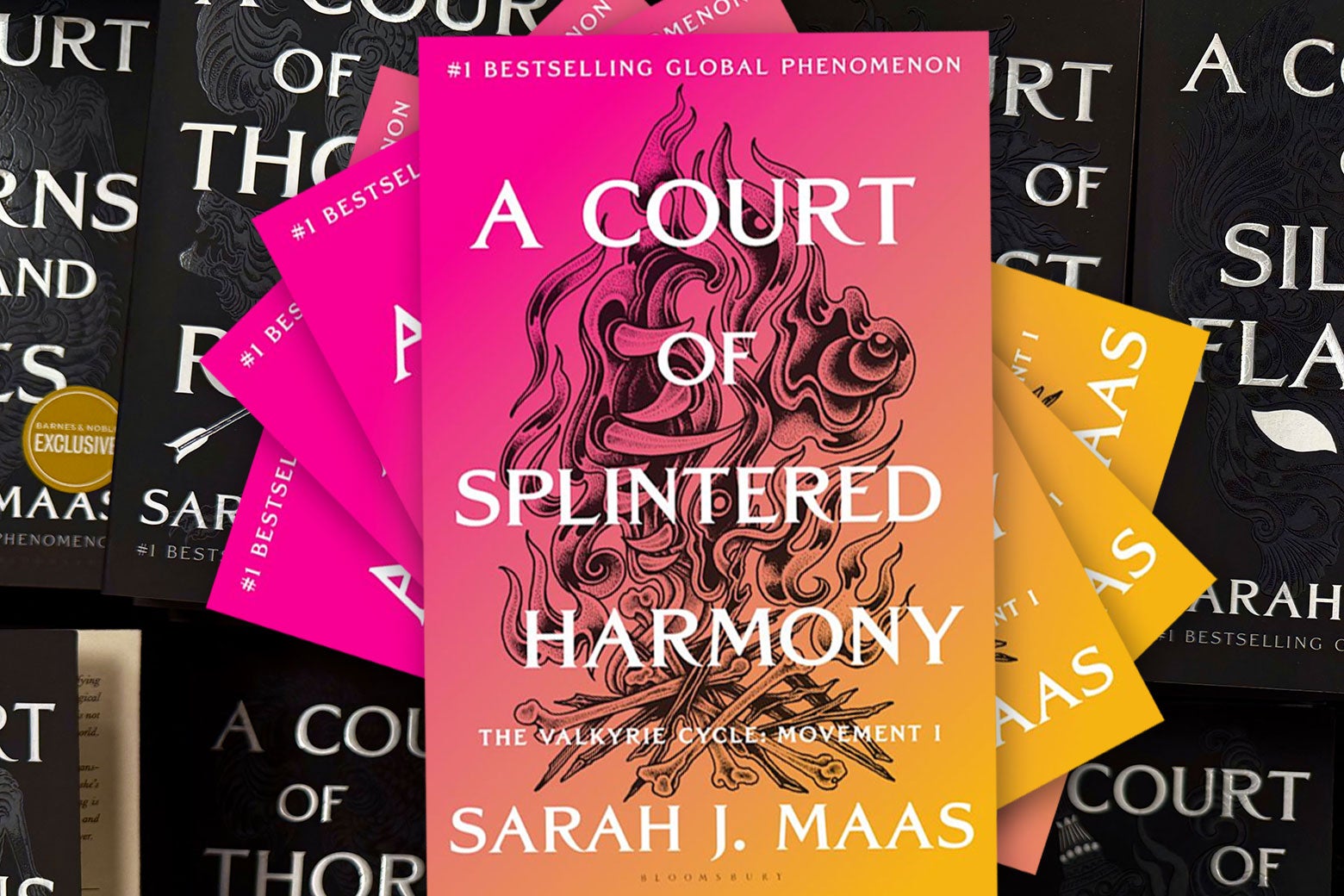
Books A Court of Splintered Harmony Sure Is Splintering Harmony Fans of the Sarah J. Maas series waited five years for the latest ACOTAR sequel. Now that it’s here, they’re not all pleased. By Enter your email to receive alerts for this author. Sign in or create an account to better manage your email preferences. Unsubscribe from email alerts Are you sure you want to unsubscribe from email alerts for Nadira Goffe? Nov 05, 20261:30 PM Photo ilustration by Slate. Photos by Manon Beliot/AFP via Getty Images and Bloomsbury. Sign up for the Slatest to get the most insightful analysis, criticism, and advice out there, delivered to your inbox daily. Sinking ships, extra chapters, and unwarranted crossovers, oh my! Fans have been waiting more than five years for A Court of Splintered Harmony, the sixth installment of author Sarah J. Maas’ megahit romantasy series A Court of Thorns and Roses (ACOTAR, for short). At its start, the story followed a human teenage girl named Feyre Archeron who found herself embroiled in the affairs (both political and romantic) of the neighboring faerie realm, Prythian. Since the first novel of the series—which was published over a decade ago in 2015, before finding a resounding resurgence in popularity during the pandemic when the story (and its many scenes of fantasy smut) became a BookTok obsession—the story has sprawled: Feyre’s allegiances have changed, a war has been waged and won, and our ensemble of main characters has grown exponentially. Now, ACOTAR is nothing short of a phenomenon: This sixth novel, published on Oct. 27, sold over 1.7 million copies on release day alone. Chances are, if you know a woman between the ages of 18 and 35, they are reading up on the latest happenings in Prythian. Yet, despite Splintered Harmony’s economic success, the long-awaited sequel is flailing in one key category: reader satisfaction. The ratings for Splintered Harmony are the lowest of any of ACOTAR’s main novels on the book-review site Goodreads, and social media and Reddit threads are rife with complaints about everything from the story to the characters to the prose. There’s disarray in Maas’ kingdom—but this chaos is partially a mess of her own creation. Readers’ trenchant criticisms of Splintered Harmony begin with something as fundamental as its structure. The sixth ACOTAR installment feels like merely part of a book because, essentially, it is: Splintered Harmony starts with the announcement that this arc of Prythian’s story will be split into four parts, dubbed “movements” by Maas, that will be told, confusingly, over three volumes. Still, even with the knowledge that this is the first part of many—the second and third movements will be detailed in the next book, A Court of Forgotten Melody, which is set to release a mere three months from now—Splintered Harmony feels annoyingly unfinished. I, a casual ACOTAR reader who doesn’t keep up with Maas’ publicity tours on podcasts like Call Her Daddy, had naively assumed that the series’ fifth volume, A Court of Silver Flames—which follows Feyre’s eldest sister Nesta, a newly turned fae who struggles to find her new normal after the devastation of their recently won war—would be the start of a few final books of resolution. I had also naively assumed that Maas would feel as I do about fantasy series: They should only involve one big war throughout the entire arc—that’s it. In hindsight, Splintered Harmony reveals that Silver Flames was no resolution at all; instead, it was the quiet before yet another brewing storm (and another war!). This means that Splintered Harmony, despite touching on the stories of all of our main players, fails to deliver anything very concrete as far as plot goes. The book follows Feyre and her partner (or, to use ACOTAR parlance, “mate”) Rhysand’s turn as brand-new parents, the fallout of their close friend Azriel’s doomed attraction to Feyre’s second-eldest sister, Elain, and a bunch of chessboard-setting for the impending conflict. On paper, this might sound expected for a first part of four, but in reality, the reading experience felt like paying for a season of television and only getting a singular episode. It was irritating to engage in 350 pages’ or 13 hours of audiobook narration’s worth of seed-sowing when you expect, at the very least, a single sprout. That shouldn’t be too much to ask for from a full novel. If the unfinished timbre of Splintered Harmony weren’t defeating enough, an even more frustrating aspect of reading this latest volume is how much of its vital context—particularly of the events that happened between Books 5 and 6 of the series—is wrapped up in the plot of an entirely different series. Maas began her third fantasy series, Crescent City, in 2020; it follows a half-fae, half-human girl named Bryce Quinlan who encounters mystery and political intrigue on her planet of Midgard. ACOTAR readers who aren’t interested in Crescent City might be surprised to find out just how important the events of the most recent Crescent City book, House of Flame and Shadow, are to Splintered Harmony. The events of House of Flame and Shadow, which was published in 2024, are integral to understanding why, despite saving many lives and endearing herself to the Inner Circle at the end of Silver Flames, Nesta starts off Splintered Harmony in a completely different state of being, distanced from our main cast of characters after we had just left her in a place of harmony in her book. Essentially, Maas has pulled a Marvel and begun the multiversification of her series. This, as you might expect, is just as bothersome to encounter in a book as it is in a movie or TV show. Most of these grievances could fit under the umbrella of tactics designed to make publishers and authors more money. Splitting one story up into so many parts, releasing a book that is barely a book, referencing work outside the main series that readers will then have to catch up on; all of these amount to, to put it bluntly, tried-and-true cash grabs. As Vulture’s Kathryn VanArendonk noted, these tactics have worked and will work here, because “it’s a perfect book-based enactment of the sunk-cost fallacy. The only way to justify reading this one is to read the next one, too.” Often these gimmicks come at other costs, as well; Splintered Harmony also suffers from what feels like a dip in writing quality at times. And it doesn’t help that Maas has done similar things in the past, namely choosing to release special editions of a book that include bonus chapters—fairly important ones!—that are only available in copies sold by specific vendors, like Barnes and Noble. The end of Splintered Harmony, in case you’re wondering, includes three extra scenes that provide helpful context to the current relationships between many characters. They sure would’ve been nice to have had years ago without having to go hunting for special copies. To be clear, fans aren’t only upset because of the industry-level strategizing around this book release. There’s also been discord over the romances in the story. In fact, many ACOTAR die-hards are so invested in these couples that they’re angry for an entirely different reason: ship wars. The main relationship explored, albeit briefly, in Splintered Harmony is that of Azriel and Elain (a pairing known as “Elriel”). The two fae have feelings for each other, but their attraction is condemned because Elain is the mate of Feyre’s friend and critical political ally, Lucien. In Maas’ world, a mating bond forms involuntarily, causing fae to become beholden to an animalistic attraction and connection to another fae at random, much like the cursed imprinting in the Twilight universe. Despite the reality we’ve been shown that Elain only likes Azriel (and feels deeply uncomfortable with Lucien, mating bond be damned), Splintered Harmony essentially obliterates that ship. This is bad news for Elriel shippers, and also a squick-y moment in Maas’ story that seems to strip Elain of much of her bodily agency (though it wouldn’t be romantasy if someone weren’t being emotionally tortured for little to no reason). Splintered Harmony could be setting up a path for Elain and Lucien (“Elucien”) to be endgame, after all, though it gives zero notion as to how the uneasy mates will get over the hump they’re left facing by the end of this installment. Azriel, meanwhile, may be getting set up with a new romantic interest, but Splintered Harmony stops short of delivering anything of real significance in that area. As it stands, the book ends with Azriel emotionally devastated and feeling outcast, as is Maas’ tendency; the author is known for breaking her characters down to their lowest points before they can find happiness or love. We’ll have to wait another book for any signs of resolution or character development, and in the meantime, the ship wars have waged fiercely online and even in Maas’ social media comments, inflaming some of the negative feelings surrounding this release. Is Splintered Harmony’s mixed reception a sign of the franchise’s waning prowess as a romantasy mainstay? I doubt it; just look at Maas’ sales and the fact that we’re still talking about it all. Still, this release does make me worry about the quality of these future “movements,” especially on the heels of Silver Flames, which was one of Maas’ best entries in the ACOTAR series. The romantasy genre is, in many ways, predicated on making its readers feel, whether that’s good, bad, or horny—but the only thing I felt when reading Splintered Harmony was the sneaking suspicion that I might wind up wasting my time. At least two things we can be sure of going forward: 1) Maas is laughing all the way to the bank, and 2) things can’t get worse from here. (Right?) Books Romance Fantasy
Fans Waited Five Years for a Sequel to One of Books’ Biggest Series. Now That It’s Here, They’re Not All Pleased.
Full Article
Original Source
Read the full article at Slate →KhanList aggregates and links to publicly available news content. We do not host full articles from third-party sources. Always verify important information with original sources.